
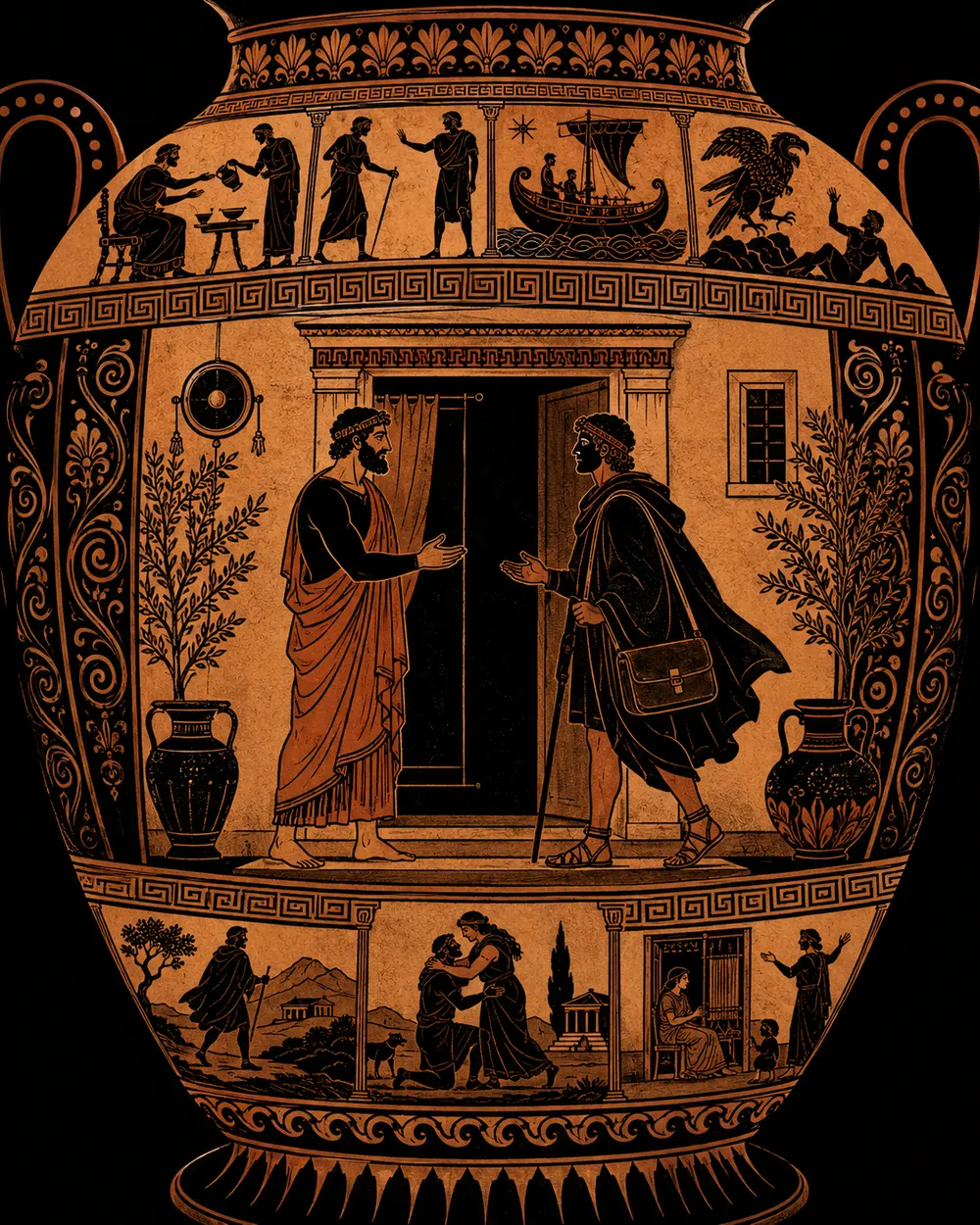
Ever since I was a child, Homer’s Iliad and Odyssey have been part of my life, to the extent that all of our various homes were called “Troy” and all of our pets were named after characters in from the poems. We had a very elegant Persian cat called Priam, a beautiful dog inevitably called Helen, and a large bullmastiff called Hector. We even had a sailboat called The Wooden Horse.
The classics are having a moment, in part because of the omnipresent and wonderful Mary Beard, Emily Wilson's new translations, and even the now-decade old Why Homer Matters, by Adam Nicolson. They were stirring before Christopher Nolan’s The Odyssey, but the movie — and particularly the arguments about the movie — has turbocharged things. Sales of Homer have surged, and libraries are reporting queues for translations. Classicists have rediscovered the rare pleasure of being asked at parties whether a blockbuster “got Homer right”.
But is this merely the periodic return of classical drama, or is something else going on?
The present vogue for Greek mythology predating Nolan's movie and includes Madeline Miller's The Song of Achilles, published in 2011, which became a phenomenon again through BookTok a decade later, and was followed three years later by her page-turning Circe. Bookshops have, for several years, been stacked with books by Miller, Natalie Haynes, Jennifer Saint, Pat Barker, and other writers revisiting Greek myth, often from the perspective of women, who had smaller roles in the original stories.
But what is happening now is kinda crazy. One recent Italian study, conducted by NIQ for Netflix, tracked 187 film and television adaptations and 2,403 associated titles, finding that sales of the source books rose an average 197% in the four weeks after the movie's release. Compare that with UK sales of The Odyssey, which have reportedly risen about 1,400% around Nolan's film.
 Emma Loffhagen
But you have to take into account that The Odyssey is also just irresistible material, honed in frequent reorganising and retelling. Start with the premise. As I wrote recently in our Financial Mail newsletter, it is the original story about a man refusing to ask for directions.
In a sentence, what happens is that Odysseus takes ten years to get home from Troy and then, presumably, has to explain to Penelope where he has been. “Tell me about your trip,” she says. “Lovely”, he replies. “Bit windy”. Odysseus encountered monsters, witches, cannibals, shipwrecks, and angry gods. Think OR Tambo in December. Homer also discovered the central rule of travel journalism: the worse the trip, the better the post-trip dinner-table stories.
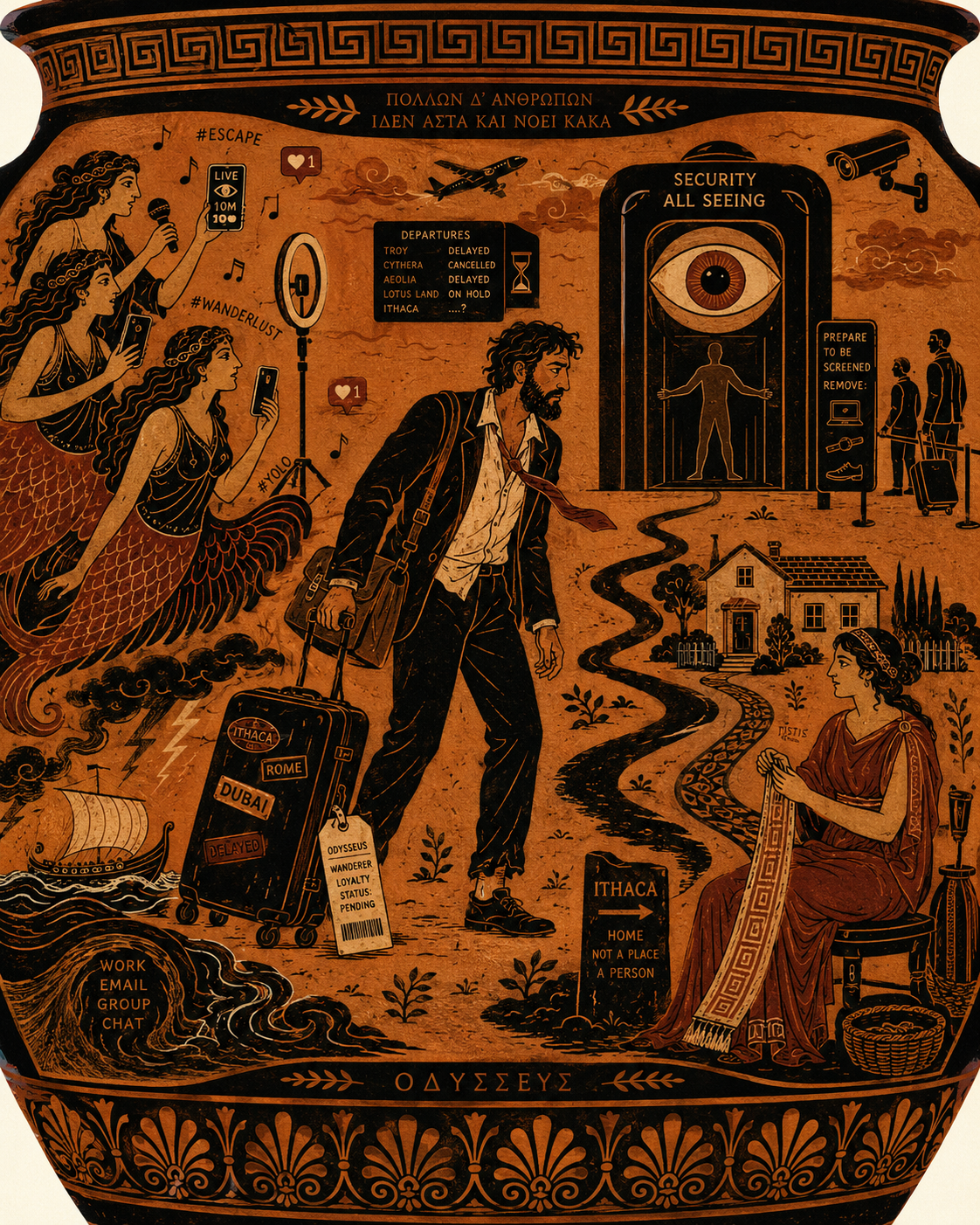
Seriously, here are six possible reasons why the classics are returning, to the extent they are.
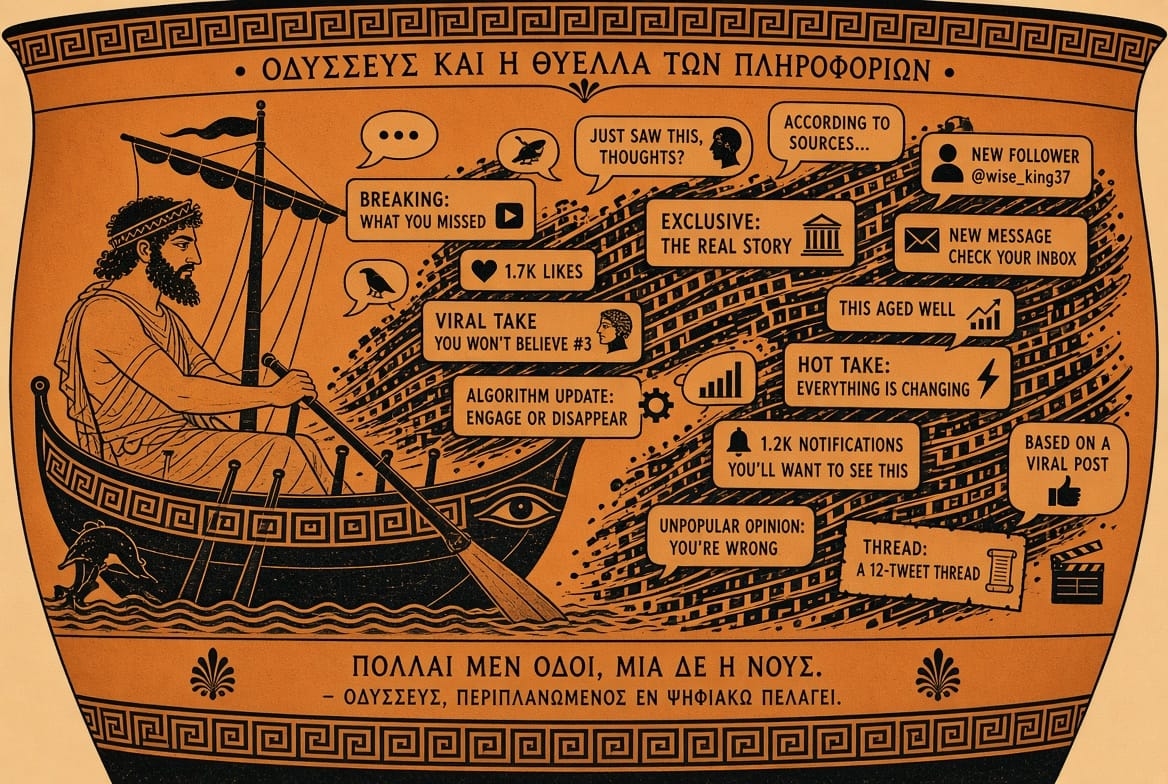
1) Modernity has given us an information surplus and a meaning deficit.
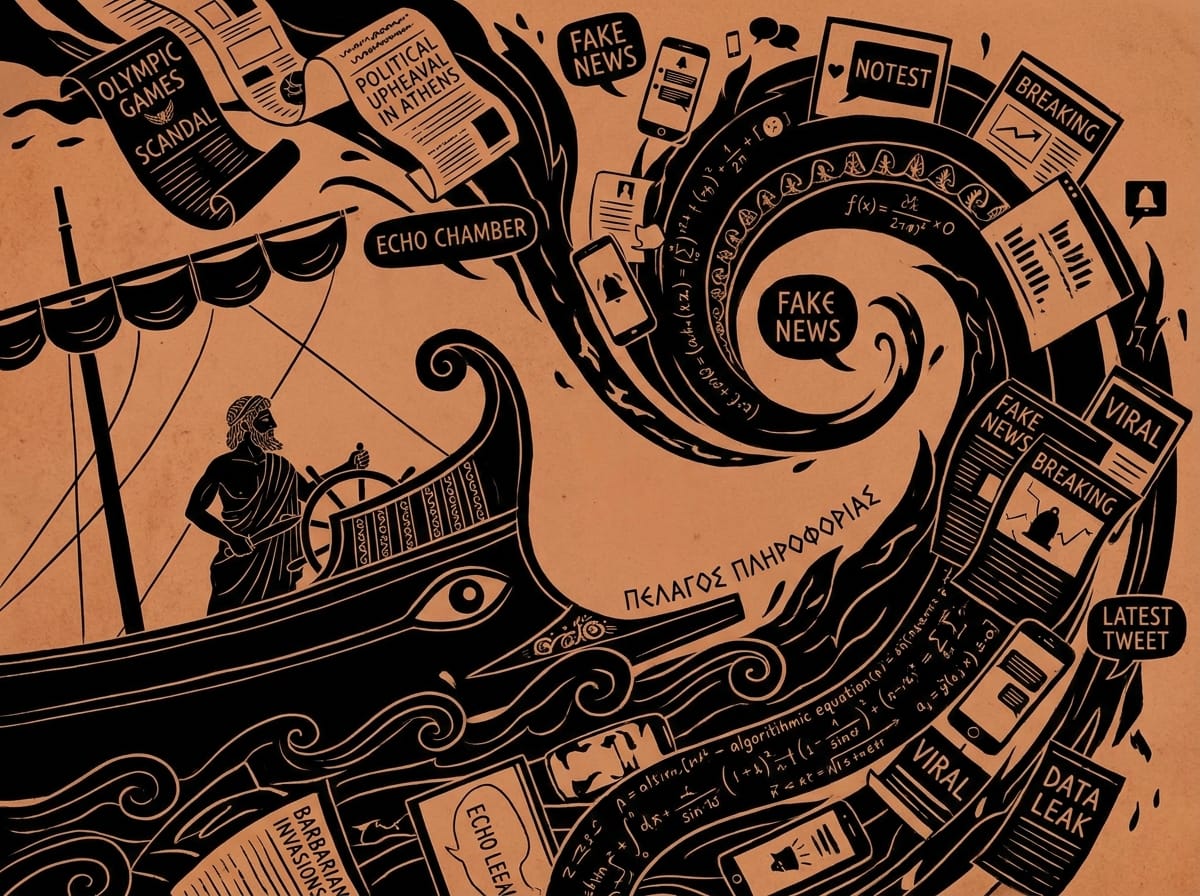
We have never had more facts (or 'alternative facts'), feeds, clips and opinions, yet we seem hungry for narratives large enough to organise them. Myth is an unusually appropriate method in these circumstances because it tosses “facts” out the window from the start.
Myth is unusually appropriate in these circumstances because it declares from the outset that documentary truth isn't the point. Gods intervene, monsters eat people, and geography melts into fantasy; the question isn't whether it happened but whether the pattern tells us something true.
Perhaps our problem isn't actually a shortage of meaning. The modern world manufactures “meanings” on an industrial scale: nationalism, wellness, identity, conspiracy, technological salvation, apocalypse. But I think it's possible that we may suffer not from too little meaning, but from too many incompatible systems of meaning, all shouting at once.
It's a relief to get away from the pressure of “factuality” and “information”, and instead indulge in patterns which are explicitly not part of the political and ideological relentlessness of the real world.
In short: information has become abundant. Contrived coherence has become premium content.
2) In a world that feels unstable, Odysseus is the patron saint of the pivot.
Odysseus is not Achilles. Achilles has one magnificent core competency: being Achilles. Odysseus, on the other hand, has very transferable skills.
He lies, negotiates, hides, fights, waits, flatters, invents identities, reads rooms and, when necessary, clings to pieces of timber. His great quality is not strength but mētis: cunning, situational intelligence, the ability to understand what sort of problem this particular problem is.
This feels distinctly contemporary.
We have spent a short period moving through pandemic, geopolitical fracture, migration, remote work, inflation, AI, and the alarming realisation among several white-collar professions that the machine which was initially going to write amusing limericks may shortly be reviewing their invoices. Odysseus would cope magnificently.
Of course every generation thinks it has invented uncertainty. It's difficult to tell people who lived through 1914 to 1945 that our world is unusually unstable without sounding slightly needy. Perhaps the deeper lesson of Homer is that our world is not particularly unpredictable.
3) We have rediscovered home after spending 50 years trying to escape it.
Perhaps we are rediscovering home after half a century in which the dominant aspirational story of the late-20th century was departure - escape.
Leave the village. Leave the farm. Leave the provincial town. Go to university. Get on the aeroplane. Become international. Reinvent yourself in London, New York, Sydney, or somewhere else with a decent cappuccino. Freedom meant mobility.
Odysseus has experienced the ultimate version of this lifestyle but charmingly and desperately wants the precise opposite. He has stayed on exotic islands, encountered remarkable cultures, met glamorous supernatural women and experienced local cuisine of extremely uneven quality.
But what he really wants, in the end, is Ithaca.
There is something unexpectedly contemporary about this in an era of globalisation and remote work, when theoretically we can live anywhere and consequently spend an increasing amount of time wondering where we actually belong. The Odyssey understood something we all know: the principal pleasure of travel is sometimes returning to your own bed.
4) We are beginning to become very familiar with flawed heroes.
One thing about Odysseus is that he is magnificently flawed. He is brave, loving, deceitful, ingenious, vain, ruthless, loyal, unfaithful, patient, and sometimes astonishingly stupid. Even his stupidity is kinda interesting because it often emerges directly from intelligence.
He escapes the Cyclops by refusing to reveal his identity, executes an ingenious plan, reaches the safety of his ship and then, because he cannot bear the thought that Polyphemus might not know who defeated him, effectively shouts back his name and address - he may as well have just posted it on TikTok. Even Homer understood that clever men are often defeated by the need to tell everybody how clever they are.
We see confidence becoming arrogance and adaptability becoming duplicity. Persistence becomes obsession, and cleverness becomes vanity. This all feels very modern, but perhaps only because we have become modern enough to rediscover something ancient. The classics are less remarkable for anticipating modernity than for undermining our conviction that our present circumstances are unique.
5) The Odyssey gives us a perspective for thinking about forbidden subjects from a safe historical distance.
The most obvious example here is Xenos, the origin of the word Xenophobia. Xenos, wonderfully, can mean stranger, foreigner, guest or guest-friend. The stranger at the door is therefore not yet an enemy; he is a relationship whose nature has not been decided.
This plainly gels with anti-immigrant agitation all over the world. In South Africa, that has gone so far as attempts to prevent foreigners from entering public clinics, conduct the Gauteng High Court declared unlawful and xenophobic last year. The same applies in the US, currently going through the ICE age, but also Europe, and so many other places. At the end of 2025 there were about 117.8 million forcibly displaced people worldwide, including 41.6 million refugees and 9 million asylum seekers. At the same time, immigration has become one of the defining political arguments across Europe, the US and elsewhere.
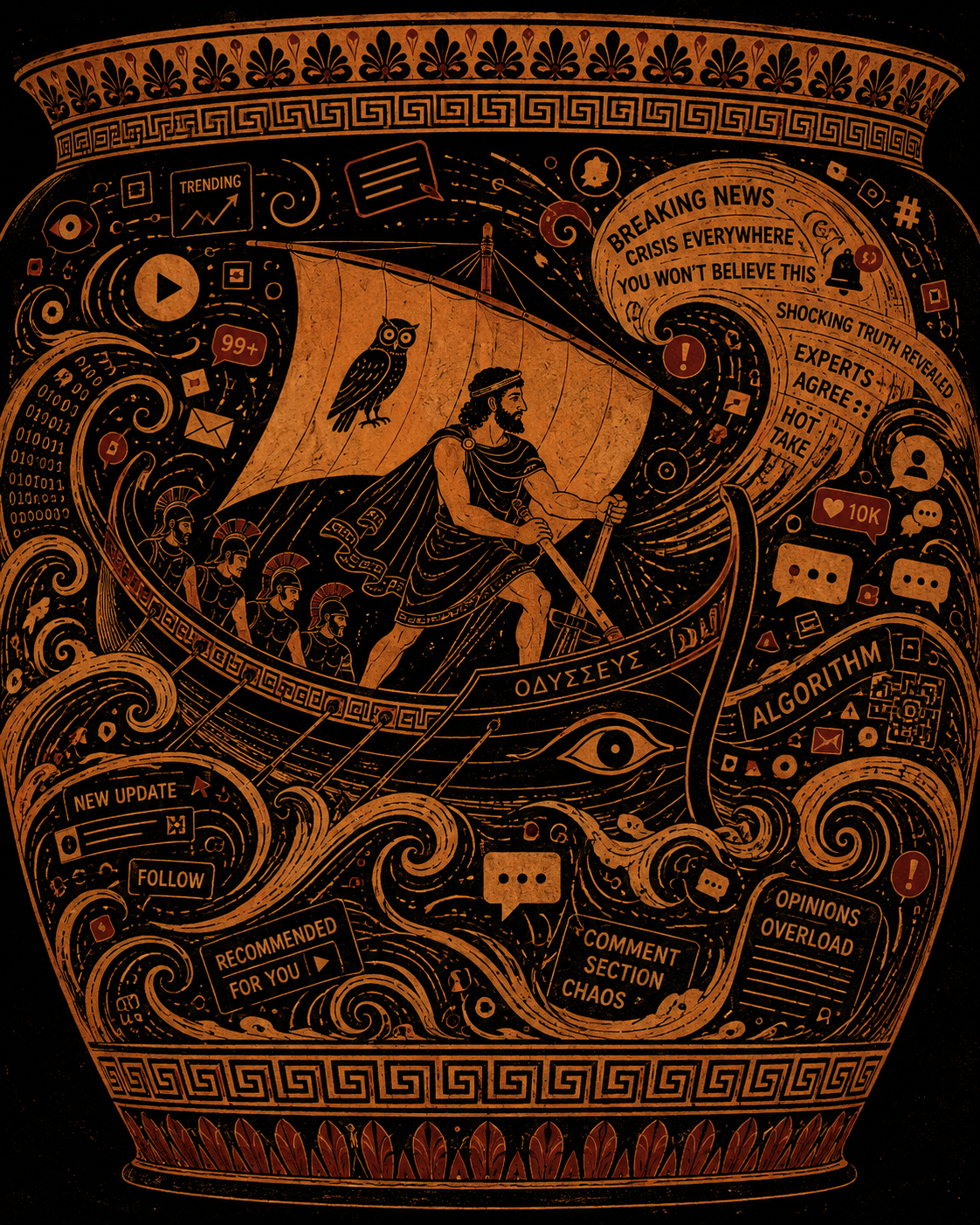
Yet Homer’s idea is subtler than “welcome everyone”. Xenia is reciprocal; the host has obligations to the guest, and the guest to the host. The suitors are villains precisely because they abuse hospitality. The Phaeacians behave well because they receive Odysseus. The Cyclops behaves monstrously because he does not.
Homer is not offering an immigration policy, of course, but what he does offer is arguably more useful: a refusal to remove morality from the encounter.
6) The Odyssey, and perhaps the classics in general, are unusually good material for an age suspicious of authority.
Greek mythology doesn't present one settled moral universe. The gods disagree, heroes clash, clever people do appalling things, justice is murky, and naturally, good people suffer.
There isn't a narrator arriving at the end to explain the correct opinion. That makes these stories surprisingly compatible with a culture suspicious of official answers.
Just the fact that there are several gods, not just one great god, is in its own way expanding and liberating. More than that, the gods in Greek mythology are not moral beings first and foremost and don’t present themselves as the centre of the moral universe. They are selfish and spiteful and vengeful - a bit like us.
Well, there are some ideas anyway. Are all or any of these theories convincing? One of the joys of Homer is that he deals in permanently unfashionable subjects: courage, vanity, temptation, war, family, loyalty, home, and mortality. And our licence, nay requirement, is that we work out for ourselves what we think he means. 💥
From the department of actually that stupid ...
 Natali Anderson
From the department of the belatedly vindicated crank...


From the department of pocket money for the machines...
 Will Papper
Thanks for reading - please share if you have a friend (or enemy!) you think would value this blog and ask them to add their email in the block below - it's free for the time being. If the sign-up link doesn't appear, you'll find it on the site.
Till next time. 💥