When politics get weird, the sage to whom we are always drawn is Machiavelli. Partly this is because he is wonderfully unsentimental about good intentions. A politician can be wise, honourable, and even correct, and still end up with his head on a spike. Or, in a democracy, he lands with his party polling at 30% (perhaps less painful, but it involves considerably more television analysis).
As I write this, two pivotal elections draw near. The US midterms and the SA local government elections are not even the main course on the political menu, but in both cases, their outcomes loom large in the ongoing and ceaseless drama that politics has become. But even now, one thing is obvious: US president Donald Trump and SA’s president Cyril Ramaphosa are going to get a lekker snotclap.
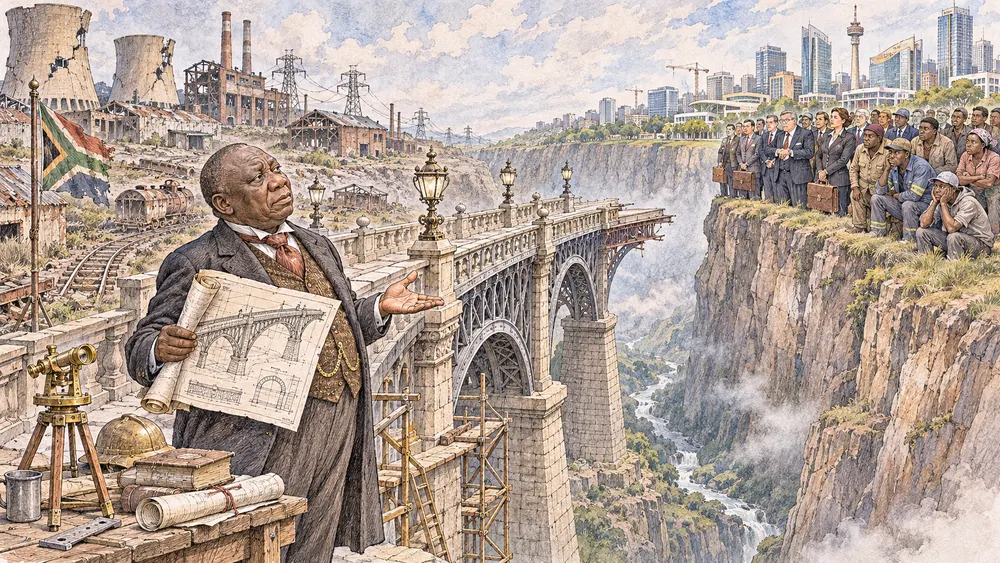
In the cast of modern South African politics (I'll write about the US elections next week), the Machiavelli passage that comes to mind from The Prince is this: “For the reformer has enemies in all those who profit by the old order, and only lukewarm defenders in all those who would profit by the new order.” It is difficult to think of a more economical account of Cyril Ramaphosa's predicament. Those threatened by reform know exactly what they stand to lose. Those who might gain from it generally have to wait until somebody has built the railway.
I actually feel for Ramaphosa. His speech at the ANC's Siyanqoba rally in Buffalo City on Sunday on the eve of Wednesday's local government elections contains some genuinely fine passages, delivered by a man who, whatever else one thinks of him, has become rather more thoughtful about the limits of his party's historic claim on the electorate. Addressing young people, he acknowledged the suspicion that the ANC was forever presenting the liberation struggle as an unpaid invoice: “It might sometimes sound like we are holding this over you, as if your vote is a debt you owe us.” Then he said something rather magnificent: “Freedom was won so that you could use it on your own terms.”
He offered the young graduate endlessly checking a phone for a job notification that never comes, a wonderfully precise image of South Africa's peculiar ability to educate people into unemployment. He dispensed with the vocabulary of national transformation in favour of whether the tap works, the street light comes on, or the refuse gets collected. One feels that, after all these years, someone in the ANC has finally discovered that rubbish removal is not primarily a philosophical question.
The speech was also revealing in its restraint. Ramaphosa conceded that the ANC could no longer simply invoke 1994 and expect a standing ovation. “We do not win by proclaiming victory. We only win by working,” he told a rally called, somewhat optimistically, We are winning. There is a sincerity here that I find quite affecting. Calling him the country's best president might cause an altercation at a Mandela memorial, but consider the narrower proposition: Ramaphosa has patience, constitutional instincts, and a gift for keeping antagonists in a room long after the sensible people have escaped through the windows. These are considerable political talents, provided the room is not on fire.
And yet, if the opinion polls are anywhere near correct, the ANC is about to receive a monumental thumper. Ipsos puts national ANC support at 30%; a Social Research Foundation survey has it at 32%. These are measurements of voter sentiment, not forecasts, and local elections have a nasty habit of confounding national calculations. But the comparison is brutal enough: the ANC won 45.6% in the 2021 municipal elections, having taken about 62% in 2011. It could have lost almost half its support in 15 years, and its president's good manners are unlikely to reverse the arithmetic.
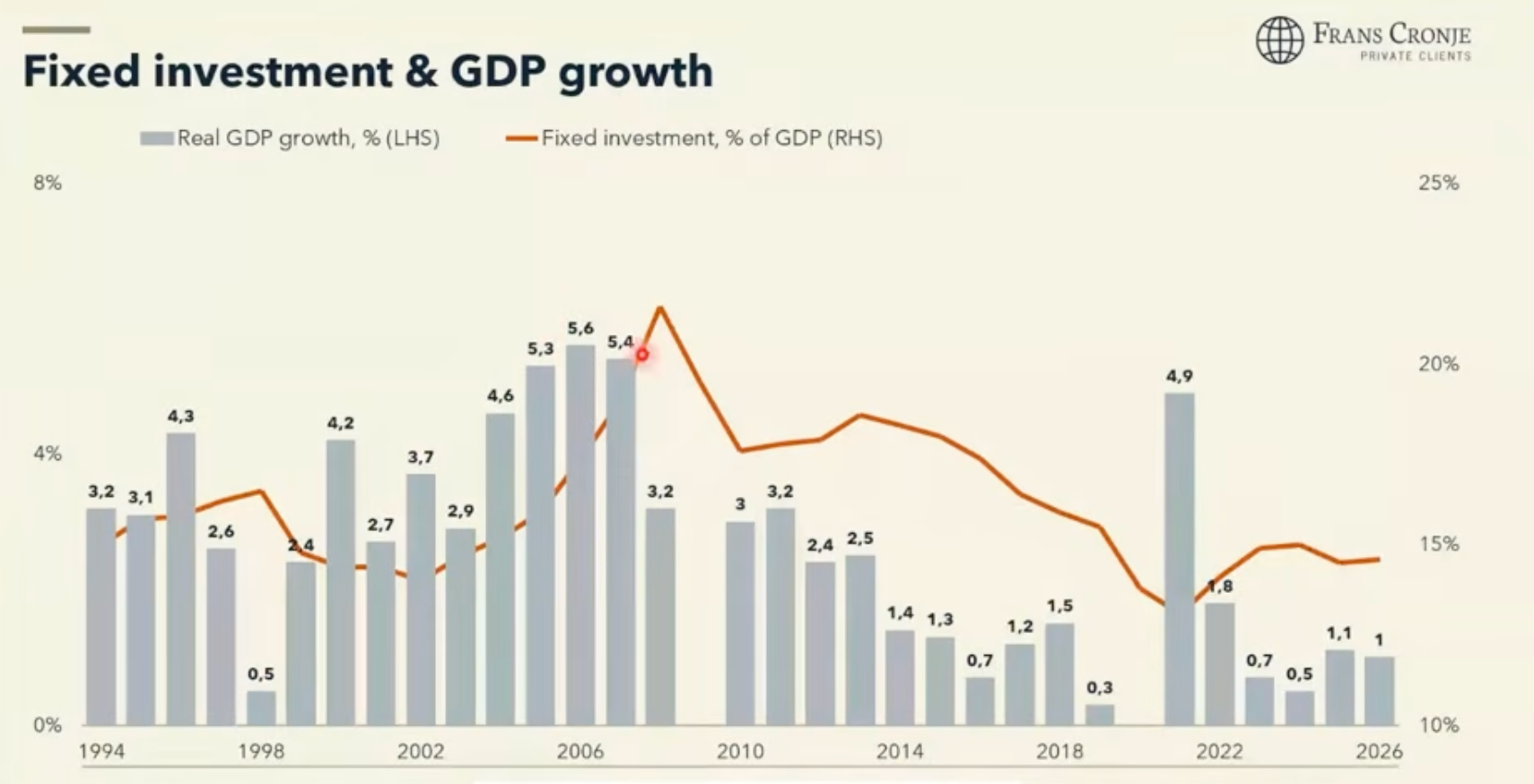
Why? Start with the economy, where the figures make even his most indulgent admirers reach for an antacid. Using broad calendar-year averages, South Africa grew by about 2.7% a year under Mandela, 4.2% under Mbeki and 1.6% under Zuma. Under Ramaphosa, from 2018 to 2025, the average has been around 0.6%.
These figures are a useful provocation, though a lousy verdict on their own. Mbeki enjoyed a global commodity boom; Zuma was walloped by the financial crisis; Ramaphosa presided during the Covid pandemic, which briefly turned national output into a rather dramatic ski slope. Presidents cannot choose the world economy, however much their communications departments wish they could.
But look at the most recent two completed years, when the electricity crisis was easing, the GNU had been formed, and some of the long-promised reforms were finally getting traction. Growth was 0.5% in 2024 and 1.1% in 2025, an average of just 0.8%. The economy then contracted by 0.2% in the second quarter of 2026. This is a recovery only in the sense that a patient who has stopped bleeding but cannot get out of bed is recovering. It may be medically accurate, but there is still a problem.
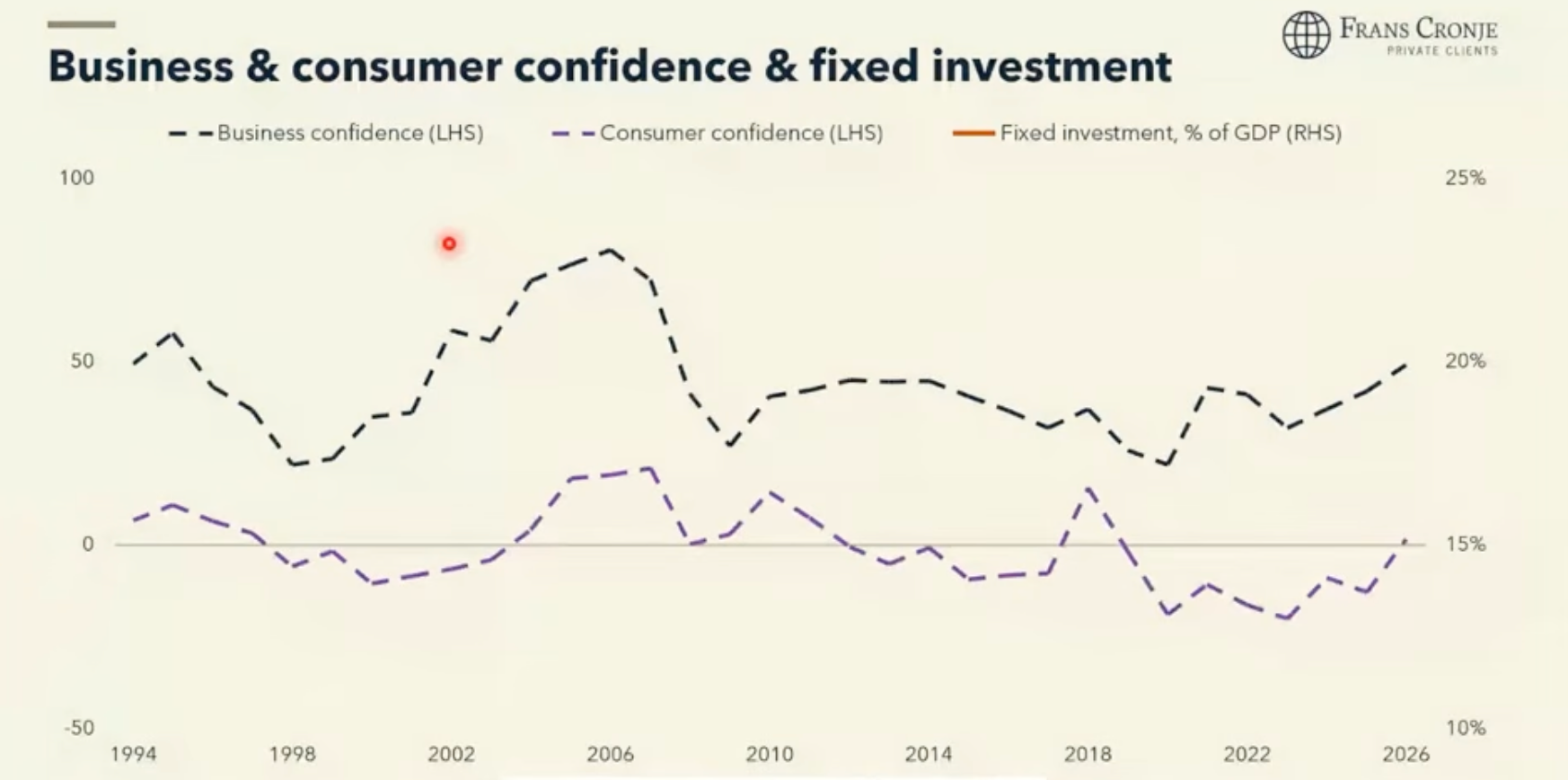
The question becomes more troubling when you examine investment. In an illuminating presentation, political analyst Frans Cronje tracks South Africa's fixed-investment ratio climbing above 20% of GDP towards the end of the Mbeki era, before sinking back to the neighbourhood of 14%. The Reserve Bank puts it at 13.9% in 2025. That is an extraordinary destination after years of presidential investment conferences, each accompanied by pledges of enormous sums of money, substantial applause, and the usual photographs of men who have come to an agreement about agreeing to invest. He analysed the problem correctly, did his best to remedy it, and … nothing happened.
Investment is not a decorative economic indicator. It is the machinery, infrastructure, and productive capacity that make future growth possible. If investors are not expanding factories, mines, and transport systems, there is little prospect of absorbing the people entering the labour market. Cronje observes that South Africa had roughly 14.6 million people in employment in 2008, against 16.7 million in mid-2026. Whatever the measurement caveats in comparisons over such a long period, the direction is unmistakable. Official unemployment, 26.7% when Ramaphosa took office, was 33.6% in the second quarter of this year. Somewhere along the way, the economy stopped making enough room for its own population.
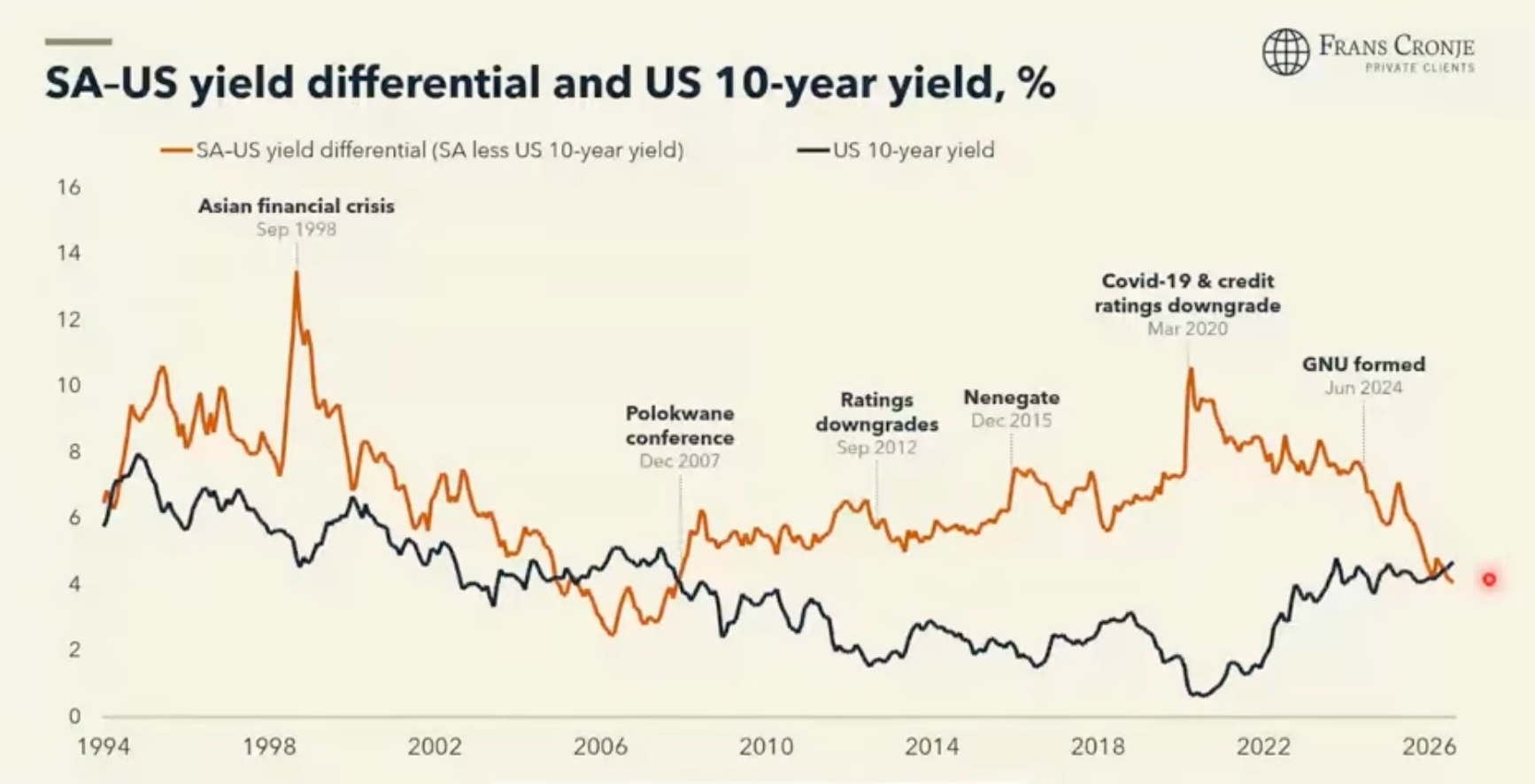
The fascinating wrinkle is that financial markets are becoming much more cheerful. Cronje's graph of the yield differential between South African and American ten-year government bonds shows it narrowing dramatically after the GNU was formed in June 2024, to levels associated with a very different South African economy.
The comparison is imperfect because rand and dollar bond yields also reflect inflation and currencies, but dollar sovereign spreads tell a similar story of improved confidence. Bond investors appear increasingly willing to believe that South Africa can manage its financial affairs. The people deciding whether to build a factory are proving more demanding.
And there is another small humiliation embedded in that graph: sentiment improved substantially after the ANC lost its majority and had to govern with other parties. One interpretation is that investors welcomed restraints on the very party Ramaphosa leads. Another, more generous, is that he deserves considerable credit for assembling a functioning GNU when the alternatives might have been ruinous. Both can be true. One man's greatest political achievement can consist of persuading his own organisation to accept that it needs supervision.
There are substantive achievements, too. National load shedding has largely disappeared, Eskom's operational performance has improved, private generation has expanded, and the door is at last opening to greater private participation in rail and ports. Operation Vulindlela has demonstrated that regulatory obstacles can be removed with sufficient attention from the Presidency and Treasury. South Africa received a sovereign credit-rating upgrade in 2025. These are not imaginary accomplishments manufactured by a presidential press office. They are changes with economic consequences, some of which may take years to become visible.
And substantial difficulty lingers. Reforming electricity supply does not create customers for a factory that has no orders. Eskom's sales volumes fell 6.2% in the year to March 2026, partly because of private generation and efficiency, but also because industrial demand is weak. The electricity crisis may have disappeared only to reveal a more depressing problem: large parts of the economy no longer need as much electricity as they once did. One can fix the power station without automatically reopening the smelter.
Cronje has a harsher account. He argues that Ramaphosa's temperament was poorly suited to the task. “He kept looking for consensus, and he looked for consensus as an excuse not to take those decisions,” he said in his recent presentation. The country required a reformer prepared to confront vested interests; it got a negotiator whose instinct was to assemble another negotiating committee.
History offers several possible endings to this story, and none is especially comforting to the person sitting in the presidential chair. Germany's Gerhard Schröder, whose Agenda 2010 labour and welfare reforms antagonised the Social Democrats' traditional supporters and contributed to his defeat in 2005. Germany's subsequent employment revival was partly attributed to those reforms, although their precise contribution remains disputed. Angela Merkel received much of the political benefit. Schröder got to discover that history sometimes sends the thank-you card to the wrong address.
Then there is India's P V Narasimha Rao, who, with finance minister Manmohan Singh, dismantled large parts of the country's suffocating economic licensing system after the 1991 crisis. Investment followed, and the reforms helped establish the foundations of India's later expansion. Rao's Congress government nevertheless lost power in 1996, amid corruption scandals and party divisions. Opening an economy and retaining an electoral majority turned out to be two entirely separate professions. There is a parallel worth considering if Ramaphosa's electricity and logistics reforms eventually accelerate growth under somebody else's presidency.
The third precedent is darker. Mikhail Gorbachev attempted to reform a Soviet system whose beneficiaries remained entrenched inside the institutions required to carry out the reforms. He loosened controls without successfully establishing an effective replacement, while economic crisis and political disintegration overtook him. By 1991, the Soviet Union had disappeared, an outcome he had not intended. South Africa is obviously not the Soviet Union, and Ramaphosa is not Gorbachev. But the institutional puzzle is familiar: how do you change a political organisation when you are obliged to rely on the very people whose power you intend to diminish? It is a question to which the ANC has so far offered only an impressive selection of commissions.
These histories suggest different readings of Ramaphosa's predicament. Perhaps he is Schröder or Rao, a leader laying foundations whose rewards will arrive after he has gone. Perhaps the Gorbachev comparison is closer, and the political compromises necessary to keep reform alive have also prevented it from becoming decisive. Or perhaps something more prosaic is happening: his reforms have made the country less dangerous to lend to without making it sufficiently attractive to invest in. That is not nothing, but it will not put 8.5 million unemployed people to work.
The image of young South Africans waiting for their phones to light up with an opportunity in the president's speech is haunting. But promises, however elegantly delivered, do not make phones ring. 💥
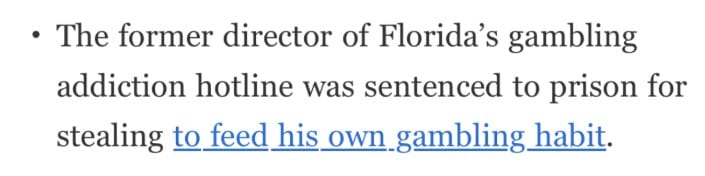
From the department of Florida man ...
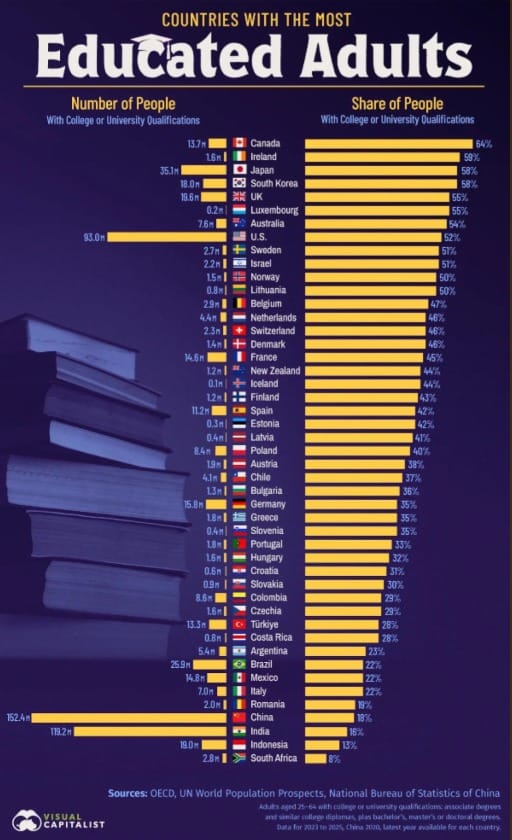
From the department of the bottom of the list being a thing ...
Thanks for reading - please share if you have a friend (or enemy!) you think would value this blog and ask them to add their email in the block below - it's free for the time being. If the sign-up link doesn't appear, you'll find it on the site. And my book - based on these columns - has just been published, get it here!
By all means respond in the space below or email me directly.
Till next time. 💥