

I have been wondering whether one of the great economic problems of our age is not inflation itself but the peculiar havoc it wreaks inside our heads.
There is even a word for this now: “vibecession”, coined by economic commentator Kyla Scanlon for that odd circumstance in which the statistics say the economy is doing reasonably well while almost everybody sitting around the dinner table insists it is going to hell in a handbasket. The concept was invented for America, where, for several years unemployment was low, real wages were rising, and household wealth was soaring, but voters described the economy in terms normally reserved for Argentine military governments.
South Africa may have its own version.
Consider 2025. It was hardly the second coming of the Rand Daily Mail Christmas party, economically speaking; GDP grew only 1.1%. Yet household consumption increased, real disposable income improved, interest costs began easing, inflation averaged just 3.2% — the lowest in 21 years — and the JSE All Share Index rose an astonishing 37.7%, its best performance since 2005. Household net wealth consequently rose.
And what did South Africans say?
Pretty much what South Africans always say: things are terrible; everything is ridiculously expensive; you cannot believe what Woolies wants for three lamb chops; the country is finished.
There is something going on here.
Inflation is different from almost every other economic phenomenon because we encounter it personally. Nobody experiences GDP. I have never been ambushed by gross fixed capital formation in the vegetable aisle. Productivity has never appeared at the petrol station and demanded R1,400 before allowing me to leave.
But we experience prices differently - they have memories and narratives and histories and personalities. You remember when a restaurant's main course cost R90. (Well, some of us!) You remember when a decent bottle of wine was R60, a new Golf was R250,000 and someone who paid R4-million for a house was either an oligarch or had lost his mind. Then one day the Golf costs something approaching the GDP of Lesotho and the old R60 bottle is standing on a shelf marked R189.99 looking rather pleased with itself.
This creates a fascinating mental asymmetry.
Suppose your salary rises 8% and prices rise 5%. Economically, you are roughly 3% better off.
But that is not how you experience it. The salary increase is yours because you worked for it and your employer finally recognised your dazzling contribution to the accounts department. The extra 5% charged by Checkers, meanwhile, represents something akin to theft.
Harvard economist Stefanie Stantcheva has gone and asked people about this, and people overwhelmingly believe inflation lowers their living standards because wages fail to keep up, and they tend to regard wage increases as rewards for their own effort rather than as part of the same inflationary process.
 Stefanie Stantcheva
Robert Shiller discovered something similar decades ago. One respondent in his famous study complained that inflation created enough confusion for other people to “play tricks on me”.
That may be as good a description of inflation as anything in an economics textbook. Inflation makes you feel vaguely cheated without being entirely sure who did the cheating.
The Bank for International Settlements has now surveyed households in 31 countries, including South Africa, and found that people systematically overestimate the deterioration in their real wages after the pandemic. Their inflation expectations also remain higher than actual inflation, as though the great post-Covid price shock has taken up permanent residence in the spare room and refuses to leave.
 Francesco D’Acunto
There is another misunderstanding at work here, and it is enormous.
When economists announce that inflation has fallen from 7% to 3%, people quite reasonably look around and ask: where? The answer is nowhere.
Inflation falling does not normally mean prices fall. It means they are rising more slowly. The R100 object that became R107, then R114, then R119 does not obediently return to R100 when inflation reaches 3%. It becomes R122.
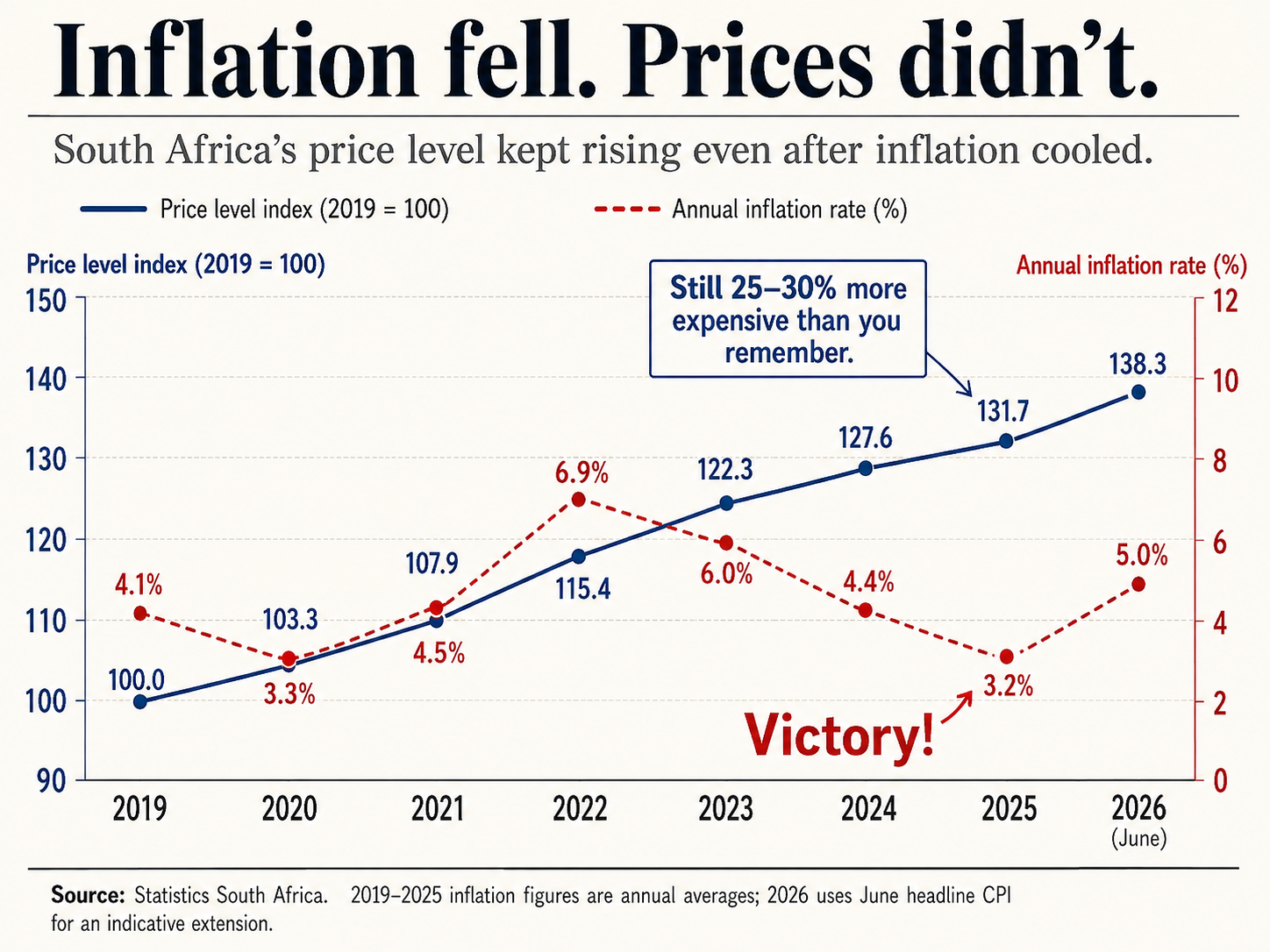
Hence, the peculiar political difficulty of defeating inflation. The central bank wins the war, holds a press conference announcing victory, and the population surveys the battlefield and only to discover that a cappuccino is still R42.
John Maynard Keynes called inflation “unjust” and deflation “inexpedient”, which is one of those splendid Keynesian formulations that manages to sound simultaneously profound and like a complaint about the lunch service at King’s College.
The deeper point is that there isn't really a national inflation rate.
The Stats SA inflation rate is an extremely valuable statistical construction based on the weighted spending of millions of households. But you do not buy the national basket. You buy your own personal basket.
Stats SA’s new basket contains 391 products and now includes such landmarks of modern South African civilisation as streaming services, air fryers, and rosé wine. This is progress of some kind.
But if you are a pensioner who owns your house, doesn't drive much and spends heavily on medical care, you have one inflation rate. If you are 28, renting in Cape Town, driving 50km to work and consuming takeaway coffee as though it were an intravenous medication, you have another. A poor rural household spending heavily on maize meal, meat, and transport has another again.
This is not theoretical. In April 2023, when headline inflation was 6.8%, Stats SA calculated that the poorest tenth of households were experiencing inflation of 11.3%, while the richest tenth experienced 6.2%.
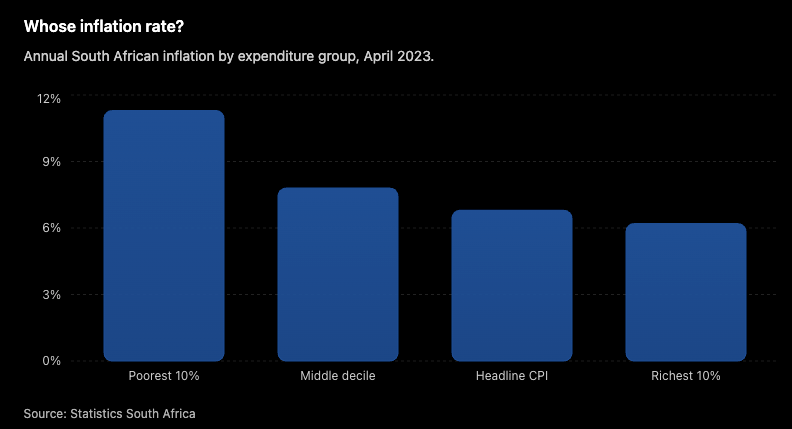
The national inflation number is therefore both indispensable and fictitious, in the same sense that the “average South African” is indispensable and fictitious. Somewhere, statistically speaking, there exists a 36-year-old person who owns 0.7 of a refrigerator and drinks exactly the national average quantity of rosé. Unfortunately, we haven’t yet met.
But here is the more cheerful part.
Human beings are extraordinarily bad at noticing small improvements compounded over long periods.
Economists are always banging on about productivity, which is unfortunate because productivity sounds like something endlessly being discussed in a seminar taking place in a hotel conference room near OR Tambo. What productivity actually means, however, is getting slightly more stuff from the same effort.
And slightly is enough.
Take Denmark. It did not become rich because somebody in Copenhagen discovered one weird trick involving the CPI; it became rich through trade, agricultural transformation, industrialisation, education, institutions, and productivity. But look at the arithmetic. Danish real GDP per capita only increased by 2.9% on average during the 20th century.
Three per cent! It sounds pathetic. Yet 3% compounded for 35 years trebles living standards. Over the century, it increases them 19 fold. I am not making this up. That is more or less the great secret of becoming Denmark: arrange matters so that incomes and productivity beat prices by a couple of percentage points, then avoid doing anything spectacularly stupid for several generations.
Economic development is less like winning the lottery than watching grass grow. Unfortunately, grass has a terrible rating on Rotten Tomatoes.
Consider the millennials. For roughly 20 years we have been told that millennials were the tragic generation: crushed by student debt, locked out of housing, victims of Boomers who had bought entire suburbs in 1973 for approximately R11.50.
Yet the latest US Federal Reserve calculations find households headed by younger Americans had, at roughly age 34, 35% more inflation-adjusted average wealth than Boomers had at the same age, and 23% more than Gen X.
 Ana Hernández Kent
Better still, they are now standing beneath history’s largest inheritance waterfall. Advisory firm Cerulli estimates that some $124-trillion will change hands in America through 2048, with millennials inheriting around $46-trillion, more than any other generation.

There would be a certain comic perfection if the generation that spent its youth accusing the Boomers of having all the money ended up solving the problem by acquiring the Boomers' money. But the same will apply to the next generation and the next.
None of this means people who say they are struggling should be told to shut up and admire their pension savings statements. South Africa has 30%-plus unemployment, appalling poverty, and virtually nonexistent per-capita economic growth. A young person without a job, house, or portfolio has not been rescued by a 37.7% JSE rally.
But among employed, pensioned, house-owning, investment-owning South Africans, which includes much of the audience that complains most energetically about the price of restaurant wine, there may be a substantial "vibecession" premium IMHO.
The CPI number may be telling us something important. But our own eyes occasionally tell us porky pies. 💥
From the department of backing the wrong horse ...


From the department of making sure you are absolutely never too paranoid ...


Thanks for reading - please share if you have a friend (or enemy!) you think would value this blog and ask them to add their email in the block below - it's free for the time being. If the sign-up link doesn't appear, you'll find it on the site.
Till next time. 💥