
One of the terrible curses of journalism is that you often tend to think you know more than you do. I’ve just come back from a trip to Mexico, and I have things to say. But are they useful, or merely misguided notions derived from a small glimpse into a complicated situation?
I live in dread of the famous statement by the American journalist Lincoln Steffens, who visited revolutionary Russia in 1919 and returned with the immortal verdict: “I have seen the future, and it works.” It is hard to imagine a more succinct demonstration of the dangers of travel writing, although several thousand ill-informed TripAdvisor reviews come close.
There is, fortunately, another option: you can state categorically that you are still not really quite sure about the future after you've travelled; it’s unclear whether it will work; and even if it does, it almost certainly won’t look like whatever you predict. This protection against inaccuracy is simply to blanket yourself in imponderables, a technique economists perfected some time before journalists discovered it.
So let me start with some absolute certainties and certain absolutes. Mexican food is fabulous. The preponderance of chiles has led Mexican restaurants outside Mexico to turn dinner into a test of culinary masculinity. In Mexico itself I found something subtler. A jalapeño is essentially Mexico’s way of asking whether you have been paying attention - it is not necessarily there to notify your next of kin. The cuisine is enormously varied and absurdly old, with agricultural roots stretching back thousands of years, which means tacos have a more convincing pedigree than several European royal families.
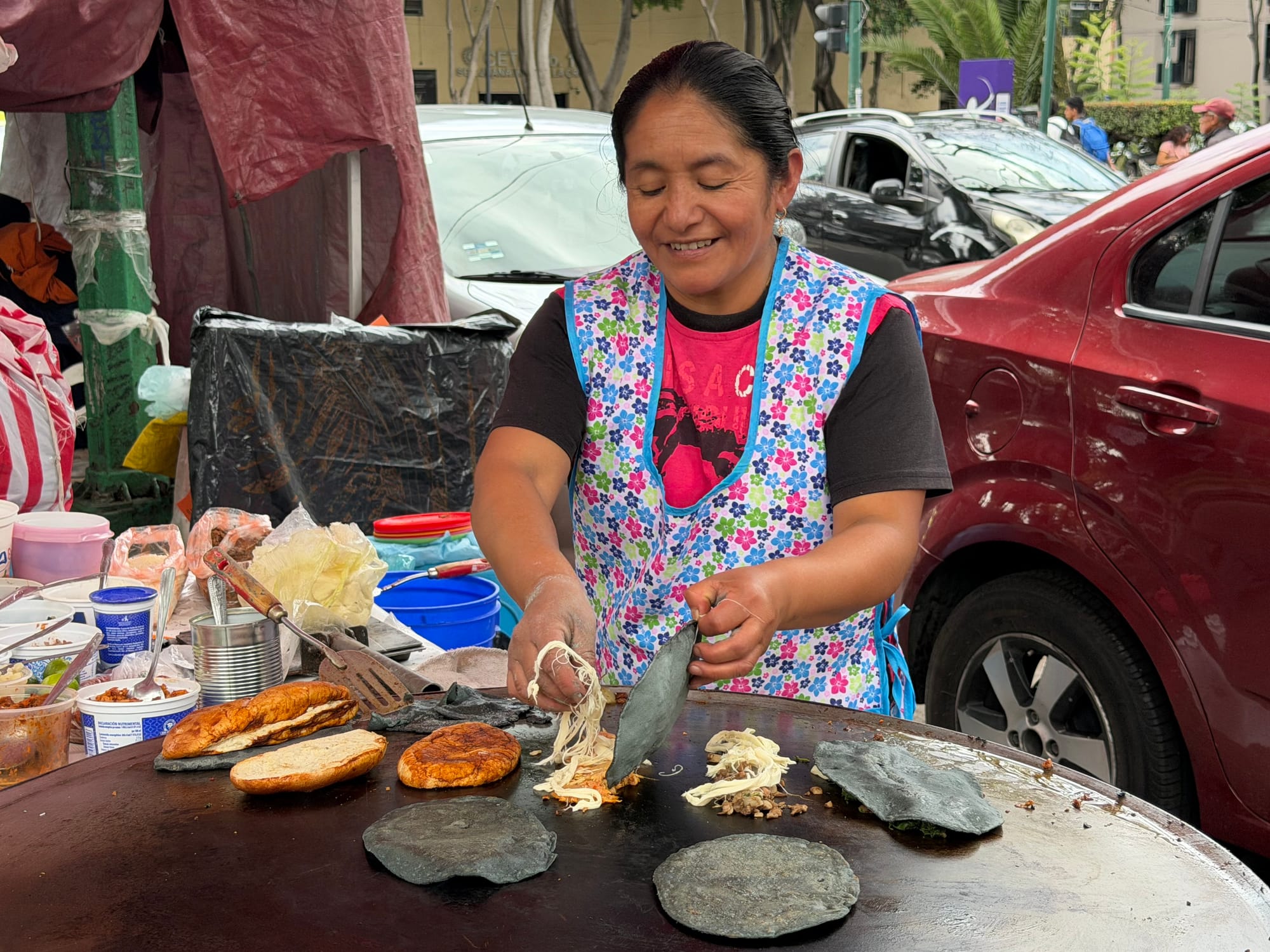
The second obvious fact is that the indigenous culture of Mexico is not something confined to history, although history is everywhere. It remains extraordinarily alive and diverse - linguistically and culturally - and is particularly visible in food, textiles, and craft. South Africans congratulate ourselves on coping with 11 official languages. Mexico officially recognises 68 indigenous language groupings (plus Spanish, of course) and 364 linguistic variants, which rather reduces our linguistic heroism to the level of a warm-up act.
Third, the colonial story is very different from Africa’s. Spanish conquest began centuries earlier, and the Mexican state that eventually emerged was subsequently invaded or occupied by Spain, France, and the United States. And then there was the revolution and 60 years of PRI rule, and so on.
Cinco de Mayo, often confused abroad with just about every other Mexican independence, commemorates the Mexican army’s unexpected defeat of French forces at Puebla in 1862. The Day of the Dead is unrelated and something else entirely. Mexico has had enough historical drama without foreigners combining its festivals to save diary space.
Fourth - and I say this with the affection and sympathy of a resident of a country with many similar afflictions - Mexico is a bit of a mess. Mexico City is a good example. It is one of those places that seems to have been assembled by accumulation rather than design. It sprawls across a high-altitude basin under a pale, often hazy sky, a city of grand avenues, cracked (and sinking) pavements, colonial facades, glass office towers, shrines, taco stands, jacarandas, apartment blocks and a frankly heroic quantity of overhead wiring. The wiring alone appears to have been installed according to the principle that electricity and fibre optics, like democracy, work best if everybody has a go.

Traffic surges and stalls. Street vendors colonise every available patch of pavement. Somewhere a man is repairing a shoe, somewhere else a woman is pressing tortillas, and around the corner a perfectly dressed banker disappears into a marble lobby.
There are neighbourhoods of almost European elegance and others that seem to have been built one room, one floor, and one economic improvement at a time. The place is noisy, industrious, slightly battered, and completely alive. It does not present itself as orderly and neither does it feel inert. Quite the opposite: Mexico City gives the impression that practically everyone is making, fixing, selling, cooking, carrying, or negotiating something, including, quite possibly, the pavement you are standing on.
Then there are the politics. When we strayed into a conversation about the subject with our food guide in Mexico City, the frustration with local state-owned enterprises sounded hilariously similar to an average Eskom conniption fit in a Johannesburg suburban restaurant. “How is it possible that an oil company can lose money?” he demanded, throwing his hands into the air while discussing Pemex, the giant state oil company. “How is that humanly possible?” South Africans may recognise the tone: it is the universal voice of somebody discovering that government has managed to lose money selling something everyone desperately needs.
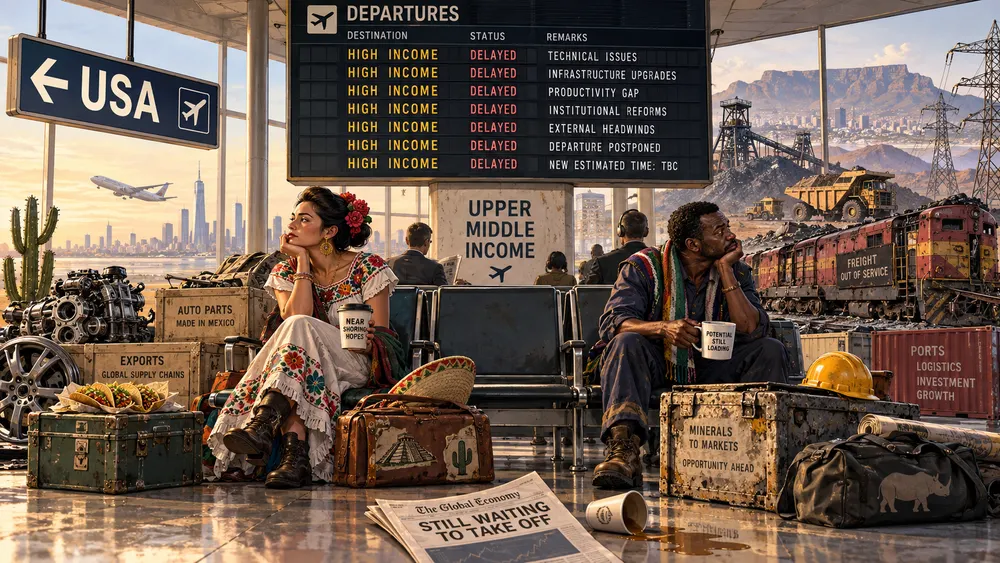
And that brings us to the similarity between two nations, among many, struggling to escape an odd economic disease: the middle-income trap.
The phrase itself is relatively new. World Bank economists Indermit Gill and Homi Kharas popularised it in 2007 to describe countries that had escaped poverty but then struggled to make the next jump into the ranks of rich economies. The basic idea is intuitive enough. A poor country can grow rapidly by moving people from low-productivity agriculture into factories, importing technology, building roads, and educating children. Eventually wages rise and those easy gains diminish. At that stage you have to become genuinely more productive, technologically capable, and innovative. In development economics, this is approximately the moment when the exam stops being multiple choice.
Mexico and South Africa are both classified as upper-middle-income economies, and both have been hanging around the neighbourhood for an embarrassingly long time. But they appear to be trapped in rather different rooms.
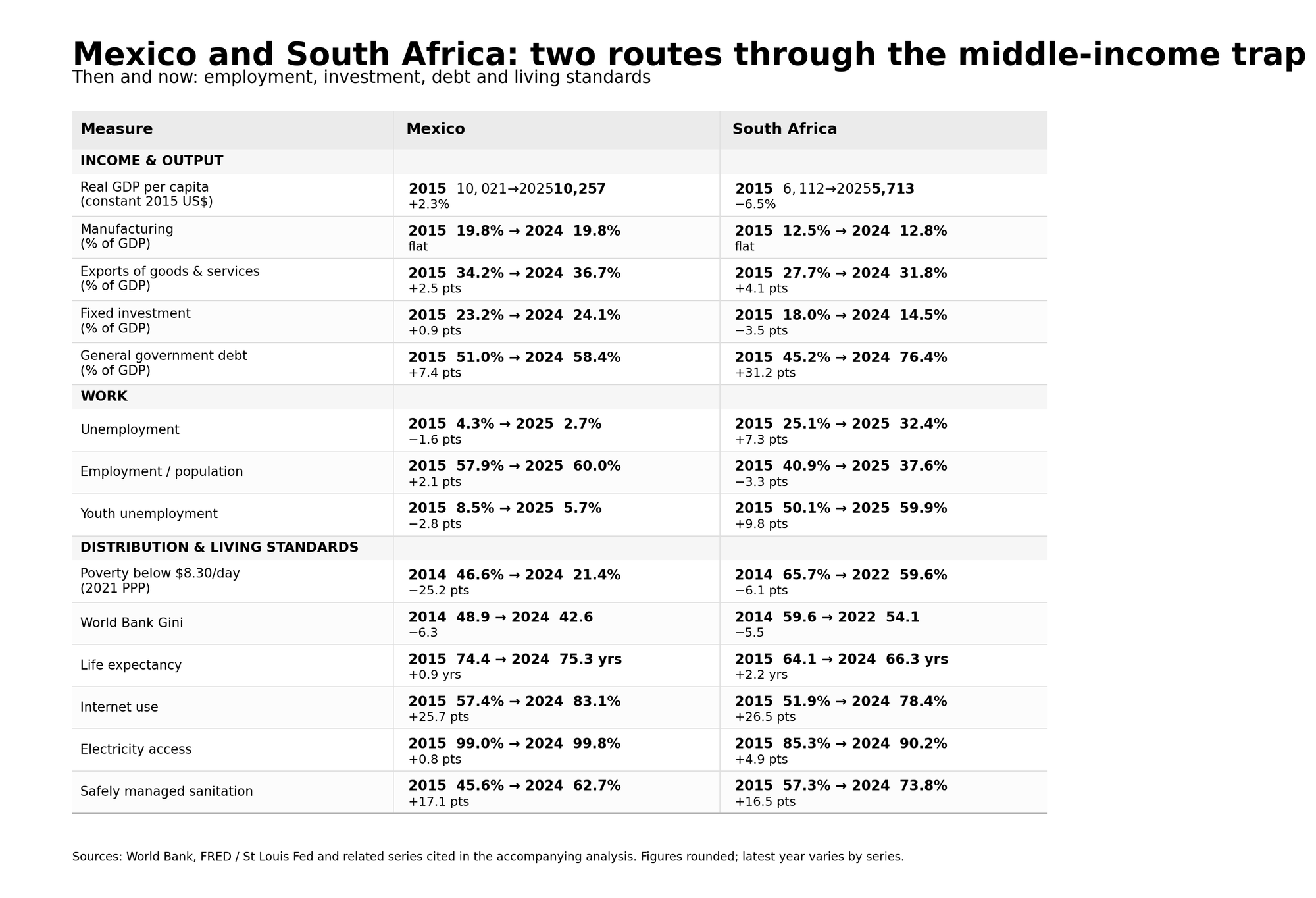
Consider one of the first things that struck me in Mexico City: everybody seemed to be working. Normally this sort of tourist observation should be filed alongside “the locals are very friendly” and “there seems to be a lot of traffic”. Yet in this instance the statistics are startlingly supportive. Mexican unemployment is around 3%. South Africa’s is technically above 30%. Using the more revealing employment-to-population ratio, roughly 60% of Mexican adults are employed compared with about 38% of South Africans. Among young people the contrast becomes almost grotesque: internationally harmonised measures put Mexican youth unemployment in the single digits and South Africa’s close to 60%. For once the tourist had accidentally noticed something backed up by facts, which is always unnerving.
There is a very large catch, though. More than half of Mexican workers are informal. They sell food, repair things, drive, trade, manufacture on a small scale, or work for businesses outside much of the tax and social-security system. Mexico has solved part of the unemployment problem by allowing people to get on with earning money, although frequently not very much of it. South Africa has created a considerably more formal labour market in which the fortunate insider may enjoy decent wages and protections while a vast number of outsiders wait at the gate. Mexico has too many bad jobs; South Africa has too many people with no jobs. Choosing between these is a little like being asked which side of the lifeboat you would prefer to leak.
This difference helps explain another Mexican paradox. Over roughly the past decade, real Mexican GDP per person has barely increased, perhaps 2% or 3% in total depending on the period and measure. South African real GDP per person has actually declined by around 6%. Neither country has provided the Asian tigers with sleepless nights. Yet Mexican poverty has fallen dramatically, while the improvement in South Africa has been much smaller. Mexico has somehow managed to distribute mediocre growth more effectively, which is faint praise only until you compare it with distributing no growth at all.
The minimum wage has risen substantially under Andrés Manuel López Obrador and his successor Claudia Sheinbaum; social programmes have expanded, and inequality has declined. Mexico’s World Bank Gini measure has fallen from roughly 49 a decade ago to about 43. South Africa’s comparable measure has also improved, but remains in the mid-50s on that series and much higher on some domestic measures. These statistics come with all the usual definitional health warnings, but even after administering the medication, South Africa remains spectacularly unequal.
Mexico’s more obvious economic advantage is industrial. Manufacturing accounts for about 20% of GDP, compared with roughly 13% in South Africa. More important is the kind of manufacturing involved. Mexico produces vehicles, electronics, medical devices, appliances, and aerospace components inside enormously complicated international supply chains. South Africa retains world-class factories and important automotive production, but minerals and commodity-linked exports still carry much greater weight. Mexico makes a remarkable quantity of things that have screws in them, which remains one of the better informal definitions of industrialisation.
Behind this stands the gigantic economic fact of Mexican geography: the United States. Roughly 82% of Mexican goods exports go north across the border. The comparable South African figure is around 7%. Mexico sells well over $500bn of goods to America in a year; South Africa’s exports to the US are measured in the tens of billions. South Africa trades with America. Mexico manufactures with it. An informed South African I met in Mexico described the “trade war” talk between the US and Mexico as “ridiculous”. “They desperately need each other”.
This relationship was deliberately constructed through NAFTA from 1994 and subsequently USMCA. A car assembled in Mexico can contain American components, Mexican labour, Canadian materials, and software created somewhere else entirely. Parts can cross borders repeatedly before the finished vehicle reaches a showroom. Asking whether such a car is Mexican or American eventually becomes an exercise for philosophers, customs officials, and Donald Trump, three groups not normally walking into the bar together.
One might reasonably expect proximity to the richest consumer market on Earth, combined with this degree of industrial integration, to have turned Mexico into something approaching Spain in a sombrero. It hasn’t. Mexican GDP per head remains far below US levels and has barely converged for decades. This is perhaps the most interesting part of the story, because Mexico has accomplished several things South African policymakers routinely list as national aspirations: massive foreign direct investment, sophisticated manufacturing, preferential market access, and deep integration into global supply chains. It acquired the factories and still somehow failed to get properly rich.
The explanation appears to lie in what happened outside the factories. The Mexican operations most closely connected to exports and foreign companies are often impressively productive. The difficulty has been transmitting that productivity to the huge number of smaller domestic businesses around them. Mexico contains world-class automotive plants beside tiny firms operating with very little capital, technology, or access to finance. It's possible to manufacture a sophisticated German automobile in the morning and buy lunch from an enterprise whose accounting system consists of a biscuit tin. Both are part of Mexico; only one looks like Germany.
Economists call this weak productivity diffusion. Humans call it two economies living next door to each other. Mexico’s northern and central industrial regions have benefited enormously from American integration, while many southern states remain much poorer and less productive. Chiapas and Nuevo León sometimes seem less like the states of one economy than countries sharing a flag.
This is where South Africa begins to look eerily familiar. We too have islands of extraordinary sophistication: world-class financial services, advanced mining technology, globally competitive agriculture, automotive plants, and telecommunications companies. Then, often only a few kilometres away, large numbers of people exist almost entirely outside formal production.
Investment deepens the contrast. Mexican fixed investment has remained around 24% of GDP. South Africa’s has fallen from about 18% a decade ago to roughly 15%. At the same time South African government debt has climbed from around 45% of GDP to somewhere in the mid-70s, while Mexico’s has risen much more modestly, from roughly 51% to the high-50s. South Africa has therefore achieved the difficult fiscal trick of borrowing considerably more while investing considerably less, a feat that presumably deserves a commemorative plaque somewhere in Pretoria and the outrage of our local food guides.
Then come the state-owned enterprises. Pemex, once the great financial engine of the Mexican state, is now one of the world’s most indebted oil companies, with declining production and continuing dependence on government support. Mexico’s electricity company CFE remains politically important and increasingly protected. South Africans need no translation. Eskom and Transnet spent much of the past decade demonstrating that a national champion can, with sufficient persistence, become a national patient.
There is nevertheless an intriguing difference. Mexico concessioned most of its freight railway system to private operators in the 1990s. South Africa retained the integrated Transnet model and is only now opening rail corridors and terminals to private participation after discovering that ideological purity is easier to maintain when the trains move. In energy, however, the direction is reversed: Mexico under López Obrador and Sheinbaum has strengthened the state’s role, while South Africa has been cautiously dismantling Eskom’s monopoly and inviting private electricity producers into the system. The two countries appear to be passing each other on the ideological staircase.
Politics adds another layer of contradiction. Sheinbaum leads a proudly nationalist, left-wing movement and talks enthusiastically about sovereignty, the state, and Mexican industrial capacity. Yet the economic machine beneath her government is more tightly integrated into American capitalism than almost any comparable economy on Earth. Mexico’s political rhetoric occasionally sounds considerably further left than South Africa’s; its factories look considerably more like Texas. Ideology, like an enchilada, turns out to vary substantially depending on where it is served.
The middle-income trap therefore looks different from each side. Mexico successfully moved huge numbers of people into work, built an enormous manufacturing base and attached itself to the US economy, then struggled to spread productivity from its best firms through the rest of society. South Africa built a sophisticated formal economy but failed to draw enough people into it, while electricity, logistics, weak investment, and dysfunctional government institutions made the climb progressively harder.
The World Bank now describes the escape from middle income through three stages: investment, infusion of foreign technology, and eventually innovation. Mexico has done reasonably well at the first two. It attracted investment and absorbed astonishing amounts of foreign know-how. The difficult transition is turning Mexican factories using international technology into a broader economy that creates more technology, more productive firms, and more Mexican intellectual property. South Africa, rather inconveniently, appears still to be arguing about the investment stage while simultaneously aspiring to the innovation stage. We would like to invent the future shortly after repairing the railway line.
There is a temptation after travelling somewhere interesting to return with recommendations. Mexico ought to do this; South Africa ought to copy that. This is where Lincoln Steffens begins hovering ominously over the keyboard. Mexico is hardly a model economy. Growth has been disappointing, crime remains appalling in parts of the country, the rule of law is inconsistent, Pemex is a fiscal headache and dependence on the United States has become distinctly uncomfortable in the Trump era. Having 82% of your exports go to one customer is wonderful until the customer starts renegotiating the relationship in public.
But Mexico does pose an uncomfortable question for South Africa. Walking through those crowded streets, the mess itself begins to look slightly different. Street stalls, tiny workshops, and informal businesses may offend the aesthetic preferences of planners, tax officials, and owners of matching municipal furniture, but they also represent people participating in economic life. Mexico’s challenge is getting those people from the pavement into progressively more productive enterprises. South Africa’s challenge begins one rung lower: too many people never get onto the economic ladder at all.
Perhaps that is the most useful observation I brought home, assuming it survives the traditional post-holiday encounter with the facts. Mexico demonstrates how much a country can get right and still remain stuck in the middle-income trap. South Africa demonstrates that there are several floors below that trap from which one can continue digging.
So I have seen the future, and I am pleased to report that I have absolutely no idea whether it works. On the evidence of Mexico and South Africa, however, it appears to have jobs, factories, debt, state companies, chiles, and a great deal of unfinished wiring. Which, now that I think about it, sounds suspiciously like the present.💥
From the department of nightmare fuel with excellent manners...


From the department of two markets, one economy...
 The Premarket Brief
From the department of being in two minds about stuff pretty much always ...
 Krista Conger
Thanks for reading - please share if you have a friend (or enemy!) you think would value this blog and ask them to add their email in the block below - it's free for the time being. If the sign-up link doesn't appear, you'll find it on the site. And my book - based on these columns - has just been published, get it here!
Till next time. 💥