Imagine for a moment that South Africa finally decides to do what people have been recommending for decades, by bringing in a proper businessperson to run the country. Huzzah!
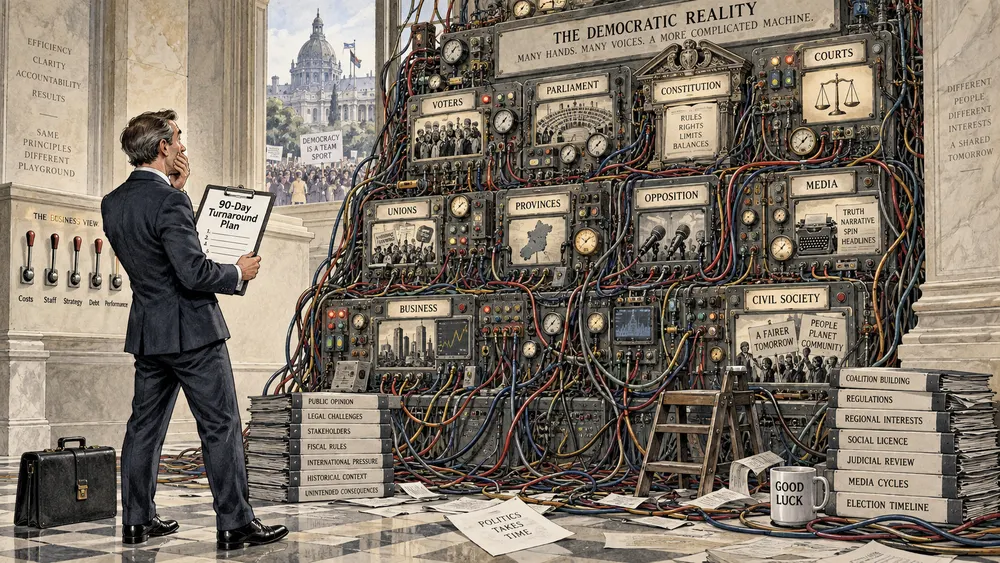
His or her first concern would be that the headcount is ridiculous. Sixty-three million employees and few of them report to anybody, least of all the person at the apex of the pyramid of power. They seem to be working against each other with no accountability. Nine regional divisions, all siloed, with several chronically underperforming, and apparently no effective change management tools to dispose of them. Crazy!
Why has the Eastern Cape never been put on a obligatory performance improvement plan? It's incredible. Nobody seems to know!
Parliament is clearly overstaffed and ought to be right-sized. Home Affairs needs a customer-retention strategy. The police require KPIs. There is no obvious reason why the provinces cannot be merged to achieve synergies and cut costs. The opposition is persistently off-message and should probably be replaced.
If you ask Treasury for the country's EBITDA, Treasury says there isn't one. Can you believe it?
By lunchtime the businessperson has identified the central problem: nobody is really in charge here, least of all me.
More seriously, it reminds me of British economist Ronald Coase who asked a wonderfully simple question in his famous 1937 essay, The Nature of the Firm. If free markets are such an efficient way of organising economic activity, why do companies exist, and why do they exist in the rather militaristic form they do? Why doesn't everyone simply contract freely with everyone else for every service required?
The answer is that it would just be impossibly cumbersome. Companies therefore create what Coase called (borrowing from another economist), “islands of conscious power”. Inside the company, the market largely disappears. Somebody gives instructions. Somebody else follows them.
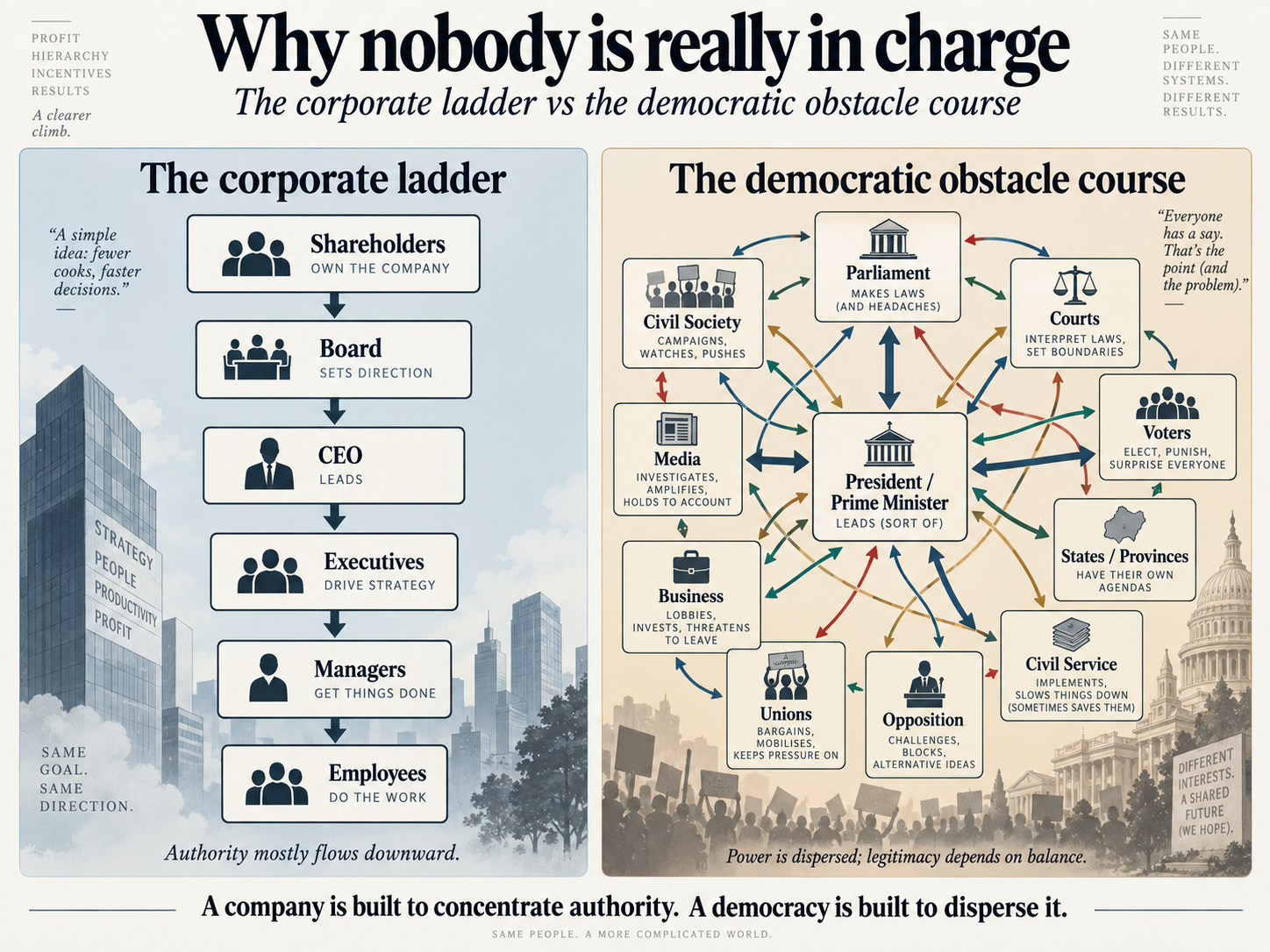
This produces one of capitalism's odder contradictions. We celebrate the market because it is decentralised, competitive and free, then spend our working lives inside organisations constructed broadly along the lines of the Prussian army. Somehow, it seems to work, probably because the quasi-military structure inside the company operates in a context of free exchange.
This acute and unusual insight into the nature of the company and its environment helps explain something that has always worried me - why are businessmen generally so bad at politics? It's not always the case, but at this particular moment we have two oddly contradictory examples: two very different businessmen at the apex of their political systems, US president Donald Trump and South African president Cyril Ramaphosa. And yet both are, objectively, proving enormously disappointing, interestingly much more so in their second terms as in their first.
There are obvious differences between business and politics, and the core of it I think, is that businesses are essentially about direction, while politics is essentially about balance.
The chief executive is usually presented with an objective that everyone broadly accepts and understands. Pick n Pay does not have an internal parliamentary opposition demanding that it stop selling groceries to concentrate on ballet. The argument is over how the company can sell more groceries, more profitably.
Political objectives, on the other hand, are themselves fiercely contested. The miner wants cheaper electricity. Eskom wants higher tariffs. The employee wants better wages. The employer wants lower costs. The politician's peculiar occupation is arranging these incompatible demands into something resembling a government.
This may explain the surprisingly patchy record of famous businessmen who enter politics promising to run the country like a company. And, as it happens, visa versa.
Herbert Hoover was an extraordinarily successful mining engineer and businessman before becoming one of America's great humanitarian administrators. He arrived at the presidency with considerably more executive experience than most presidents. Unfortunately, he also arrived just in time for the Great Depression, where managerial competence proved a poor substitute for political imagination.
Silvio Berlusconi discovered that the skills required to build a media empire transfer wonderfully to winning elections and rather less reliably to governing Italy. Thaksin Shinawatra's telecoms fortune helped finance one of Asia's most successful political machines before Thailand's political system eventually threw him out. Michael Bloomberg probably provides the strongest modern counter-example, although running New York City is unusually close to running a very large corporation and Bloomberg was considerably more respectful of data and expertise than the average corporate messiah.
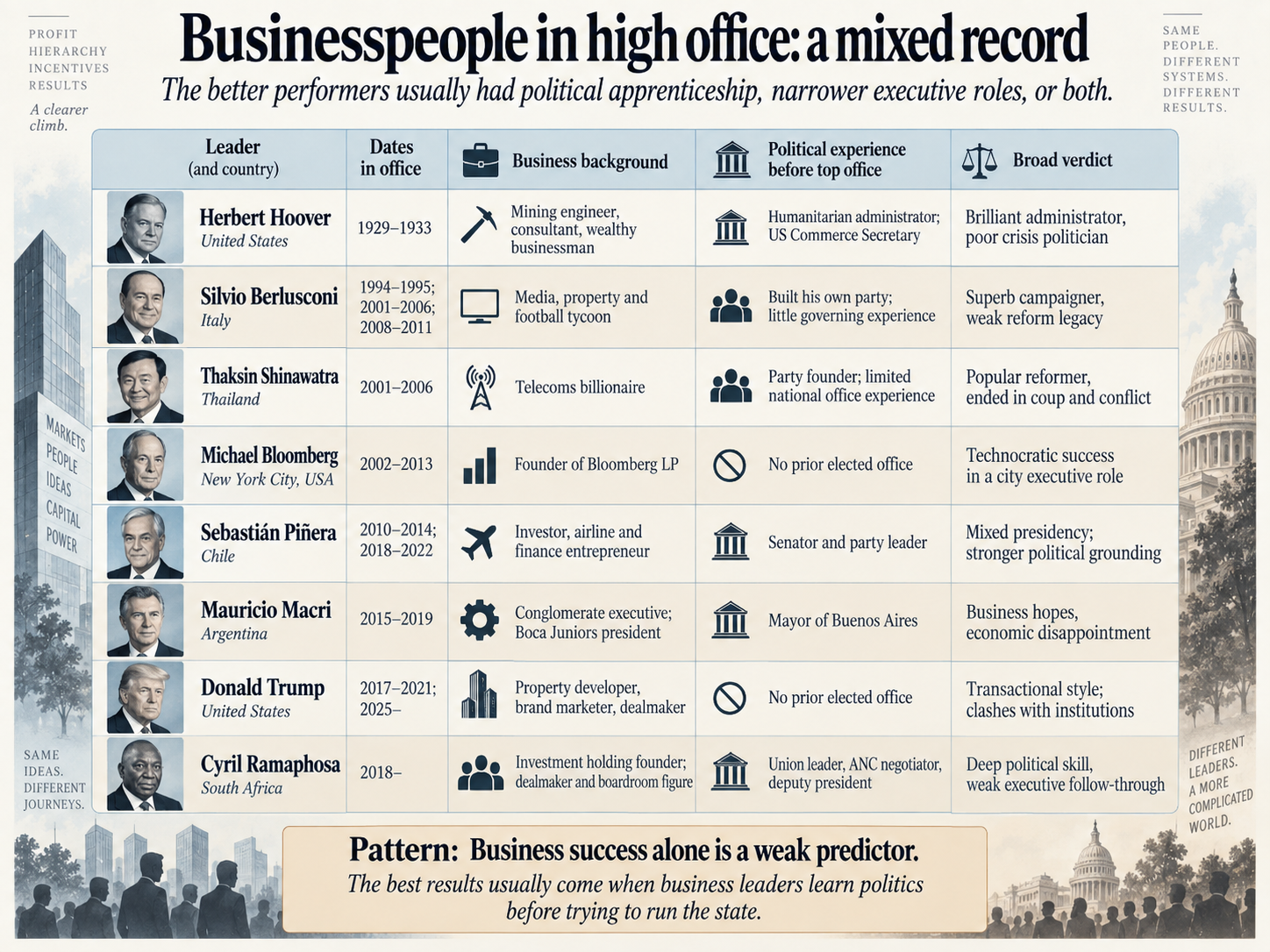
There is also a selection problem. When governments decide they need business expertise, they invariably recruit the chairman, the billionaire, or the chief executive whose photograph appears on the cover of the annual report. This may be exactly the wrong person.
By this stage, for the particular person concerned, material achievement is probably no longer in short supply. Money may be no longer particularly interesting. What remains available is legacy. And being motivated by legacy is not the same as being motivated by performance.
Perhaps governments should hire fewer captains of industry and more colonels of industry. If you want to fix the railway, the most useful person at Anglo American may not be the former CEO. It may be the woman three floors down who actually knows how to do SAP integration.
Robert McNamara remains the magnificent cautionary tale. He brought formidable analytical abilities from Ford into the Pentagon and revolutionised aspects of budgeting and procurement. Then the same confidence in systems, measurement, and managerial control was carried into Vietnam, where the problem inconveniently involved politics, nationalism, history, and human beings who declined to conform to the spreadsheet.
Donald Trump represents an especially interesting variation because he demonstrates that it's not just that successful businessmen are bad at politics in general, but it really matters precisely what kind of businessman is entering the political field.
Trump was not, in any meaningful sense, an industrialist. He was overwhelmingly a property developer, dealmaker, TV personality, and, eventually, a spectacularly successful marketer of the Trump brand.
Property gives you a particular view of economics, trade barely enters the daily picture, and interest rates enter it before breakfast.
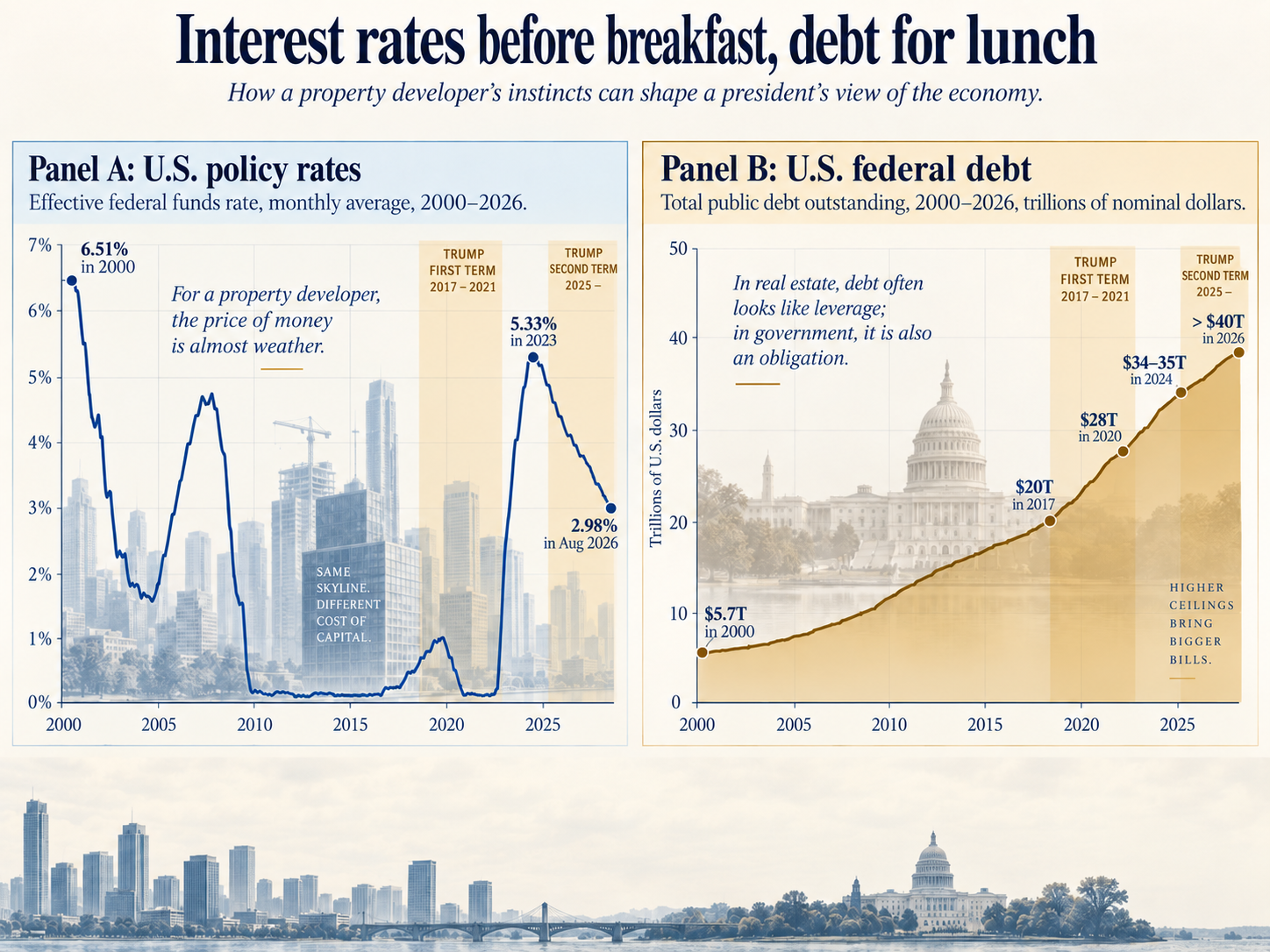
Debt is not primarily a national burden bequeathed to your grandchildren. It is leverage, or at least it can be. Trump's business career was repeatedly built around large amounts of borrowing, and people around his real-estate operation openly described the strategy as borrowing as much as possible for as long as possible.
Trump has described himself as the “king of debt”, (although he has also said explicitly that he would prefer the United States to have less national debt). But he is generally comfortable with debt, and he had better be because the US Federal Government now has $40-trillion of it. For the maths-challenged, that is $40,000,000,000,000. He and former President Joe Biden have doubled the national debt in 15 years.
The same background helps explain his extraordinary fixation with interest rates. For a heavily financed property business, the price of money is almost the weather. Even now, with US inflation again uncomfortable, Trump continues to press the Federal Reserve for lower rates.
His approach to trade is equally revealing. He certainly cares about trade; arguably nobody in modern American politics talks about it more. But he tends to conceive of it as a property man conceives of a transaction: someone is winning the deal and someone is losing it. A trade deficit looks suspiciously like evidence that the other fellow has negotiated better.
Hence tariffs look to him like potential leverage rather than a win-win transaction. In the process, allies can become not "friends" but counterparties. Canada can begin to resemble a difficult tenant not a historic partner and collaborator.
The problem is that international trade is a network, not a single transaction. Supply chains stretch across borders. A bilateral deficit tells you remarkably little about who has “won”.
Trump's business psychology compounds the problem. Business success produces justified confidence in a narrow field, which can then produce unjustified confidence about everything else. The entrepreneur who has spent decades being rewarded for ignoring experts can eventually reach the unfortunate conclusion that ignoring experts is itself expertise.
Cyril Ramaphosa is almost the reverse case.
He is commonly described as the businessman-president, although the description obscures more than it reveals. Ramaphosa was a union organiser, ANC secretary-general, and constitutional negotiator before he was a businessman. Politics made him before business did, and he entered business to take advantage of a political opportunity rather than a busines opportunity.
He did establish Shanduka in 2001, so it would be wrong to say he never started a business. But Shanduka was an investment holding company. Its expertise was assembling stakes in mining, financial services, telecoms, energy, property, beverages, and eventually McDonald's South African operations.
That is a very different commercial education from building Discovery, Capitec, or Takealot.
Ramaphosa's great business skill was more about allocation than invention. He was able to parlay his skills to negotiate participation, acquire ownership, structure transactions, and sit at the intersection of capital and South Africa's programme of black economic empowerment.
None of this was necessarily improper. But it does speak to the curious question about why Ramaphosa’s business acumen has not worked for him in politics. He has tried to create a bridge between government and business, and that has been one of his notable successes. He does value investment. But does he have and overall through-going philosophy of growth? I don't think so. If you look at it coldly, rather than creation of new products or services, he was effective at distribution (mostly, it must be said, to himself) and that has carried through into a distributive rather that creative government. And that has resulted in low GDP growth, huge cash distribution programs, and - like the US - exploding government debt.
Ramaphosa is superbly trained in discovering who needs to be in the room, what each participant requires and how ownership, influence, or policy can be distributed sufficiently widely to make an agreement possible. Those skills helped negotiate South Africa's Constitution and his enormous wealth. They are considerably less impressive when the bridge needs to be built by Thursday.
Hence the peculiar contrast between the two men. Trump sees a committee and wonders why nobody has been fired. Ramaphosa sees a committee and seems to believe that its mere existence is evidence that something is happening.
Trump's instinct is to overcome interests. Ramaphosa's is to accommodate them. Trump can mistake resistance for insubordination; Ramaphosa can mistake agreement for execution.
One has too much direction and insufficient balance. The other can produce so much balance that direction becomes difficult to detect.
Both illuminate the weakness in the old promise that government would improve enormously if only more businesspeople were allowed to run it.
Companies and countries are different human inventions. The company exists partly to concentrate authority. Democracy exists partly to disperse it. A good CEO has to get thousands of people moving in roughly the same direction. A good politician has to govern millions of people who have no intention of doing that.
Sadly, neither of the leaders has developed the self awareness to overcome and redefine their own personal histories and predilections. And we, the people, are the victims. 💥
From the department of perennial cheaters ...

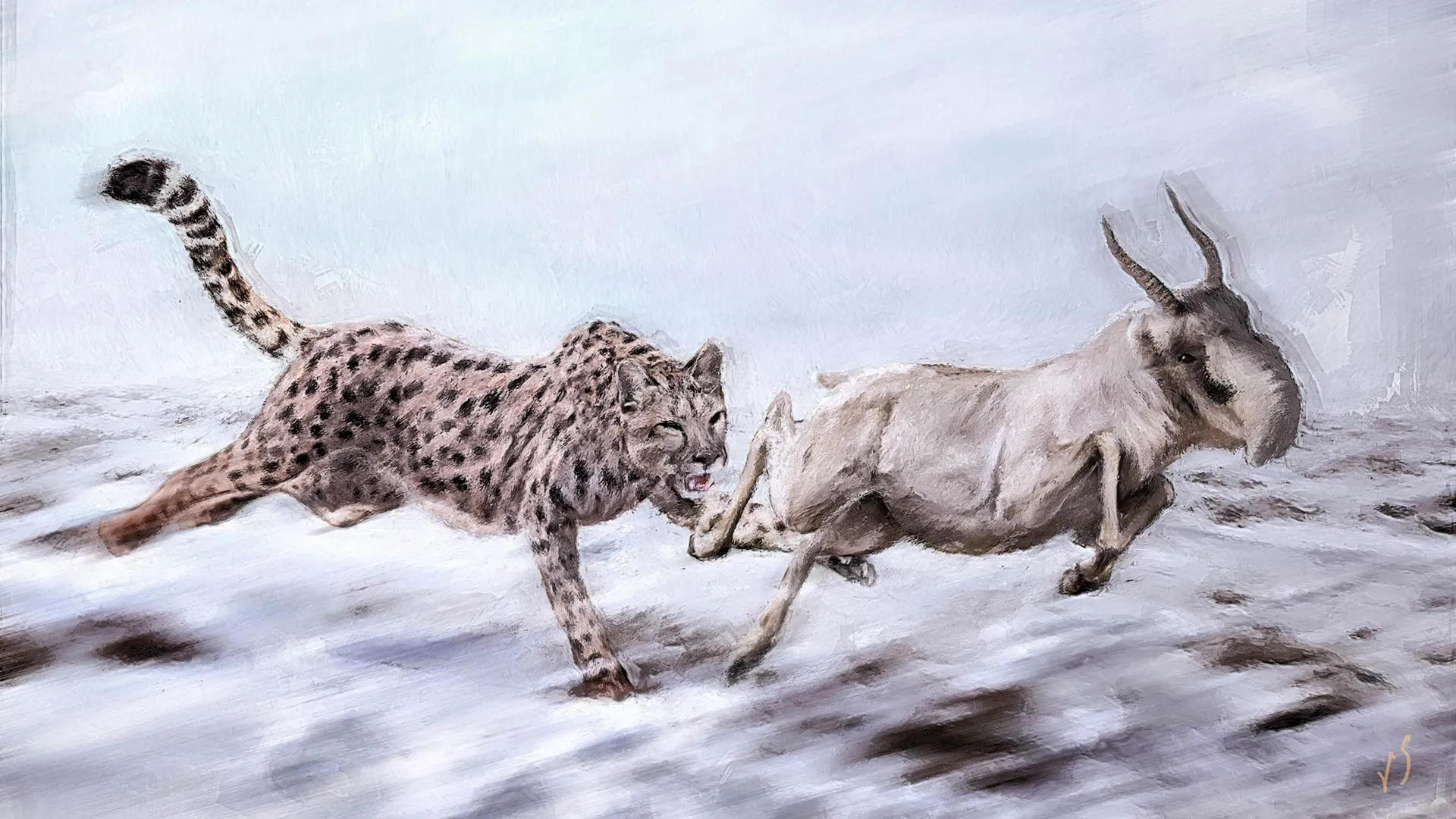
From the department of a delightful, confusing, salacious scientific drama ...
From the department of hoping it means Trump will lose interest in Greenland ...
 Anthony Ohemeng-Boamah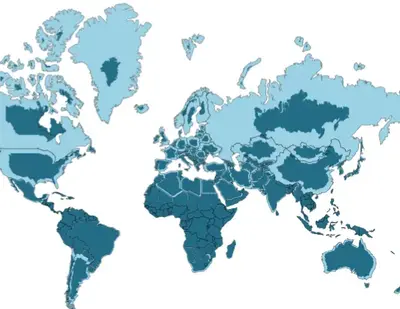
Thanks for reading - please share if you have a friend (or enemy!) you think would value this blog and ask them to add their email in the block below - it's free for the time being. If the sign-up link doesn't appear, you'll find it on the site. And my book - based on these columns - has just been published, get it here!
Till next time. 💥