Greed is such an odd thing. Most people think it is the understandable, if morally dubious, consequence of scarcity. You have nothing, so you are desperate to get more. Its obvious. But actually, more often than not, I suspect, it is the consequence of success, not failure. It's much more of a tailwind than a headwind.
In the classical era, Juvenal made the point very directly: “While your purse is full to bursting, your love of gain grows as much as the money itself has grown.”
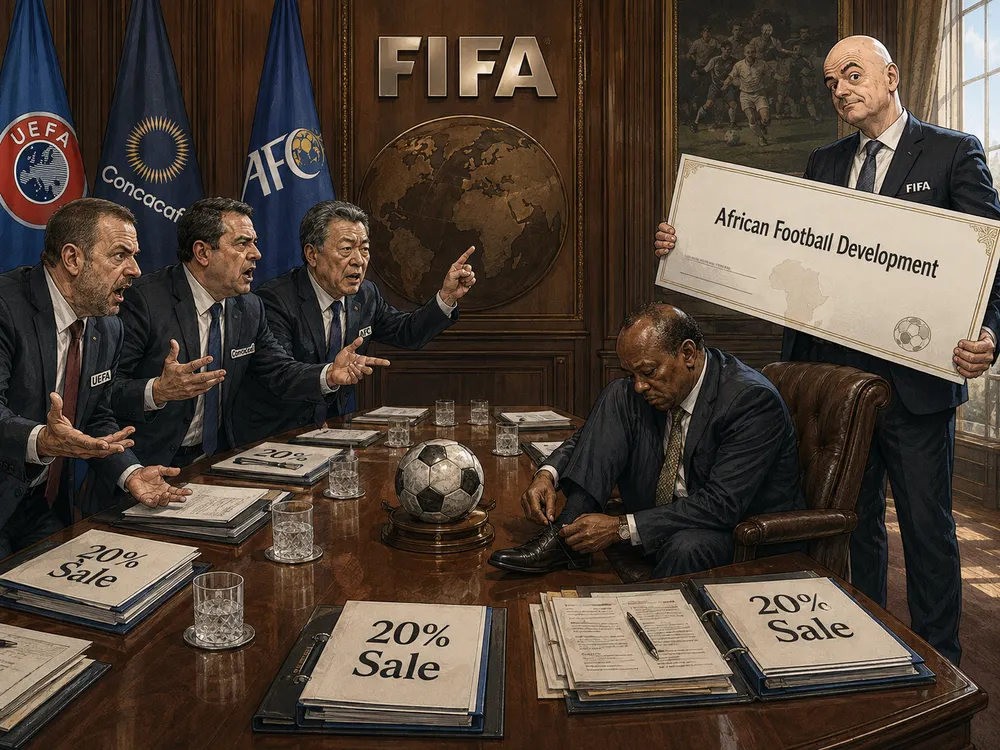
Few recent events demonstrate this so vividly as the now-scrapped plan to sell 20% of FIFA’s commercial business to private investors.
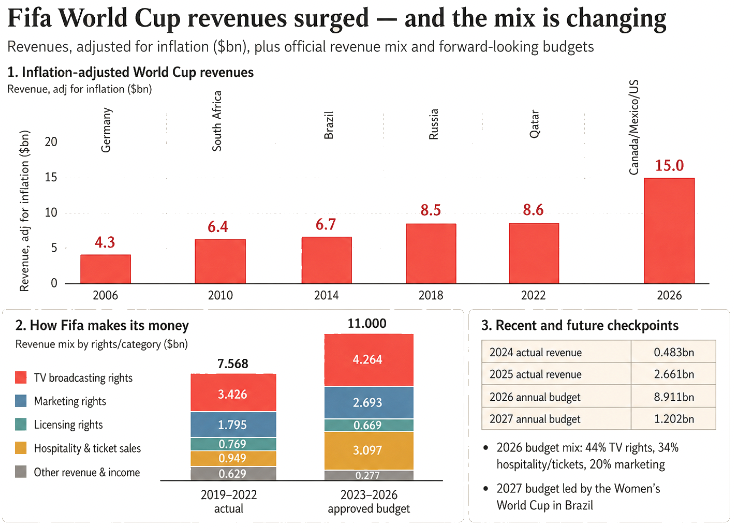
The proposal emerged shortly after the most lucrative World Cup in history. FIFA’s expected revenue for the 2023–2026 cycle is likely to exceed $15bn, almost double the $7.6bn generated in the cycle ending with Qatar 2022, and nearly six times the comparable figure for the cycle ending with Germany 2006.
All the innovations to the 2026 tournament, which I thought initially were bound to cause trouble, turned out to be pure genius. The decision to expand the tournament from 32 to 48 teams, and consequently from 64 matches to 104, led to fun upsets, and included a whole bunch of countries that might have missed out before.
The idea of stretching the tournament across the US, Canada and Mexico was not only inclusive, but it avoided the problem of countries having to spend enormous amounts on white-elephant stadiums. (Hello, South Africa). The idea of allowing free pricing of tickets in the secondary market did not dent attendance despite some astronomical sums paid; stadiums were almost completely full, and there was unprecedented worldwide engagement.
The three-minute “hydration breaks” in the 22nd and 67th minutes of every match, irrespective of whether the players were melting in the Mexican sun or playing beneath a roof in air-conditioned comfort, were a clever ruse. FIFA insisted the breaks were introduced for the players' welfare and competitive consistency, and that FIFA itself received no additional income from them because its commercial agreements had already been signed. But broadcasters, nevertheless, discovered that three minutes was a remarkably convenient period in which to sell advertisements.
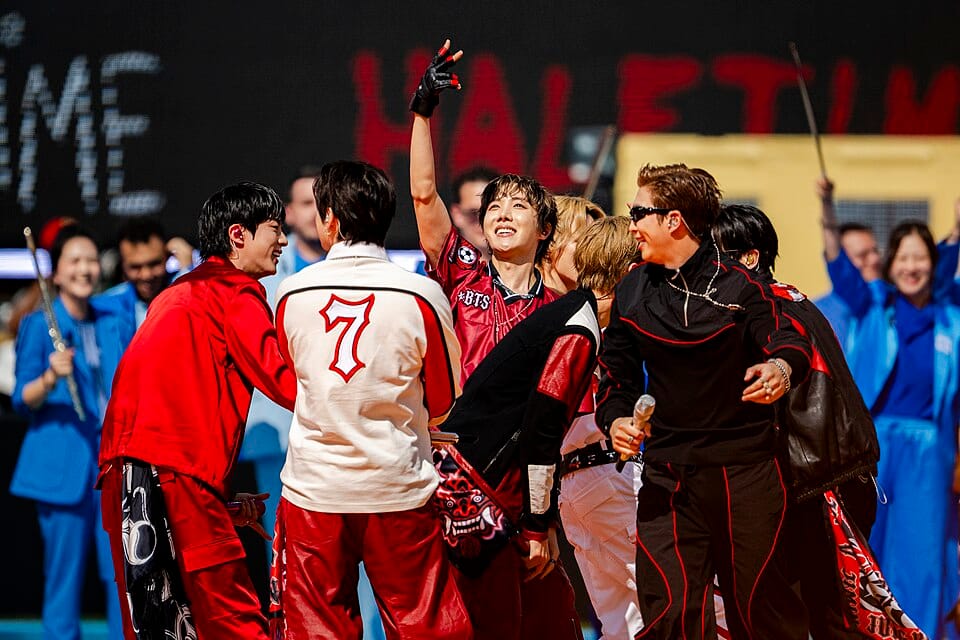
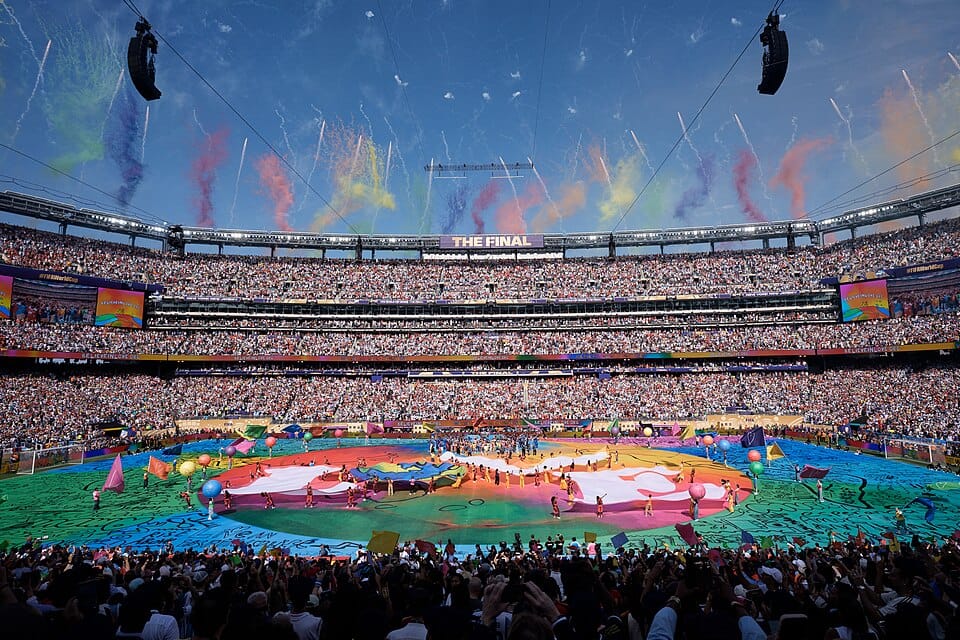
There was also, for the first time, a Super Bowl-style half-time show during the final. The traditional 15-minute interval expanded to half an hour, featuring Madonna, Shakira, BTS, and Justin Bieber because evidently, what the world’s most-watched sporting event had always lacked was Justin Bieber. FIFA presented the show partly as a charitable exercise supporting education. It was also another step in converting the World Cup from a football competition into an all-purpose global entertainment platform.
So then ... a little select core of FIFA’s leadership looked at an event generating more money than any football tournament had ever generated and concluded that something was being left on the table. Incredible, but apparently true.
FIFA's president, Gianni Infantino, called it “previously uncaptured commercial value”, which is just fabulous euphemistic corporate-speak for soaring greed. The trouble with uncaptured value is that it makes everything valuable look captured. The intended transaction could have raised about $4.2bn, with Joshua Kushner’s Thrive Eternal expected to lead the investor consortium. (Kushner is the brother of, yes, Jared Kushner, who is married to Ivanka Trump, US President Donald Trump’s daughter). FIFA would retain majority control, but investors would acquire a long-term claim on income generated by the World Cup and other FIFA competitions.
This was not, strictly speaking, the privatisation of FIFA, but would have been a step down that road. FIFA would still govern the sport, write the rules, and control the competitions. The investors would own a minority of the commercial company.
This is a distinction with a whiff of lawyerly air freshener about it. The World Cup is valuable because people care about the football. Once investors own part of its commercial machinery, they do not need to select referees or rewrite the offside rule to exert influence. They need only insist, quite reasonably from their perspective, that revenue must grow.
There is a more-or-less respectable argument in favour of the deal. Football’s enormous wealth is concentrated in a small number of European clubs, leagues, and broadcasters. Many of FIFA’s 211 national associations are poor. They lack pitches, academies, training centres, women’s leagues, and youth structures.
Under Infantino’s proposal, participating associations would have received an enormous immediate payout, with annual FIFA distributions also rising substantially - one of the reasons the Confederation of African Football has been the only major body not to oppose the deal.
Infantino’s defenders could also reasonably argue that FIFA’s commercial assets have been managed conservatively. A specialist commercial company might sell media rights more effectively, develop digital products, and diversify FIFA’s income. Selling a minority stake would transfer some future commercial risk to investors while making billions available for development immediately.
There is no public proof that Infantino would personally have received shares, a transaction fee, or a percentage of the money raised. Reports that he might eventually occupy a highly paid position in the commercial enterprise were denied by FIFA. The personal-greed case remains suggestive rather than established.
But the institutional-greed case is overwhelming.
FIFA does not need rescuing. It has billions in resources, no obvious debt crisis and a tournament that had just exceeded almost every commercial expectation. One of Infantino’s own senior advisers resigned, pointing out that FIFA already possessed the financial capacity to increase development spending without surrendering part of its future income.
The plan involved selling tomorrow’s earnings to produce a vast pot of money today. The people voting on the scheme - the national associations - would themselves receive part of that pot, always a bit of a red flag.
Some of the problem lies in the peculiar structure of FIFA. Its 211 member associations each enjoy a single vote. Brazil gets one. Germany gets one. And Montserrat gets one.
The FIFA president is elected by these associations, which makes the presidents of small national federations collectively more important to Infantino’s survival than the owners of Manchester United, Bayern Munich and Real Madrid.
Between congresses, the main decision-making body is the 37-member FIFA Council, comprising the president, eight vice-presidents and 28 other members elected through the confederations. Patrice Motsepe, as president of the Confederation of African Football, is one of FIFA’s vice-presidents and sits on the Council.
The arrangement is democratic in a peculiar United Nations sort of way. But it creates a built-in temptation. FIFA generates money centrally and distributes it to the associations whose officials elect the FIFA president. The president can therefore present himself simultaneously as chief executive, benefactor and candidate.
That reticence becomes less mysterious when one remembers that, only three months earlier, all 54 CAF associations had unanimously endorsed Infantino for re-election in 2027. FIFA says it has invested more than $1bn in African football since Infantino came to office. Africa is both a genuine beneficiary of FIFA development spending and a crucial component of Infantino’s electoral coalition.
The deeper question is why did Infantino get himself into this position? The simplest answer is greed. But greed is seldom simple.
Infantino's commercial instinct has been fabulously rewarded, and the embarrassment of providing US president Donald Trump with the bogus peace award has been subsumed by that success. But the way the event transpired illustrates what management theorists sometimes call the success trap.
The trap is best described as when a person stops distinguishing between a good outcome and a good decision. Since the immediate past risk succeeded, risk itself starts to look like wisdom. Since critics were wrong before, criticism becomes proof that one is right.
Infantino himself boasted during the tournament that FIFA had “silenced all the critics,” with justification. His previous decisions had worked; therefore the next one would work. Success did not satisfy Infantino’s appetite. It certified it.
This is where greed and confirmation bias meet. The most dangerous greedy people are seldom those who know they are greedy. They are the ones who believe their appetite is a public service.
The plan finally failed because Infantino overlooked a distinction that successful people often overlook: the difference between something that can be sold and something that should be sold.
Football has survived his previous commercial experiments. He seems to have interpreted this resilience as permission. But the ability of a great institution to withstand indignity is not an invitation to impose more of it.
Once money becomes the measure of success, enough begins to look like failure. 💥
I should make an acknowledgement about some of these columns: I find myself using AI more and more. You can see it in today's piece because shockingly, I don’t have all of Juvenal in my head after studying Latin for only a single year...
When I do use AI, I usually start with an idea - in this case, it was examining greed through the lens of FIFA's proposed agreement. Then I ask AI a series of questions, one of which is normally who said what about the topic, hence the Juvenal quote above. And you know, answers are often very useful and stimulating, generating a whole new set of other ideas.
But sometimes they are very bad IMHO; I find AI kinda sludgy. But, interestingly you can ask it to argue both sides of an issue, as I did in this case, asking what was both good and bad about the FIFA proposal, which is a really useful tool. Normally, you can't do that in an interview, because the interviewee will have their own singular point of view.
What I find AI is very bad at is actually writing an article based on a suggestion. It ends up a mess. But it's good at finding details and making sure you remember all aspects of a topic; it's like Google on steroids. And, it's very good at fact checking an article you wrote. When you give AI something to chew on, it does it with vigour. I mostly use ChatGPT and Claude, and often have fun getting them to check each other. But the idea, the crafting of the story, the conclusion I draw and the frequency with which I find myself typing, "I am not making this up," is all me.
Anyway, so long as you know. I do think that in future, the differentiator in researching and writing, as with everything else, might not be whether you use AI or not but how well you use it, so best we get on that bicycle. But let me know if you think AI is taking over and degrading rather than bolstering these contributions.
From the department of what comes around, goes around...
 Francisco Rodrigues
From the department of putting the "no" into Nobel ...
 Mariella Moon
From the department of the totally typical and sadly inevitable ...
 Guardian staff reporter
Thanks for reading - please share if you have a friend (or enemy!) you think would value this blog and ask them to add their email in the block below - it's free for the time being. If the sign-up link doesn't appear, you'll find it on the site.
Till next time. 💥