Oh boy. The Israeli/Palestinian conflict. Where do you even start? Mountains have been written on the subject, and it’s so complicated that like other very complicated topics it’s possible to have two contradictory but simultaneously correct views. It’s a conflict so fraught that sensible people keep away from it (hello, Ed Sheeran) ... so obviously I'm going to jump right in. I hate fence sitters (hello, Ed Sheeran - again). And IMHO, in essence, its actually not as complicated as its often made out if you exclude the mountains of propaganda and bumf.
For most of my life, my sympathies in the eternal Israeli-Palestinian conflict have largely been with the Palestinians, with big caveats. I still think there are compelling historical reasons for those sympathies, but the events of 7 October 2023 changed my understanding of the conflict, perhaps more profoundly than anything else in its modern history.
After the Second World War, and the almost unimaginable catastrophe of the Holocaust, the Jewish people surely deserved a patch of land to call their own, somewhere they could live without relying on the occasional tolerance of their neighbours. But the awkward difficulty was that the land wasn't empty. The creation of Israel therefore carried an enormous moral responsibility towards the Palestinians already living there.
(I should make it clear I am not Jewish, although obviously I have Jewish heritage given my name, but its long past. I have visited both Israel and Palestine. I have been to Auschwitz and Birkenau).
Israel has frequently failed that responsibility. Visiting Palestine was an eyeopener in the casual horribleness of the Israel population toward even their own Muslim citizens. I think the comparison with Apartheid is basically specious, but boy there are some shocking parallels; it so reminds me of the casual racism of white South Africans back in the day who weren't really even conscious of their racism it was so deeply entrenched. Israel's continuing expansion of settlements in the West Bank, often at the expense of Palestinian communities, is particularly difficult to defend. It is hard to argue that you want peace while steadily appropriating the land on which the other party might eventually establish a country. They have boxed up the Palestinians into such tight spaces, it's hardly a surprise the radicalisation is intensifying.
But 7 October changed something fundamental for me. The deliberate killing of civilians, the taking of hostages, and the sheer savagery of the assault revealed a dimension of Hamas's strategy that deserves far more attention than it generally receives.
What exactly is Hamas trying to achieve? It is a question surprisingly seldom asked with any seriousness.
Having lived through South Africa's liberation struggle, I think I recognise part of the answer. The South African political scientist Tom Lodge wrote an influential 1983 study of the ANC's armed struggle entitled The African National Congress in South Africa, 1976–1983: Guerrilla War and Armed Propaganda.
The concept of armed propaganda is worth understanding. An underground liberation movement, incapable of defeating a vastly more powerful state militarily, uses acts of violence to achieve political effects far greater than their military significance. Attacking a strategic installation demonstrates that the supposedly invincible government is vulnerable. It inspires supporters, attracts recruits, provokes a state response, and forces people who might otherwise prefer to remain uninvolved to choose sides. Radical organisations have used this strategy since time immemorial.
The ANC understood this very well. Umkhonto we Sizwe's attacks on installations such as Sasol, Koeberg, and military headquarters were intended to demonstrate the movement's capacity to strike the apartheid state, while mobilising political support. Every important military action had a political audience.
There are obvious similarities with the strategy of Palestinian armed movements. When military victory is impossible, international opinion becomes an alternative battlefield. The spectacle of violence, the government's response, and the resulting international coverage become integral to the campaign.
But here the similarities become increasingly uncomfortable. One of the problems with armed proparganda as a strategy is that you have to deal with your own; your propaganda fails if your own notional supporters contradict your pitch, so outsiders have to be put down brutally in necessary.
Hamas is a brutal, authoritarian organisation whose record cannot remotely be confused with that of a democratic liberation movement. You can read small mountains of journalism on the subject in South African and all over the world that don't even mention this. The distinction is not that the ANC never committed atrocities. It did, and some of them were appalling. The distinction is the political objective and the extent of the systematic use of violence against its own civilians.
Hamas deliberately attacked Israeli civilians long before October 2023. Human Rights Watch documented its suicide bombings against buses, restaurants, and other civilian targets during the 1990s and the Second Intifada. The change on 7 October was therefore one of scale, coordination and extraordinary brutality, rather than the discovery of an entirely new method.
Its treatment of Palestinians themselves is scarcely more encouraging. During the 2007 conflict with Fatah, Hamas fighters executed political opponents. During the 2014 Gaza war, Amnesty International documented the abduction, torture and summary execution of at least 23 Palestinians, many accused of collaborating with Israel. The best-documented recent incident is the 13 October 2025 public execution of eight members of the Dughmush family in Gaza City. Amnesty's August 2026 investigation established that the men were blindfolded and shackled.
Even Palestinians who protest against Hamas's rule have faced intimidation and violence. These are the people Hamas claims to represent. One suspects they have a somewhat different understanding of the word liberation.
This history makes the propaganda dimension of the 7 October attacks important. Hamas could hardly have expected to defeat Israel militarily. It could, however, have anticipated a devastating Israeli response, enormous Palestinian suffering, and a transformation of international opinion. Whether its leaders intended every consequence is impossible to know, but the political benefits of turning global attention towards Israel's conduct were entirely foreseeable.
Of course, this does not absolve Israel of responsibility for what followed. The destruction of Gaza has been staggering. In a sense, I feel the actual perpetrators of October 7 were baiting Israel, and given the current political balance in Israel they took the bait with gusto. More than 74,000 Palestinians have been recorded as killed since October 2023, approximately one in 30 of the pre-war population. Vast areas have been reduced to rubble, and millions have endured displacement, deprivation, and fear.
Israel's military conduct deserves the most rigorous scrutiny. But it is equally important to recognise that Palestinian suffering can be entirely real while Hamas seeks to exploit that suffering politically. Both propositions can be true, inconvenient though that may be for those who prefer conflicts divided into neatly labelled moral compartments.
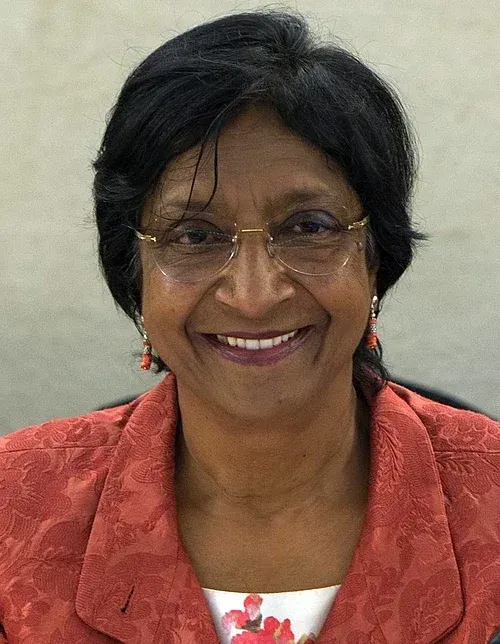
Which brings me to Navi Pillay.
I do have respect for her personal achievements. She overcame extraordinary obstacles as an Indian South African woman under apartheid, defended political prisoners, became a pioneering judge, and helped establish important principles of international criminal law. Her contribution to the Rwandan genocide tribunal, particularly the recognition that rape could constitute genocide, was genuinely historic.
I am also delighted whenever another South African wins a Nobel Prize. We have accumulated a remarkable collection, particularly in the Peace Prize category, although our domestic record of achieving peace sometimes suggests that exporting the talent has been more successful than retaining it.
But Pillay also comes from a particular political tradition, and as her fellow countryman, I absolutely recognise the type. As a university student, she joined the Non-European Unity Movement, whose intellectual origins lay partly in South African Trotskyism. The movement was fiercely anti-colonial, suspicious of capitalist power, and critical even of the ANC's approach to liberation as overly nationalist.
I would not describe Pillay as anything close to that today - like so many leftists of that era she has changed her position dramatically. Her later economic views are much closer to social democracy; in an April 2013 speech at Wits University, Pillay said:
"Globalization of the market economy can have a positive impact on human rights."
But the characteristic of these human rights warriors, who are very, very evident on X, is not so much socialism per se, but just a kind of ignorance about economics. Its just not part of their lexicon. Their default position on almost all social problems tends to be that the State should fix it. But as we are learning to our cost in South Africa, state involvement is too often synonymous with a worse long term outcome, not an improvement.
But with Pillay, the continuity in her anti-colonial understanding of international politics is very evident, especially in the way she approaches Israel and Palestine.
There is nothing inherently improper about this. Lots of my friends hold these views, and good on them. Everybody has a political history and a political approach. Judges do not arrive in court having emerged from a politically sterile laboratory.
But South Africa has also produced a particular kind of human-rights advocate whose certainty about the righteousness of their cause can be quite astonishing. Having once been on the right side of an enormous moral struggle, some appear to conclude that they must therefore be on the right side of every subsequent comparible argument. Disagreement becomes evidence of moral inadequacy rather than an invitation to debate. Their moral compass is so firmly calibrated that occasionally one wonders whether it is capable of detecting North.
Just to take one example, an episode recently recalled by former Danish foreign minister Per Stig Møller provides an intriguing example of the danger.
In an interview with Berlingske following Pillay's Nobel announcement, Møller described Denmark's attempts to secure international support after the 2008 bombing of its embassy in Pakistan, amid the controversy surrounding Danish newspaper cartoons of the Prophet Muhammad.
According to Møller, Pillay, then the UN High Commissioner for Human Rights, was brutally unhelpful and suggested that Denmark introduce censorship to prevent further incidents.
This is Møller's retrospective account, not an independently established transcript of the conversation, and Pillay should have an opportunity to respond. Nevertheless, if accurately recalled, it is a troubling response from someone charged with defending universal freedoms. A threat to freedom of expression would have effectively, in turn, been met by restricting freedom of expression. The arsonists would have effectively acquired editorial control of the newspaper. Pillay appears, on Møller's account, to have been more concerned with the offence caused by the cartoons than with the principle that newspapers should be free to publish them. For a human-rights commissioner, that is an extraordinary ordering of priorities.
More directly relevant to Gaza is Pillay's support for a June 2020 statement by the South African BDS Coalition, which called for sanctions against Israel and described its treatment of Palestinians in explicitly colonial and apartheid terms.
Then, just a year later in July 2021, she was appointed to chair the UN's Independent International Commission of Inquiry on Israel and the occupied Palestinian territories.
There is no evidence that Hamas or Fatah personally selected her. The appointment was made by the president of the UN Human Rights Council. But Palestinian organisations have long understood the importance of international institutions and the particular moral authority of South Africa's anti-apartheid history. Having prominent anti-apartheid figures endorse the Palestinian cause is an obvious diplomatic advantage.
The question is whether someone who had already publicly advocated sanctions against Israel was an appropriate choice to lead an investigation into its conduct.
Pillay would argue that a history of advocacy does not disqualify an experienced jurist from conducting an independent inquiry. That is true. But impartiality has two dimensions: actually being impartial and giving reasonable observers confidence that you are impartial. A judge who has signed a petition against one of the parties ought at least to understand why the other party might have reservations.
The commission's September 2025 report concluded that Israel was committing genocide against Palestinians in Gaza. It relied on the enormous number of deaths, destruction of infrastructure, restrictions on food and medical supplies, displacement, and statements by senior Israeli officials.
These are extremely serious allegations supported by substantial evidence. The case cannot be dismissed simply by pointing to Israel's legitimate objective of defeating Hamas. Indeed, there are grave questions about whether Israeli military operations have complied with the laws of war.
But genocide has a particularly demanding legal definition. It requires the specific intention to destroy a national, ethnic, racial or religious group, in whole or in part.
Civilian deaths, even on a catastrophic scale, do not automatically establish that intention. The legal question is whether the destruction of Palestinians as a people was intended, rather than the destruction of Hamas through military methods that may themselves have been unlawful.
Pillay's commission concluded that genocidal intent was the only reasonable inference from Israel's conduct and the statements of its leaders. Israel disputes this, pointing to its military objectives, evacuation instructions and measures to facilitate humanitarian assistance.
The commission had to evaluate those explanations against the evidence. Its finding may ultimately be vindicated, but it is an investigative conclusion reached under a reasonable-grounds standard. It is not a conviction after an adversarial trial, nor has the International Court of Justice yet delivered a final judgment in South Africa's case.
And then there is the extraordinary question of Hamas.
Pillay's commission did investigate the 7 October atrocities and concluded that Hamas and other Palestinian armed groups committed war crimes, including deliberate attacks on civilians, murder, torture, and hostage-taking. It therefore cannot fairly be accused of ignoring the attack.
But its subsequent genocide report did not investigate whether Hamas had committed genocide against Israelis. Given that the difference between "war crimes" and "genocide" is the underlying intention, it should technically be easier to draw this conclusion from the evidence, since supporters and leaders of Hamas often express themselves on the subject rather categorically. Why did they not investigate this? Surely this is straightforward bias?
The commission explained that the report was confined to Israel's state responsibility under the Genocide Convention, partly because South Africa had already instituted proceedings at the International Court of Justice. It explicitly reserved the possibility of investigating the 7 October attacks for genocide in the future.
That is a procedural explanation. But is it a satisfactory moral or investigative explanation?
Hamas's original charter contained explicitly antisemitic language. Its record includes decades of deliberate attacks on Israeli civilians. On 7 October, its fighters deliberately attacked Israeli communities and killed people because they were Israelis, many of them Jews.
An investigation of genocidal intent would therefore have had substantial evidence to consider, including ideological declarations, operational planning, and the targeting of civilians.
It would not necessarily have established genocide. The legal requirement of an intention to destroy a protected group, in whole or in substantial part, still applies. But why was the question not subjected to the same sustained examination?
There is something deeply unsatisfactory about an international inquiry confidently pronouncing on the ultimate international crime by one participant in a conflict while reserving judgment on whether the other participant's deliberately planned massacre might fall into the same category.
The commission's justification may be legally defensible. It is much less persuasive as a demonstration of even-handed investigative priorities.
And now the Norwegian Nobel Committee has awarded Pillay the 2026 Peace Prize.
The committee's formal justification is her lifetime contribution to international justice, not specifically the Gaza report. That distinction is important. Her achievements in Rwanda and international criminal law are considerable, and nobody should pretend otherwise.
But the committee explicitly referred to her chairmanship of the Palestinian inquiry. Given the international controversy surrounding that investigation, it is impossible to regard the timing of the award as politically neutral.
The Wall Street Journal editorial board has taken an altogether less charitable view. In an editorial headlined A Nobel Prize for Hating Israel, it declares: "The last thing the award to Navi Pillay will do is promote the cause of peace."
The paper's criticism goes considerably further, portraying her career as dominated by hostility towards Israel and its supporters. I think that is too sweeping. Pillay's achievements in South Africa and Rwanda cannot simply be dismissed, nor should criticism of Israeli government policy automatically be confused with hostility towards Jews.
But the Journal raises a question the Nobel Committee seems not to have taken seriously enough: what exactly does this award accomplish?
The committee declares that peace requires justice. Of course it does. But justice requires more than confidence in the righteousness of one's position. It requires consistency, impartiality, and a willingness to subject one's own conclusions to the same scrutiny imposed on everybody else.
There is a distinction here that deserves particular emphasis. I am not suggesting that Pillay knowingly participated in Hamas's propaganda strategy. There is no evidence that she did. I am suggesting that the Nobel Committee may have failed to appreciate how its award could be exploited by that strategy.
An organisation engaged in armed propaganda does not need to recruit every sympathetic journalist, academic, human-rights campaigner, or international institution into a conspiracy. It needs their attention, their influence and, wherever possible, their moral authority. Those people may be acting entirely independently, even conscientiously, while their conclusions are used for political purposes they neither intend nor endorse.
Indeed, that is what makes propaganda such an effective instrument. Its greatest achievement is persuading other people to carry its messages voluntarily.
The Nobel Committee has now conferred one of the world's most prestigious moral endorsements on a jurist whose recent and highly contentious investigation has become central to the international campaign against Israel. The award does not formally endorse every finding she made, but that distinction is likely to disappear rather quickly in the political battle over its meaning.
Hamas and other Palestinian organisations have every reason to welcome it. The Nobel Committee should have understood that reaction was foreseeable.
The danger is that international moral condemnation of Israel becomes an objective independent of the practical business of negotiating peace, protecting civilians, ending occupation, and ensuring that Hamas can no longer launch attacks against Israeli communities.
There is no contradiction in demanding that Israel respect Palestinian rights while insisting that Hamas's violence and repression must end. Indeed, a durable peace is difficult to imagine without both.
The Nobel Committee apparently believes that Pillay's contribution to international justice will help bring that peace about. I fear it may have accomplished the precise opposite: reinforcing a propaganda conflict at precisely the moment when intellectual independence, compromise, and a genuinely universal application of legal principles are most desperately needed.
I suspect the award has an additional attraction: its a kind of getting even exercise against US president Donald Trump, intended to humiliate him by awarding the prize he most wants to his nemesis. I have no idea if this is true or not, but its not hard to reach that conclusion, expecially if you read the reaction. But if that's the case, its low and unworthy.
Pillay deserves enormous credit for much of her life's work. South Africa has every reason to celebrate her achievements. I'm speculating here, but I think Pillay sees Palestinian issue through a South African lens: Hamas may be brutal, as the ANC once was during its liberation campaign, but the righteousness of its cause overrides the objection to its methods is here logic. Possibly. But the point is that Peace Prize is not a lifetime-achievement award for distinguished lawyers. It is supposed to advance the cause of peace.
I respect Navi Pillay. I can see why the committee admires her. I nevertheless think it has made a mistake.💥
From the department of Covid is finally over, and that took a while ...
 mediainquirieswho.int
From the department, literally, of has-beens ...
 Ofentse Donald Davhie
From the department of really sad ...
 Nick Clark
Thanks for reading - please share if you have a friend (or enemy!) you think would value this blog and ask them to add their email in the block below - it's free for the time being. If the sign-up link doesn't appear, you'll find it on the site. And my book - based on these columns - has just been published, get it here!
By all means respond in the space below or email me directly.
Till next time. 💥