This year's Nobel Prize in Economics was awarded to two American economists, Robert Hall of Stanford University and Michael Woodford of Columbia University, for what the Nobel committee described as their contributions to the “microeconomic foundations of macroeconomic stabilisation”.
That's a elaborate way of saying they helped explain how governments and central banks can smooth out the economic roller coaster by understanding how ordinary people and businesses respond to changing circumstances. This is a particularly interesting prize to award at a moment when the world's governments seem unusually determined to discover how much instability economies can endure.
And given the high level of global debt, you can see how this facility might become very important very quickly in the near future. There is lots about the two winners to discuss, but I would like to focus on just one aspect of Woodford’s work and that is his approach to credibility and communication because it's a hot topic at the moment. I know, weird.
I’m not an economist, but I am a communicator (of sorts), so obviously I find the subject intriguing. I’ve also listened to a lot of central bankers and politicians over the years, and if we are just being frank here, I don’t think humanity has gained very much from all those words. Just saying. Communication is so vital but it's hard not to notice that most of the world's divorces probably began with somebody saying, "We need to talk."
A key to stabilisation is the notion of “forward guidance”, or the practice of central banks telling financial markets, businesses, and consumers what they expect to do with interest rates in the future in order to influence economic behaviour today. The idea is that expectations about future interest rates can be almost as influential as interest rates themselves.
But his notion is subtle because generally the argument is not only for more explicit communication but also for more credible communication. A good example of what Woodford was advocating was spelt out in his 2012 Jackson Hole paper, in which he commented, “The most effective form of forward guidance involves advance commitment to definite criteria for future policy decisions.” The comments helped encourage tactics like inflation targeting, granting central banks more independence, and the provision of specific metrics against which central banks model their decisions. Stuff really changed.
But - and this is the weird part - the great irony of Woodford's Nobel is that the world’s most powerful central banker is now having second thoughts about precisely how much they should say.
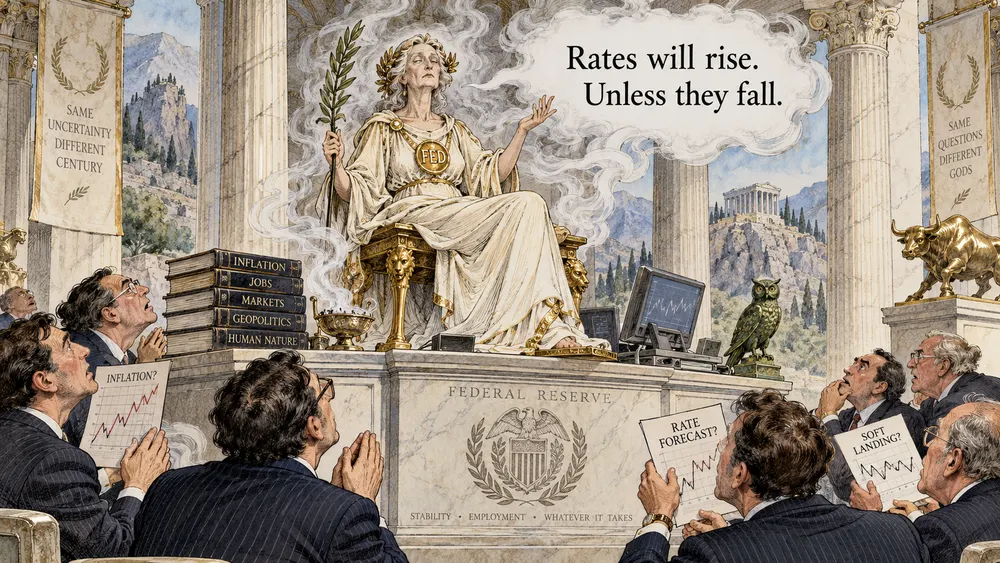
Kevin Warsh, the new chairman of the US Federal Reserve, thinks central bankers have become much too talkative. Warsh is especially critical of forward guidance.
He believes the practice has gone from being a valuable emergency instrument to something approaching an institutional addiction. Warsh calls this the "hall of mirrors" problem. Everybody is watching everybody else, and nobody is quite sure what's happening outside.
Over longer history, central bankers have discovered that words can sometimes do the work of interest rates. Unfortunately, they have also discovered that words, unlike interest rates, can acquire meanings their authors never intended.
One good example took place in Australia in 2021 when the Reserve Bank of Australia repeatedly suggested interest rates were unlikely to rise before 2024. They began rising in May 2022.
The bank explained that it hadn't actually promised low rates until 2024. It had merely forecast that conditions for raising rates were unlikely to materialise before then. The distinction was no doubt perfectly clear to the economists responsible. To Australian homebuyers who had taken out large mortgages, it was rather like one of those divorceing spouses explaining that when they promised to love you forever, they were merely communicating their baseline expectation.
For most people, making a promise and then breaking it is embarrassing. For economists, it presents an opportunity to explain the distinction between conditional forecasts and unconditional commitments. Juuuust kidding.
This dilemma has a distinguished history. Indeed, one of its greatest practitioners was Alan Greenspan, the legendary Fed chairman who turned the normally undesirable characteristic of being impossible to understand into something approaching a professional qualification.
In 1987, Greenspan famously remarked that he had learned to "mumble with great incoherence", adding: "If I seem unduly clear to you, you must have misunderstood what I said." For most people, being told that nobody understands what you are saying is a signal to improve your communication skills. For Greenspan, it was practically a performance appraisal.
Seriously, economists distinguish between two types of forward guidance, which they call Delphic and Odyssean.
Delphic guidance takes its name from the Oracle of Delphi, whose predictions were sufficiently ambiguous to accommodate an impressive variety of eventual outcomes. Delphic guidance is essentially a forecast. The central bank tells you what it expects will happen.
Odyssean guidance, by contrast, is a commitment. Odysseus, anticipating the temptation of the Sirens' song, instructed his sailors to tie him to the mast and refuse to release him, however vigorously he protested. This is broadly Woodford's idea. Promises about future policy become more credible when central banks somehow constrain their ability to break them.
Economists call this time consistency. In ordinary life, it is called asking a friend to hide the whisky.
The difficulty is that Odysseus knew precisely what temptation awaited him. Central bankers have to contend with events they haven't anticipated, which makes tying themselves to the mast rather less attractive.
There is another good reason why they should be modest about their forecasting abilities: the history of economics is hardly an uninterrupted procession of accurate predictions.
After the Great Depression, Keynesian economics emphasised the ability of governments to manage economic demand. Then came the stagflation of the 1970s, which proved you could not explain using the prevailing models. Stagflation is when high inflation occurs alongside stagnant or weak economic growth and rising unemployment. In South Africa, we are familiar with the concept.
Out of this period developed tactics to combat stagflation, and amoung them were inflation targeting, independent central banks and more sophisticated monetary models. It worked and helped produce what economists rather immodestly christened the Great Moderation.
The statistics were genuinely remarkable.
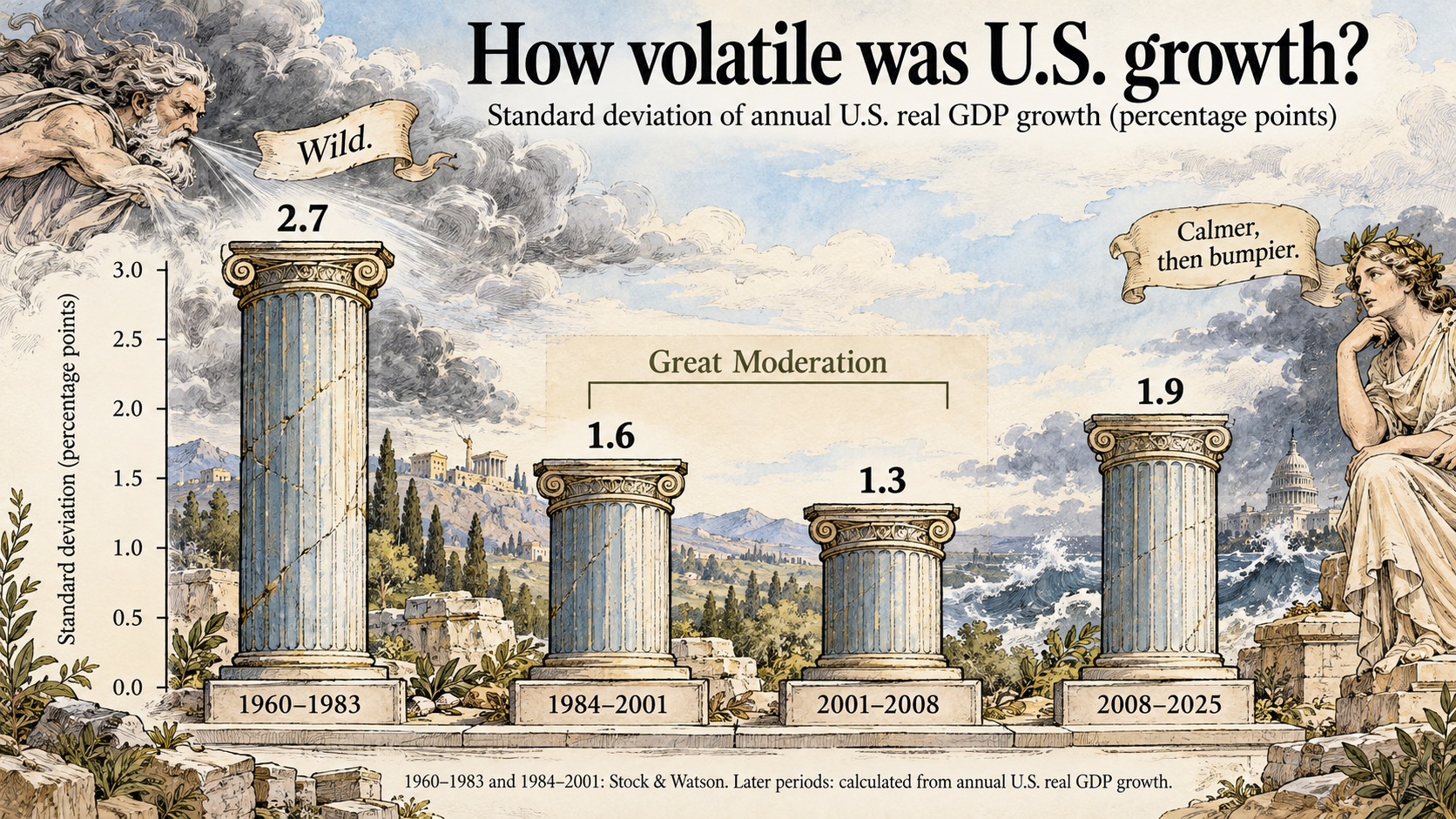
According to economists James Stock and Mark Watson, the standard deviation of annual American GDP growth declined from 2.7 percentage points during 1960–1983 to 1.6 points during 1984–2001. Economic growth had become about 41% less volatile.
Something similar occurred across much of the developed world.
But was this actually because economists had finally learned how to manage the business cycle?
Partly. The interesting thing is that Stock and Watson estimated that better economic policy explained around 20%–30% of the reduction. Favourable economic shocks and other varieties of good luck accounted for much of the rest.
Hence, after decades of increasingly sophisticated economic research, the profession discovered that a considerable part of its success was attributable to circumstances being unexpectedly agreeable. In a sense, the finding provides support for both Warsh’s approach and Woodford’s.
But then came the global financial crisis of 2008, followed by the pandemic and the inflationary surge of 2021–2022. The Great Moderation turned out to have some rather immoderate exceptions.
But despite the financial crisis, the models broadly remain useful today and central banks have become better at controlling inflation, communicating objectives and managing expectations. But stabilisation is not the same as eliminating risk. And a long period of apparent stability can sometimes encourage the accumulation of risks that only become apparent when everything falls apart.
Which brings us to the rather extraordinary circumstances surrounding this year's Nobel. The world's debts, meanwhile, have reached $365 trillion, according to the Institute of International Finance, or roughly 311% of global GDP. That is a truly astonishing number, even allowing for the fact that one person's debt is frequently another person's asset.
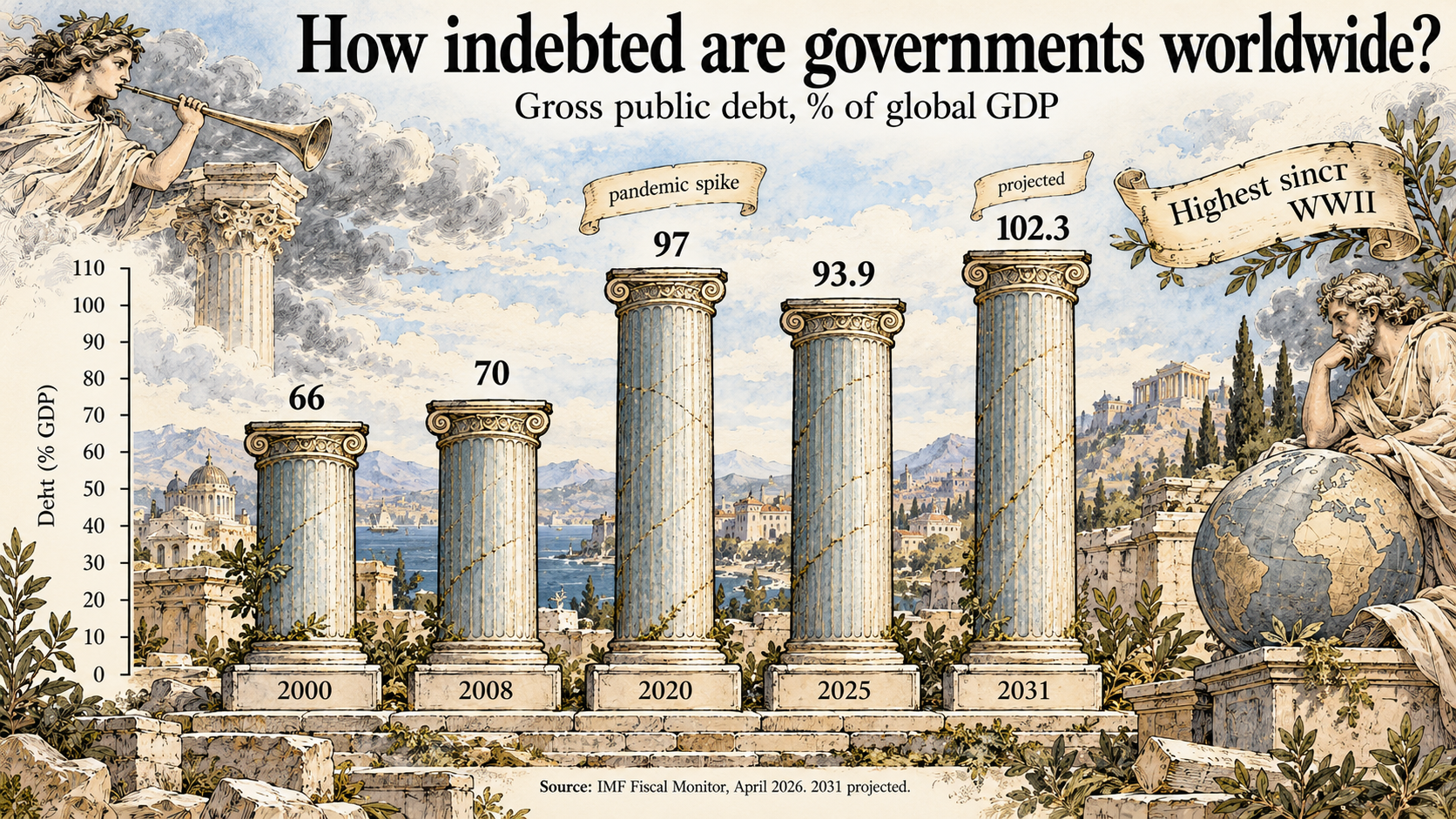
To be fair, this is a smaller proportion of world output than at the peak of the pandemic. But the difficulty with debt is not simply how much you owe; it is how much it costs to keep owing it. The US government alone spent about $1.36 trillion on gross interest in its latest financial year. Global economic management has become a little like running a household whose mortgage is three times its annual income, except that the household can print money and has several aircraft carriers.
The IMF, meanwhile, warned just this month that global public debt - debt that governments have accumulated - is approaching 100% of GDP, the highest level since World War II. America's federal debt has passed $40 trillion.
There is another wrinkle to Woodford's achievement. Much of the economic theory underlying forward guidance assumes that people are in fact forward-looking, and they process information intelligently and they adjust their behaviour accordingly. Woodford himself has subsequently become interested in the limitations of precisely these assumptions.
Perhaps the real discovery here is that central bankers have the same communication problem as the rest of humanity. They want people to believe what they say, but they also want the freedom to change their minds. Most marriages have encountered this difficulty.
One of the great unacknowledged contributions of this year's economics Nobel is to remind us that the future is strongly influenced by what we expect it to be. Not that surprising really. But the difficulty, or perhaps the joy, is that the future seldom repays the compliment in full. 💥
From the department of rules that are meant to be broken ...
 BBC News

From the department of the exactly the businesses you might expect ...
 Sarah Ewall-Wice
From the department of the art of the animal ...
 Positive News

Thanks for reading - please share if you have a friend (or enemy!) you think would value this blog and ask them to add their email in the block below - it's free for the time being. If the sign-up link doesn't appear, you'll find it on the site. And my book - based on these columns - has just been published, get it here!
By all means respond in the space below or email me directly.
Till next time. 💥