

What do South Africa’s local government elections have in common with the American midterms? Well, they took place in the same week, which, by the standards of comparative political science, is a slender basis for proceeding, but by the standards of a Sunday columnist, is practically a mandate.
The differences are considerable. Obvs. Americans were deciding who controls Congress, with implications for the world economy. South Africans were deciding who fixes the water supply. The countries have vastly different histories, economies, and electoral systems, etc., etc.
Still, there is one question that echos: will Trump end up undermining the Republicans party in the same way Jacob Zuma has undermined the ANC? The trajectory is weirdly similar: first the success against the odds, then the accusations of impropriety, then the surprising electoral victory, then the step-change in corruption, then the declining party fortune - you see what I mean.
In the midterms, Republicans have lost both houses of Congress, and so much more - Governorships, state administrations - it's been a historic blowout. An October Financial Times/Focaldata poll found that 69% of registered voters were concerned about corruption, self-dealing, or conflicts of interest in Trump’s administration, including almost half his 2024 voters. That is so reminiscent of how corruption gradually became the pivotal issue of South African politics, even eclipsing economic woes on occasion - or combining with them. Economic hardship is difficult enough to endure without discovering that the people prescribing austerity have put themselves on an all-you-can-eat plan.
Both men arrived with substantial support and abundant warning labels. Zuma was dismissed as deputy president in 2005 after his financial adviser, Schabir Shaik, was convicted of corruption. The ANC elected him its leader in 2007 and won 65.9% in 2009. Trump returned after two impeachments, an attempt to overturn an election, and a criminal conviction, amongst other egregiosities, winning 49.8% of the popular vote. Neither electorate could claim the small print had been concealed.
Zuma’s great reputational undoing was Nkandla (now falling to wrack and ruin. Natch.) Public money improved his homestead, the Public Protector ordered repayment of some costs, and the ANC’s parliamentary majority protected him. Police minister Nathi Nhleko argued that the swimming pool served a firefighting purpose. In March 2016, the Constitutional Court found that Zuma and the National Assembly had failed in their constitutional obligations. A liberation movement had acquired a sideline in swimming-pool classifications, and the customers were unimpressed.
There was also the demonstration that his judgement could damage their savings. In December 2015, Zuma dismissed finance minister Nhlanhla Nene and appointed Des van Rooyen. The rand plunged, bank shares sold off, and bond yields jumped. Four days later, Pravin Gordhan arrived to calm the markets. Three finance ministers in a week is an impressive turnover for a country struggling to create jobs.
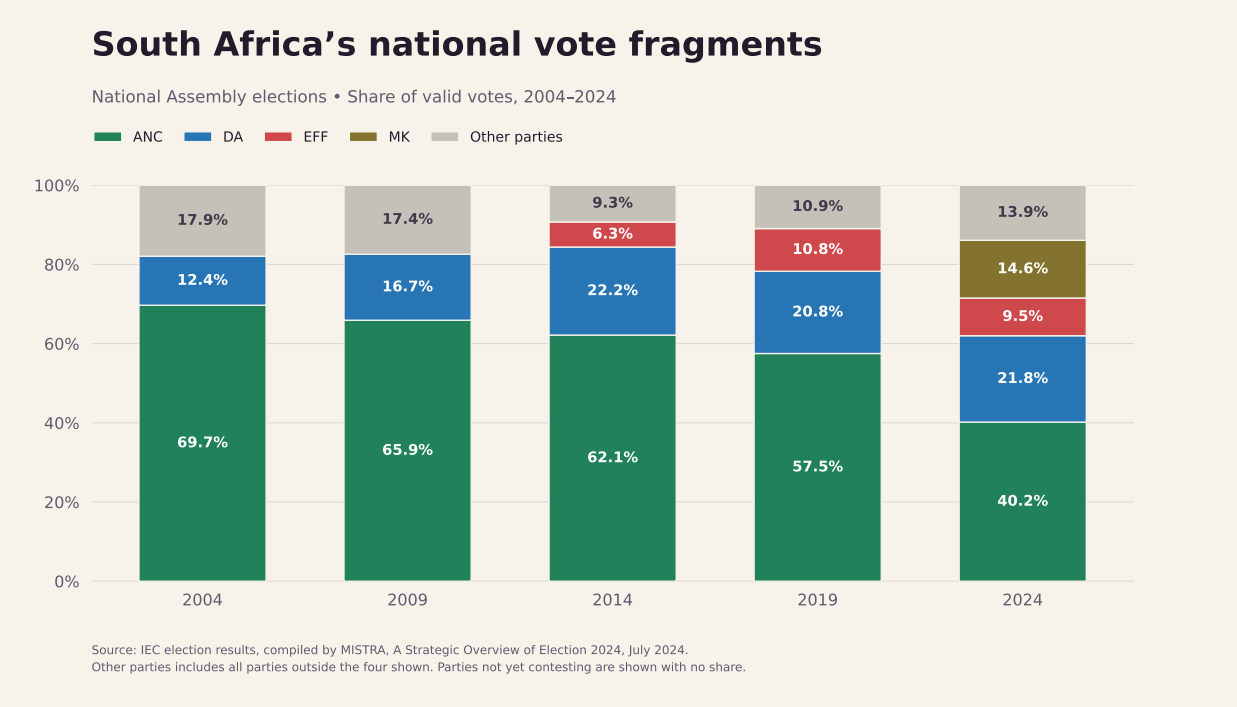
Then the ANC’s national vote fell to 62.15% in 2014. In the 2016 municipal elections, it took 53.9% and subsequently lost control of Johannesburg, Tshwane, and Nelson Mandela Bay. Different elections, certainly, but losing the administrative and economic capitals required no advanced statistical interpretation. Afrobarometer found trust in Zuma fell from 62% in 2011 to 34% in 2015. He was expending political capital almost as energetically as public money.
Trump’s trajectory has been less conveniently linear. His 2024 comeback is the strongest objection to declaring the Republican brand permanently ruined. Voters gave him another chance with remarkable knowledge of the previous administration. On his first day back, he pardoned nearly everyone charged over January 6. The party of law and order had discovered an unusually generous returns policy.
His second term has enlarged the opportunities for enrichment. Reuters estimated that the Trump Organisation’s cryptocurrency ventures alone earned $802m in the first half of 2025, against $62m from its traditional businesses. In May, he entertained leading buyers of his personal meme coin at his golf club. A hotel at least requires some job creation to make the beds. Cryptocurrency explores the presidency’s commercial possibilities with considerably less laundry.
His preoccupations offer another revealing comparison with voters’ priorities. On the eve of the midterms, he unveiled the refurbished Lincoln Memorial Reflecting Pool. The day after defeat, he toured the ballroom construction site where the White House’s beautiful East Wing had stood. The next, day he moved to protect the Oval Office and Cabinet Room as national monuments. Republicans needed a recovery plan and got site inspections.
Voters have begun charging the party for his behaviour. The AP Voter Poll found more than half considered corruption crucial to their vote, and slightly more than that said the same about living costs. Seven in ten thought Congress had provided insufficient checks on the president, including four-in-ten Republicans.
Florida governor Ron DeSantis called the defeat close to an “extinction-level event” for Republicans in many parts of the country, and it's easy to see why. Mechanically translating the provisional state-by-state House vote into a presidential contest would have produced roughly 393 electoral votes in a presidential election for Democrats against 145 for Republicans. This elephant is going to need more than just a fresh coat of (gold) paint.
James Carville, who helped elect Bill Clinton with “It’s the economy, stupid”, now objects to using his maxim to dismiss corruption. “I think it’s insane,” he said of claims that voters care only about living costs. Hardship acquires a particular flavour when the man requesting your patience is doing exceptionally well himself.
The Zuma parallel is already substantial. Defending a leader makes the party responsible for his conduct, and every fresh defence makes eventual promises of reform harder to believe. Trump’s successors must persuade voters that Republicans have recovered the independence they spent years surrendering. They could ask an ANC councillor to explain how awkward that conversation gets, particularly when somebody asks about the firepool.
The electoral background is also worth comparing.
Political parties around the world are becoming more tribal, more extreme in some senses, less ideological in some senses, more in others. The compendium of key issues is changing. One consequence is that growing numbers are declining to join the tribe. Gallup found a record 45% of American adults called themselves independent in 2025, against 27% each identifying as Republican and Democrat. In 2004, independents accounted for 31%. America’s biggest political constituency would prefer to be introduced as something else.
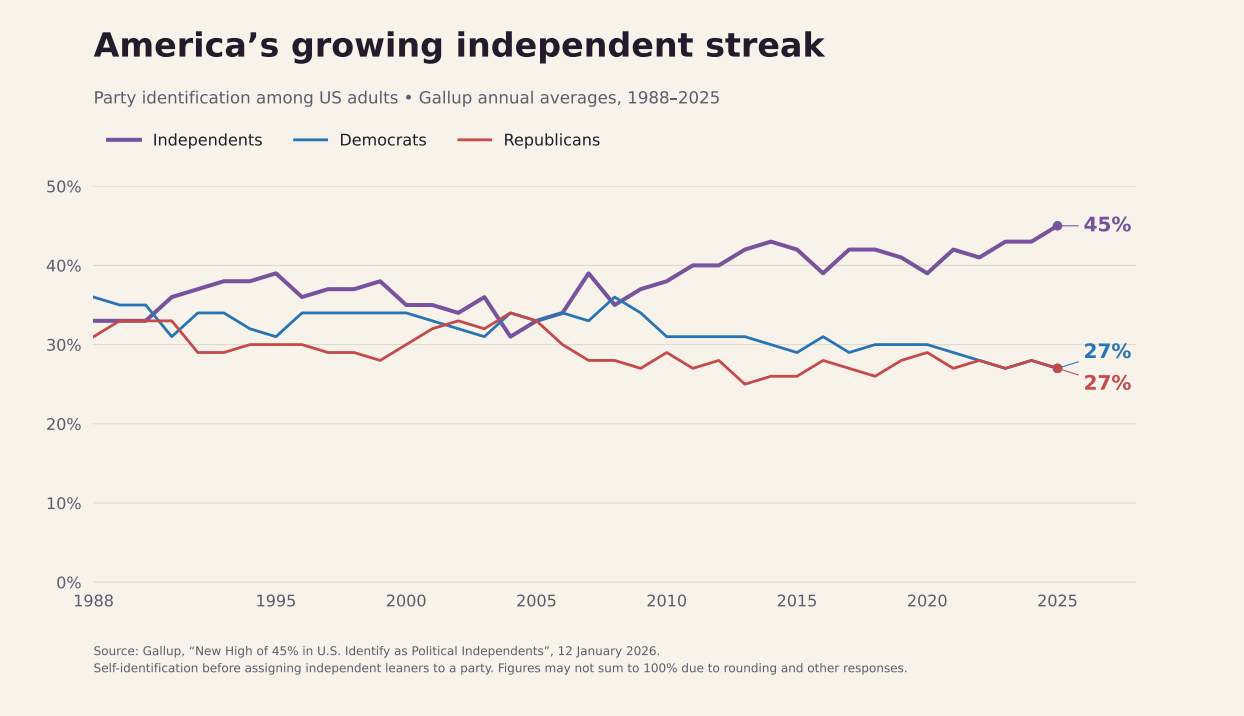
Part of this is generational. Younger Americans,- and South Africans, for that matter - favour the independent label, and millennials and Generation X have retained it as they have aged.
Most independents still lean towards a party, often voting much like its declared supporters. America has yet to become a nation of dispassionate philosophers weighing policy over breakfast. But the terms of attachment matter. Pew found that 64% of Democratic leaners cited harmful Republican policies as a major reason for their preference, against 27% citing the merits of Democratic policies. Republican equivalents were 56% and 34%. It is a peculiar courtship in which the chief attraction is that the other suitor is appalling. Parties, I think, are mistaking their supporters' dislike of their opponents for affection for themselves. It's a bit like airlines congratulating themselves on customer loyalty because the alternative involves a twelve-hour bus ride.
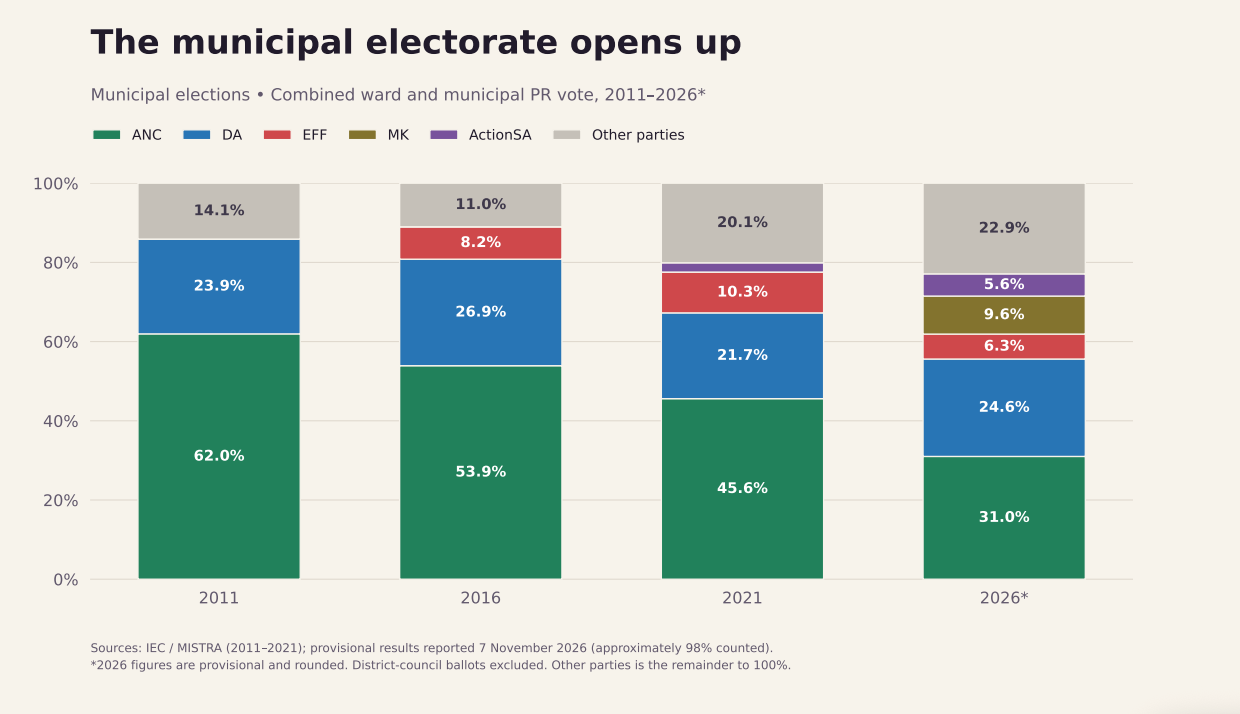
There is one big difference: South Africa offers dissatisfied voters more destinations. With the ANC at roughly 32% and the DA at 24% in the provisional municipal count this past week, about 44% lay elsewhere. In Sol Plaatje, for example, representation has spread across 12 parties. What? Proportional representation allows political disappointment to establish a small business.
America’s single-member plurality elections make translating a new party’s support into seats much harder. But dissenters can abstain. Large swings can therefore emerge from modest defections combined with changes in turnout. A party can lose power while most supporters retain their previous opinions. Politicians still describe “our voters” as registered assets. Increasingly, the voters regard themselves as customers, registering their dissatisfaction with the offerings.
The ANC’s subsequent experience shows how difficult ejecting a political liability can be, especially if the person in question still commands a dedicated support base within the party. Hello Maga. For Republicans, this is the tricky future that awaits.
In 2024, Zuma’s MK won 14.58%, while the ANC fell to 40.2% and lost its majority. Corruption, failed services, unemployment, and new leader Cyril Ramaphosa’s record all contributed. But Zuma supplied the additional indignity of opening a competing shop after years of having his interests defended by head office.
Earlier breakaways tended to enjoy exciting launches followed by long convalescences. The UDM won 3.42% nationally in 1999 and Cope 7.42% in 2009. By 2024, they were on 0.49% and 0.09%. The EFF broke that pattern, growing from 6.35% in 2014 to 10.79% in 2019 and retaining 9.52% in 2024. Zuma's new party, uMkhonto weSizwe (MK), arrived with almost twice Cope’s opening share. Expulsion has ceased to be a reliable way of pensioning somebody off. The cult of personality still means something, especially if combined with the tang of ethnicity.
Provisional municipal results this past week put MK at 9.6%, the EFF at 6.3% and ActionSA at 5.6%. The EFF has declined since the last municipal election, while ActionSA has grown from about 2.3% of combined ward and municipal PR votes in 2021, when it contested only six municipalities. Individual fortunes vary, but political life outside the parental home is now proving viable.
America’s electoral system channels this disaffection differently. Disenchanted supporters need no new party, constitution, or billionaire benefactor to punish their old organisation. They can just sit out the voting.
The University of Florida Election Lab’s preliminary estimate puts midterm turnout at 49.4% of eligible Americans, about 124.3 million people, the second-highest midterm rate since 1914. Yet Brookings’s early assessment attributes the Democratic sweep “less to Republican voters switching sides than to discontented Republicans staying home”, alongside motivated Democratic participation. Trump energised the electorate. His problem was the distribution of the enthusiasm.
Texas makes this concrete. Brookings reports that Republican governor Greg Abbott’s vote total was about 30% below Trump’s 2024 tally, while Democratic challenger Gina Hinojosa exceeded Harris’s total by 8%. Hinojosa won. Obvs. Comparing totals cannot identify precisely who abstained or switched, but the mobilisation gap is unmistakable. Much of the electorate Republicans had congratulated themselves on acquiring appears only to have been on loan.
The succession problem is consequently formidable. Republicans must recover voters alienated by Trump while retaining enough of his personal following to compete. The consequences of failure have already arrived, with an oversight committee attached.
The ANC protected Zuma because it feared losing his supporters. It eventually discovered how to lose voters both by keeping him and then by letting him go. Big irony. Republicans beware.💥
From the department of a country of old men ...
 Tickety-Boo News
From the department of things quite far away .,.


From the department of someone getting ribbed ..
 milhouse
Thanks for reading - please share if you have a friend (or enemy!) you think would value this blog and ask them to add their email in the block below - it's free for the time being. If the sign-up link doesn't appear, you'll find it on the site. And my book - based on these columns - has just been published, get it here!
By all means respond in the space below or email me directly.
Till next time. 💥