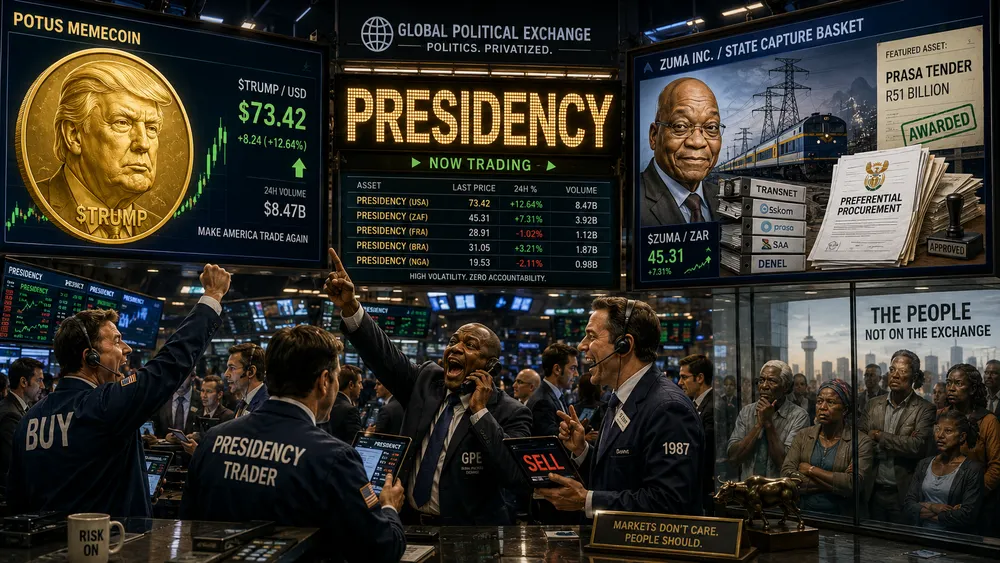
Two events, very different in legal character but rich in the symbolism of corruption, were triggered this past week and it's interesting to compare them. The first was Jacob Zuma’s reported meeting in India with Ajay Gupta, and the second was US president Donald Trump's disclosure of his financial interests, demonstrating that his crypto ventures earned him $1.4-billion last year.
In both cases, I’m interested in not only the facts of each, but also the psychology involved. How do people who are corrupt think about their own acts? Do they forgive themselves? Or do they not notice that it's corruption? Or do they have some kind of whataboutery justification. Or, bless them, do they consider themselves astute, taking advantage of the situation in front of them?
In both cases, the hypocrisy is monumental. Trump described bitcoin as a “scam” threatening the US dollar as recently as 2021. Now he wants to make America the “crypto capital of the world,” and his administration lightened regulation of the notoriously boom-and-bust sector. The Trump family’s sprawling crypto business reached into nearly every corner of the industry, drawing conflict-of-interest concerns from ethics watchdogs, the Wall Street Journal reported.
This is the same president that described Joe Biden as “the most corrupt president in the history of the United States of America” and said he would appoint a special prosecutor to investigate “the entire Biden crime family.” I am not making this up.
And another thing (there always is), Bitcoin prices have plunged, and I just can’t help wondering whether Trump and his family’s intervention has undermined the already shaky respectability of crypto. Bitcoin peaked near $109,114 on Inauguration Day; its now $62,700.
But to indulge in a momentary bout of fairmindedness about Trump and Bitcoin, it should be noted that nobody forced anybody to buy Trump’s memecoin, or Melania's for that matter. Trump made his crypto stash by issuing new assets in the form of World Liberty tokens and memecoins. If you bought shortly after the coin was issued, you are deeply out of the money.
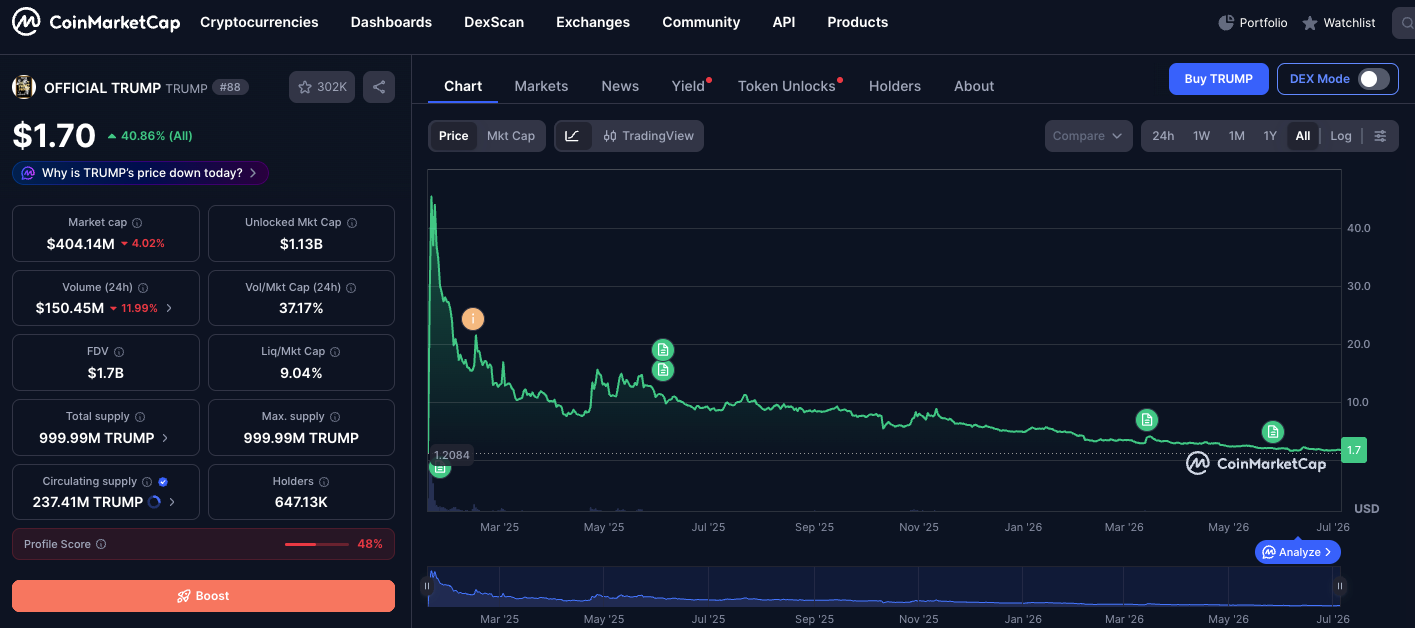
Roughly two-thirds of investors in Trump’s memecoin are currently in the red, according to crypto data provider Nansen, which tracks the 1.48 million crypto wallets that bought the token since its January 2025 launch. Loads of fans spent a few thousand dollars on Trump coins but the biggest spenders shelled out millions for the token. Nansen’s analysis of 26,663 wallets shows that 85% of World Liberty’s $WLFI token buyers in the secondary market are underwater, the Wall Street Journal reports. MarketWatch says 764,000 wallets (individuals normally) holding $TRUMP had lost money and the token dropped more than 95% since launch
That’s not great, but describing it as “corruption” might be stretching a point. The person who paid $6.2-million for a banana duct-taped to the wall has probably lost money, but nobody is blaming the artist Mauritzio Cattelan. Trump just played the game better than his supporters did. Sad for them, and not the perfect way to treat your supporters, but not illegal.
The corruption charge against Trump is not theft, per se, but the ethics of conflict of interest. What it has done is convert the presidency into a private crypto revenue machine, while giving buyers, donors, speculators and possibly foreign interests a way to enrich him or gain access through assets directly tied to his political power. That is pretty much corruption in my book.
And of course its not just crypto. Trump’s financial disclosures reportedly show huge numbers of stock trades around market-moving policy events. The Wall Street Journal reported that Trump’s brokerage accounts made more than 21,000 stock trades in 2025, including purchases shortly before he paused tariff plans and before other market-sensitive policy moves. (Trump has said he was not personally involved and that his children manage the accounts). And then there is the foreign officials staying in his hotels, the grab-a-gun issue, etc, etc.
What about former President and ANC leader Jacob Zuma? Honestly, I’m just gobsmacked by his decision to meet Ajay Gupta, what is more, with a representative of the SA government present, South Africa’s High Commissioner to India, Anil Sooklal. It essentially suggests Zuma has not accepted the moral verdict of state capture.
Zuma’s gesture shows either indifference to the symbolism or active rejection of it. This is follows, as we know all too well, the Zondo Commission’s findings that some R57 billion in state spending was “tainted” by state capture, with more than 97% linked to Transnet and Eskom; at least R15 billion flowed to the Gupta enterprise. Zondo found that Zuma “readily opened doors” for the Guptas to enter SOEs and access public money.
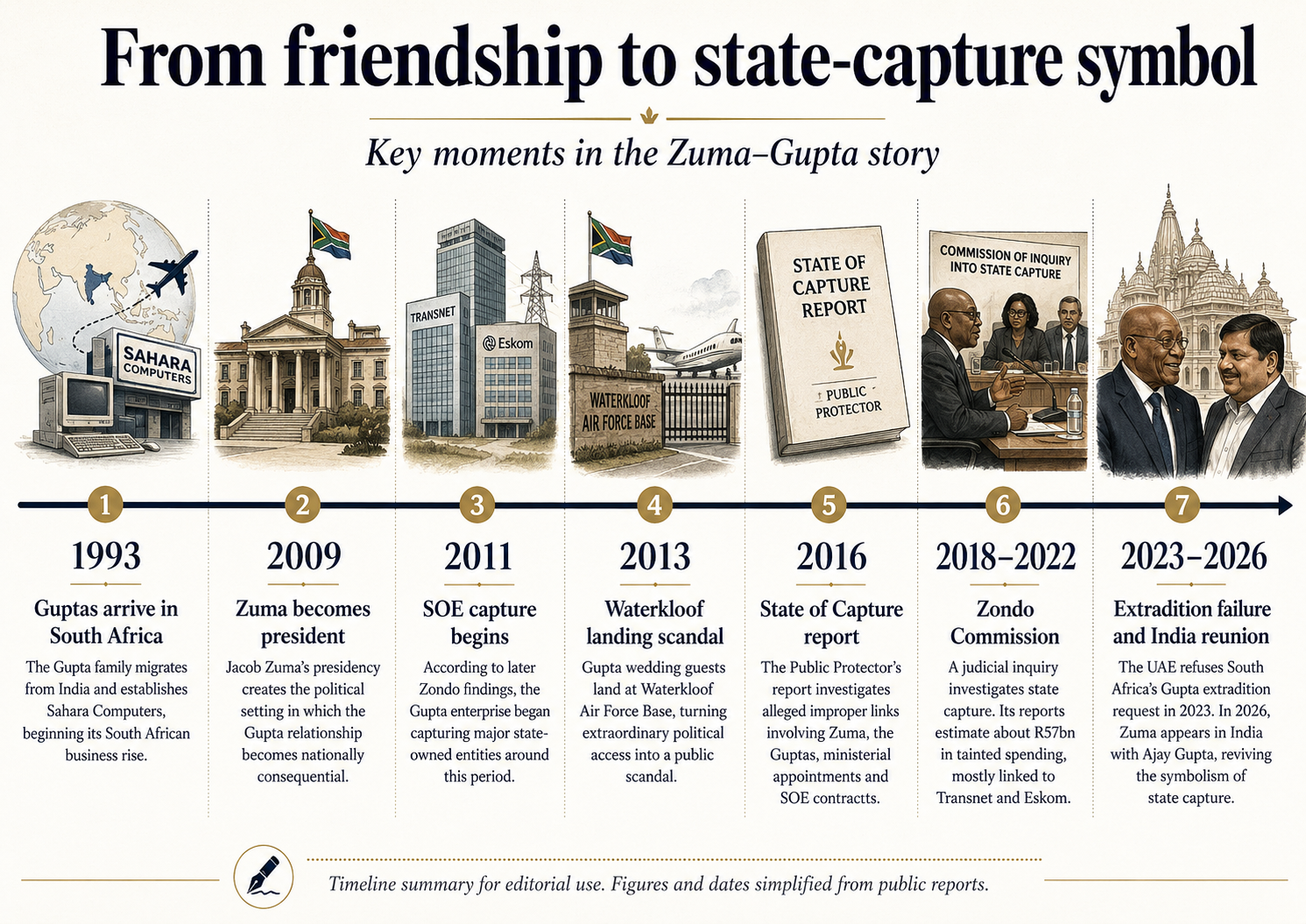
In a comparison between the Trump and Zuma, it has to be said, Zuma comes off so much worse. He did not just demonstrate conflicts of interest, but a much, much higher degree of involvement.
And obviously, neither are Zuma and Trump alone in the seemingly endless global political corruption epic. Corruption has been with us for so long, you suspect it predates agriculture.
The most-quoted figure comes from the World Bank that over $1 trillion is paid in bribes annually at a total cost of roughly $2.6–3.6 trillion a year, or about 5% of global GDP according to a (disputed) calculation by the World Economic Forum and the UN done some time ago.
 Till Johannes Hartmann and Carlos Ferreyra
The psychology of the corrupt has always been fascinating. Trump describing Biden as corrupt while failing to apply the same criteria to himself is pretty typical.
I suspect both he and Zuma think of themselves as entitled, embattled, misunderstood, historically owed, or simply operating according to what they consider to be the real rules of politics rather than the decorative rules in the government handbook.
In that world, a public office is not a temporary trust; it is a platform of distribution. Friends are rewarded. Enemies are excluded. Loyalists are protected. The state is not a neutral machine; it is a contested inheritance. To outsiders this looks like capture. To insiders it may feel like justice, reciprocity, transformation, loyalty, or the overdue settling of historical accounts.
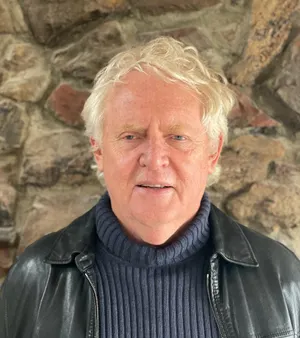
This is why corruption is rarely as psychologically simple as greed. Greed is present, obviously. But greed alone does not explain the serene expression on the face of the man photographed beside the wreckage. For that you need entitlement. You need grievance. You need a story in which the rules are fake, the critics are hypocrites, and the spoils are not stolen but due.
The Trump case also exposes a peculiar weakness in American political ethics. The US Office of Government Ethics has long advised that the president and vice-president are not legally subject to the main federal criminal conflict-of-interest restrictions that bind many other executive officials. This creates a constitutional oddity: the most powerful officeholder in the system is also, in some respects, the least constrained by the conflict rules that apply to lesser mortals. The deputy assistant secretary must worry about his stock portfolio; the president can, in theory, tower above the rules like a golden weather vane.
Defenders will say he disclosed his windfall, it may be legal, people voluntarily bought the tokens, and Trump has always been a businessman. That is not a trivial argument. But morality is not exhausted by legality. Something can be disclosed and still be corrupting.
The psychology in both cases is not the psychology of the embarrassed shoplifter. It is the psychology of the owner. Zuma’s implied posture is: I was the president; I had allies; my enemies called it capture because they lost the power struggle. Trump’s posture is: I won; I am the brand; people want what I sell; everyone is getting rich; why should I apologise for success?
In both cases, the self is too large for the office. The public role is absorbed into the private personality. The boundary between duty and benefit becomes not so much crossed as dissolved. Corruption is not merely the taking of money, it is the re-feudalisation of public life.
The danger is not just financial either. The deeper danger is epistemic and moral. You have a situation where citizens stop believing in the distinction between public and private, law and favour, office and personality. Once that line disappears, every institution begins to look like a racket and every anti-corruption campaign like a rival racket.
Cynicism becomes the national language. The honest official looks naive. The whistleblower looks suicidal.
SAD!
From the department of playing God - badly ...
 Jess Cockerill
From the department of chalking one up for the couch ...
 University of Oslo
From the department of Neolithic long-haul freight ...
 Curtin University
Thanks for reading - please share if you have a friend (or enemy!) you think would value this blog and ask them to add their email in the block below - it's free for the time being. If the sign-up link doesn't appear, you'll find it on the site.
Till next time. 💥