
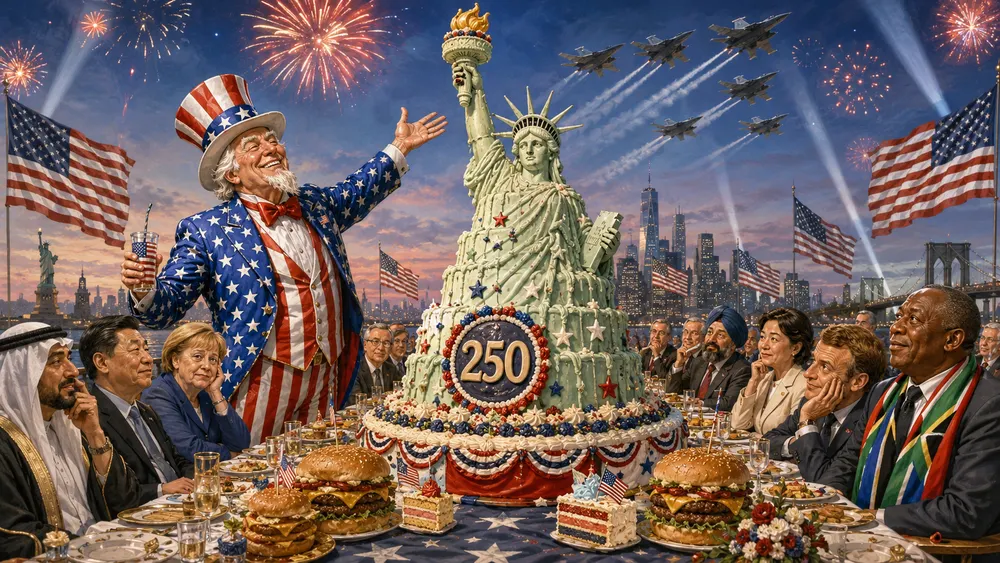
In an enormously packed field, perhaps the most embarrassing, toe-curling, chair-writhing scene in cinematic history was Bill Pullman’s pre-battle speech in the movie Independence Day. Just before the fly boys go out in their few remaining fighter jets to take on those horrid, annihilating aliens, President Thomas J. Whitmore solemnly informs the planet that July 4th will no longer be merely an American holiday, but the day the whole world will achieve its independence.
“Perhaps it's fate that today is the 4th of July, and you will once again be fighting for our freedom .. should we win the day, the 4th of July will no longer be known as an American holiday, but as the day when the world declared in one voice, we will not go quietly into the night. We will not vanish without a fight. We're going to live on. We're going to survive. Today, we celebrate our independence day,” he said. No, exclaimed. Declared. Roared!
I’m sure Americans loved this scene, because in my somewhat limited experience, no OTT gargantuan quantity of patriotism is ever too great for an American cinema audience. But for those of us in the rest of the world, it comes across as just a little, well, presumptuous. The rest of humanity, one suspects, would be less inclined to declare the Fourth of July a planetary holiday than to wonder whether America should have consulted the United Nations before weaponising the devastating power of Will Smith.
Yet the scene is revealing because it captures something authentic about the United States of America. America does not merely celebrate itself. It universalises itself. It cannot have a birthday without inviting the species. It cannot have a war without making it a battle for civilisation. It cannot open a hamburger chain without implying that human liberty itself is somehow involved.
And now, in 2026, the United States turns 250 years old. (Strictly speaking, this is the anniversary of the adoption of the Declaration of Independence, not the Constitution, which was still more than a decade away.) But the country has reached its semiquincentennial, and so what do we think about it now? What do Americans think about it now?
From the vantage point of South Africa, the United States is both familiar and alien. Familiar because so much of our political vocabulary, popular culture, economics and constitutional imagination has been touched by America; alien (and off-putting) because Americans can speak about their own country as if the rest of us are extras in their national biopic. We know the songs, the presidents, the scandals, the court cases, the movies, the slogans, the campus neuroses, the billionaires, the wars, and the fast-food chains. And yet South Africa somehow resists the inclusiveness that the export of such an outsized culture could imply.
My first experience of America was during the 1992 election campaign between Bill Clinton and the elder George Bush as part of a political junket sponsored by the US taxpayer. (Love them.) Democracy was breaking out all over the world, including in South Africa, and the US State Department cannily decided to use this as a way of giving people who had limited experience of democracy in action a taste of what an actual campaign would look like - and simultaneously provide an introduction to the US.
It was a fabulous trip, not only because I met my future wife in Washington, DC on the way. The group consisted of about 40 journalists from all over the world, which was great fun in itself, and we visited eight US cities in four weeks - many countries have these kinds of programs and I do think they make a meaningful difference. Anyway, that, and the fact that I have visited my wife’s friends and family over the years, means by now I have a good working knowlege of the US and may even have seen more of the country than the average resident.
South Africans have a particularly complicated relationship with American self-belief. On the one hand, we are not short of laudable national drama ourselves. We have our own founding miracle, our own constitution, our own language of rights, our own mythology of liberation. On the other hand, the American version is wrapped with a surround-sound system, a military-industrial complex, and merch.
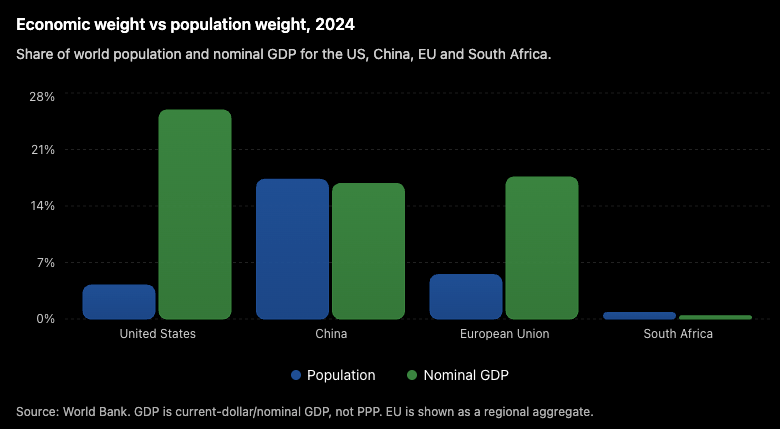
The American balance sheet is absurdly impressive. A country with roughly 4% of the world’s population produces about a quarter of global nominal GDP. The United States remains the great compounding machine of modern history: land, immigrants, capital, universities, law, oil, war, technology, risk, advertising, the dollar, Hollywood, Silicon Valley, and an almost mystical belief that no problem is so serious it cannot be turned into a subscription product.
It invented, or at least industrialised, much of modern life: the automobile mass production line, jazz, Hollywood, rock, television, the internet, social media, venture capital, the moon landing, the modern university research machine, the trillion-dollar corporation, the global financial nervous system, and the idea that coffee, coke and slushies should be sold in sizes previously associated with Jojo tanks.
But before we get too carried away, some of America’s greatness is a consequence of winning a geographic jackpot. It occupies a vast, fertile, temperate zone and a resource-rich continental space. It's protected by two oceans and bordered by Canada and Mexico, and neither of whom, post the 19th century, have been hostile peer superpowers in the European or Asian sense. It has navigable rivers, deep ports, enormous agricultural capacity, coal, oil, gas, timber, minerals, plains, and enough of an internal market to make scale itself a national industry. Compare that to South Africa: 40% desert. Canada: 90% uninhabited. Or Russia: roughly only 7% agriculturally viable.
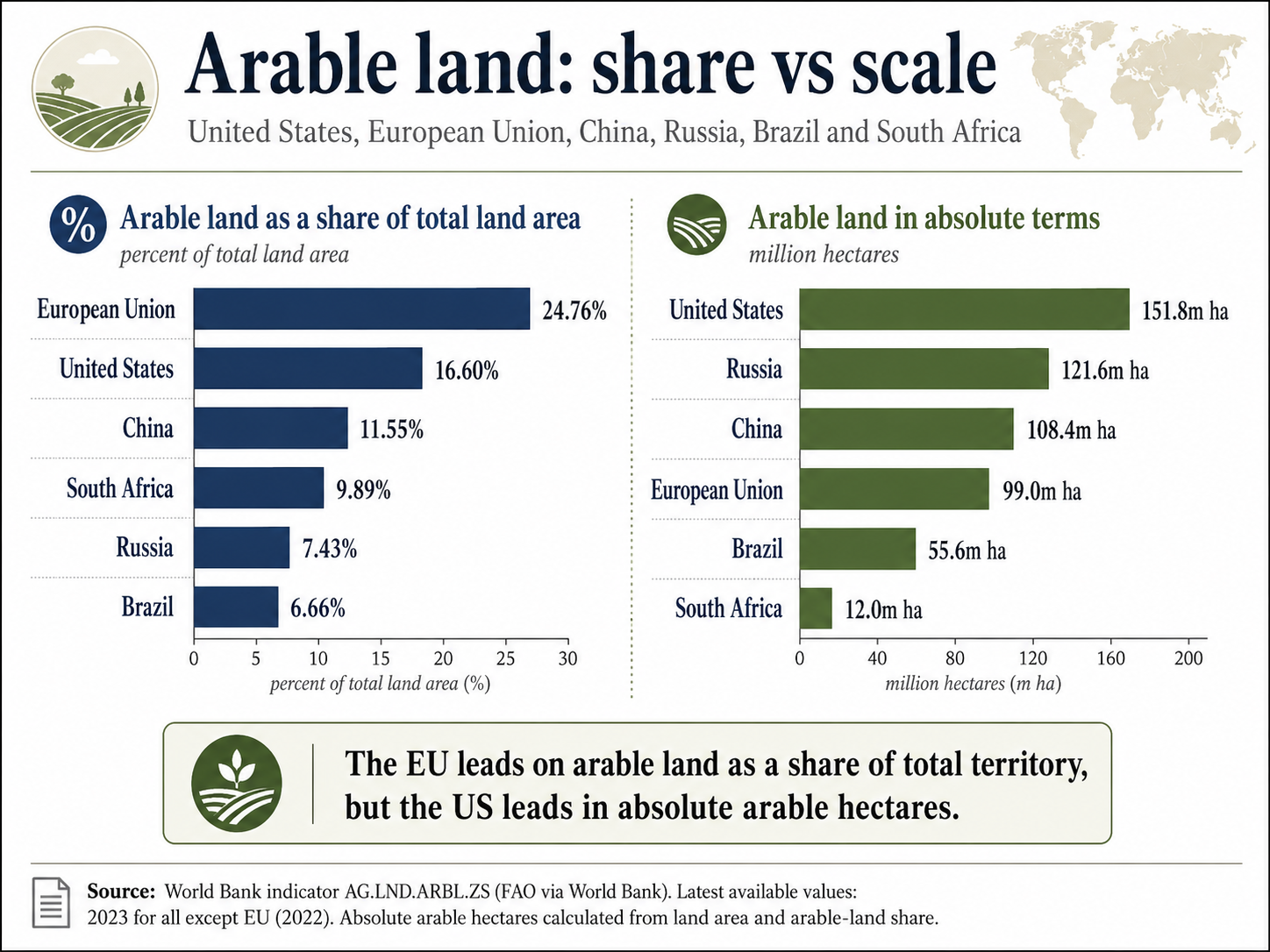
Americans often speak as if the country’s success proves something uniquely virtuous about the American character, and sometimes it does - and sometimes it does not. I mean, for one thing, the indigenous population was forcibly dispossessed of the land, like in South Africa. But it also proves the value of starting a republic on a continent-sized farm protected by oceanic moats. If the founders had launched their experiment on a rocky island with hostile empires on both sides and no navigable rivers, the Federalist Papers might today be remembered as an elegant pamphlet series explaining why the project lasted only 11 months.
Geography is not destiny, but it is a generous silent partner. America used its advantages brilliantly, often brutally, and with tremendous energy. But those advantages were real. The country’s rise was not just the luck of people like Washington, Jefferson, Madison, and Hamilton debating liberty by candlelight, although their enormous wisdom helped.
Still, luck is not enough. South Africa is a useful reminder of that. We too have mineral wealth, ports, agricultural possibilities, gifted people, constitutional language, and history by the truckload. Yet converting endowment into sustained prosperity requires institutions, law, legitimacy, education, capital, competent administration, and some capacity not to trip over oneself while walking toward the obvious. America’s gift was not merely that it was lucky. It was that, for long periods, it built institutions capable of exploiting its luck.
So how are those institutions holding up? I have to say, not that fabulously.
The US Constitution is the great example. It did not create a perfect democracy. It created a durable argument. It divided power, frustrated action, encouraged litigation, and assumed that ambition would collide with ambition. This was genius.
For a long time, that wager paid off remarkably well. George Washington’s greatest contribution was not only winning the war of independence but that he rejected monarchical temptation, resigned his military command, and later left the presidency voluntarily. That act alone may have saved the republic from the familiar post-revolutionary fate of liberators discovering that supreme power is, after all, quite nice. America’s first miracle was that its founding general went back to his farm.
The second miracle was that the founders were suspicious enough of one another to design a system for people they did not trust. This is the great practical beauty of the American founding. It is not based on the idea that politicians are noble. It is based on the idea that politicians are vain, grasping, factional, self-important, and occasionally deranged. Hello, 2026! In other words, it was designed with modern conditions in mind.
The American constitutional model then did something extraordinary: it travelled. The United States became not only a country, but a template. Its written constitution, separation of powers, federalism, bill of rights, bicameralism, presidentialism, and judicial review became part of the global constitutional repertoire.
Latin America borrowed heavily from the American model, especially presidentialism and federalism. Even Switzerland and Australia learned from the federal structure. Postwar constitutions absorbed the idea that power should be constrained by a written higher law. Germany, after Nazism, transformed that tradition into a more rights-centred, court-enforced, anti-authoritarian constitutional state. South Africa, after apartheid, then learned from Germany, Canada, India, the US and others, notionally producing one of the most admired constitutions in the democratic world.
Here South Africans have a special reason to take America seriously, even when America is being impossible. Our Constitution is not an American copy; it is much more modern, more explicit about equality, more committed to dignity, more alert to social rights, and far more conscious of historical injustice. But the American example is in the ancestry. The idea of a written supreme constitution; the idea that courts can strike down laws; the idea that government power must be divided and justified; the idea that rights are not gifts from Parliament but limits on Parliament, these ideas came to South Africa through many channels, but the American founding was one of the original fountains.
Regionalism is where South Africa’s constitutional borrowing becomes interesting, and slightly depressing. We took from the global constitutional buffet, but on regionalism we arguably chose the German potato salad rather than the American cheeseburger. The German idea of co-operative federalism sounds marvellous in theory: polite provinces, careful consultation, national coherence, committees with mineral water and notepads. In practice, in South Africa, it too often means provinces operating like branch offices of the national state, waiting for head office to send money, instructions, and blame.
The American version is messier, and more Darwinian, but also livelier. States compete. They compete for people, companies, industries, universities, tax bases, reputations, sports figures, and bragging rights. It is federalism as a beauty contest. This is not always noble, but it creates movement, experiment, and pressure.
South Africa’s provinces, by contrast, often resemble constitutional ornaments: expensive, technically significant, occasionally decorative, and mostly unable to move without asking Pretoria whether there is petrol in the car. Even when opposition parties briefly get to sit in the provincial cockpit they discover most of the buttons are decorative.
The most glaring American plot hole was slavery. The founders wrote liberty into the national scripture while tolerating slavery in the national bloodstream. They declared that all men were created equal, then spent generations explaining why “all” and “men” required specialist interpretation. The country’s founding documents became both a promise and evidence for the prosecution.
This is the part many non-Americans find both impressive and exhausting. America has always been two things simultaneously: a country and an argument about the country. French political theorist Alexis de Tocqueville saw much of this as early as in the 19th century. He understood the restless energy of American democracy, its appetite for association, commerce, religion, improvement, and self-invention. He saw that Americans were not aristocrats sitting in inherited rooms, polishing the silver of dead ancestors. They were strivers, joiners, improvers, builders, believers. They wanted equality, success and moral affirmation, preferably by Tuesday.
Tocqueville also saw the danger: democratic society could produce not only equality, but envy; not only civic energy, but a kind of anxious, panting dissatisfaction.
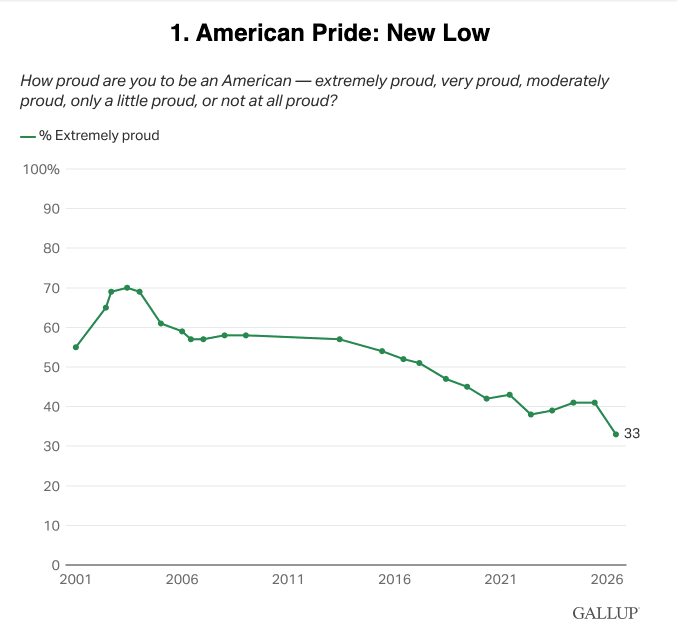
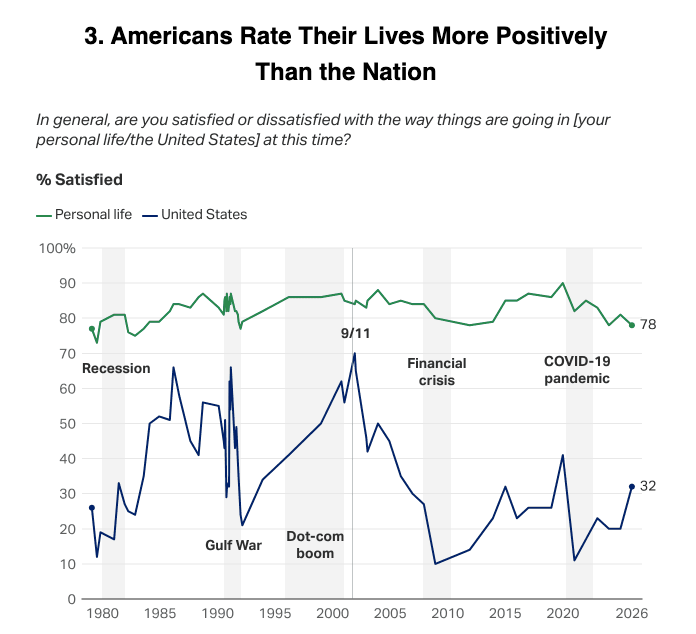
Amazingly, years later, this helps explain the modern mood. A recent Gallup poll found that 77% of Americans believe the founders would be disappointed in the country today. This is an extraordinary figure. Yet the same country remains capable of extraordinary achievement. It can be politically unhinged and technologically brilliant in the same week. It can generate constitutional crises and cancer therapies, conspiracy theories and reusable rockets, democratic backsliding and Nobel prizes, mass shootings and astonishing acts of civic generosity. It is a country forever veering between Gettysburg and QVC, the television shopping network I couldn't look away from when I first visited in the 1990s. I was determined to bring it to South Africa (someone beat me to it).
American writer Joan Didion understood this better than most because she understood that America is made not merely of institutions and wealth, but of stories. “We tell ourselves stories in order to live,” she wrote, and no country has ever told itself more stories, more insistently, more profitably, or with better lighting. America tells itself it is innocent, chosen, exceptional, betrayed, reborn, frontier-bound, under siege, indispensable, and misunderstood. It always seems to be located somewhere between 1776, a diner in Ohio, and Ronald Reagan’s ranch.
The poll demonstrates the dual American condition: prosperity with dread; abundance with paranoia; mobility with loneliness; optimism wearing a crash helmet. Countries need stories, and America’s founding story has been unusually portable. Because - and this is the absolutely crucial thing - the nation is built around an idea rather than an ethnicity. What that means is that people excluded from the promise have repeatedly been able to demand entry in the name of the promise itself. Abolitionists, suffragists, civil-rights leaders, immigrants, workers, gay-rights campaigners, and countless others have used the founding language as a lever against the founding hypocrisy.
Still, the American constitutional machinery is now under strain. The founders feared monarchy, but they did not foresee the modern presidency: part executive, part television character, part global brand manager, part commander-in-chief of the algorithm. The president now dominates foreign policy, appoints judges whose influence may last for decades, commands a vast administrative state, issues executive orders, declares emergencies, sells his own crypto, and appears on merchandise.
The Supreme Court, once imagined as the least dangerous branch, has become a kind of secular papacy with clerks. The Senate, designed as a cooling institution, often resembles a malfunctioning refrigerator. Congress, which was supposed to be the first branch of government, now too often performs as a complaints department for cable television. The parties have become stronger than the institutions they inhabit. The written Constitution survives; the unwritten habits of restraint wobble.
And yet, America is not easily dismissed. This is the mistake anti-Americans often make. They see the vulgarity and miss the vitality. They see the madness and miss the patents. British writer G.K. Chesterton called America a nation with the soul of a church, and that remains a great description. Its politics tend toward the theological. Its elections are revivals. Its scandals are heresy trials. Its pundits are preachers. Its billionaires are prophets until the stock falls, at which point they become false prophets and are cast into the outer darkness of podcasting.
But the country also keeps renewing the counterargument. Every time one is ready to declare the republic finished, it produces some astonishing act of reinvention: a civil-rights movement, a scientific breakthrough, a technological platform, a cultural form, a legal correction, a local reform, an immigrant success story, a university laboratory quietly doing the work while the politicians set fire to the curtains.
So what should one say at 250?
The United States has survived 250 years because its founding contained both a magnificent aspiration and a permanent argument. It remains the greatest ongoing experiment in whether a society can be at once free, huge, rich, diverse, quarrelsome, self-interested, self-critical and somehow still governable.
The aliens in Independence Day were unlucky. They arrived expecting a normal planet. Instead, they encountered a civilisation so convinced of its own symbolic centrality that even extraterrestrial annihilation had to be folded into the Fourth of July programme. But perhaps that is America’s gift and curse: it cannot stop turning events into meaning.
From South Africa, I think the proper response is neither swooning admiration nor fashionable contempt. We know too much about national myths to swallow them whole, and too much about constitutional miracles to mock them entirely. America’s greatness is part genius, part violence, part luck, part law, part geography, part immigration, part capital, part delusion and part astonishing civic improvisation.
At 250, the United States remains preposterous, indispensable, dangerous, admirable, infuriating and alive. It is still, in writer James Baldwin’s sense, worthy of criticism because it is still worthy of hope - much like South Africa. The world would be poorer, duller, less free, less rich, less inventive and considerably less entertaining without the United States.
Also quieter. Much, much quieter. 💥
From the department of being careful to delete your old emails ...
 Olivia Maule
From the department of not believing everything you hear ...
 Guest Contributor
From the department of not necessarily monkeying around in the sun ...


Thanks for reading - please share if you have a friend (or enemy!) you think would value this blog and ask them to add their email in the block below - it's free for the time being. If the sign-up link doesn't appear, you'll find it on the site.
Till next time. 💥