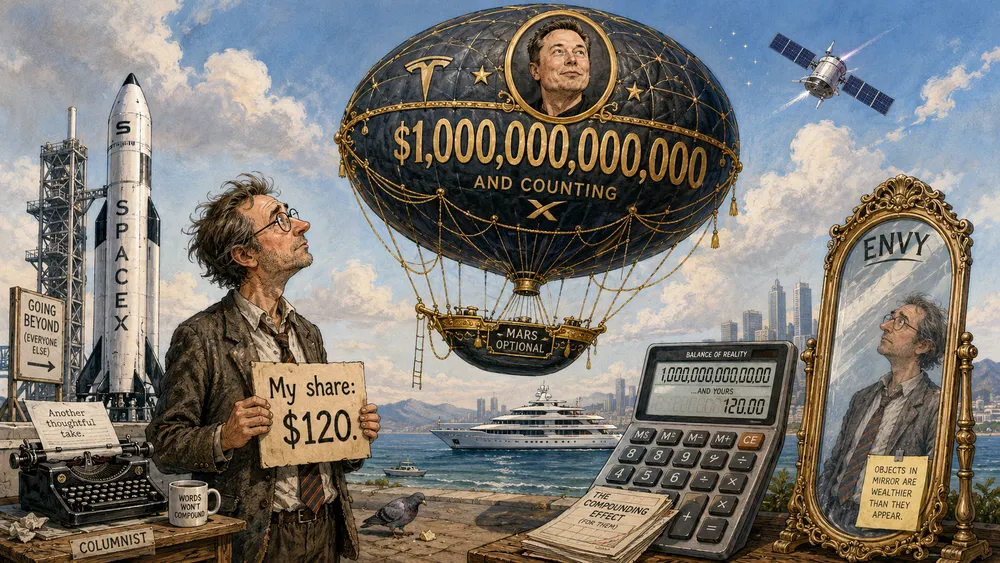
Elon Musk is now a trillionaire. Shouldn't he give a little slice of that to me (and you, for that matter)?
It is a tempting thought. I have often felt that the world would be a kinder, fairer and more emotionally balanced place if Elon Musk would just hand out some of his money. Not all of it, obviously. I am not unreasonable. Just enough to repair the small but persistent injustice of my not being able to buy a Caribbean island.
The more serious question, is whether Musk, and billionaires in general, should be more generous to poor people around the world. Many are, of course. There is The Giving Pledge, global philanthropic campaign founded in 2010 by Warren Buffett, Bill Gates, and Melinda French Gates, that encourages the world's wealthiest individuals to commit the majority of their wealth to charitable causes during their lifetimes or in their wills. But the boil has gone off that pot. Musk did actually sign the Giving Pledge in 2012, committing in principle to give the majority of his wealth to philanthropy. But Musk’s later attitude seems much more ambivalent. Reuters reported in October 2025 that Peter Thiel had urged Musk to quit the Giving Pledge, warning that Musk’s fortune might end up going to “left-wing nonprofits” chosen by Bill Gates. In Thiel’s telling, Musk took the warning seriously and replied: “What am I supposed to do—give it to my children?” Thiel’s punchline was that giving it to Gates would be worse, which I think is kinda cruel and unfair to the Gates Foundation, whose organisation is fastidious about data-drive results.
But the broader question is whether poverty can or should be ameliorated by billionaire philanthropy. And that other thing: envy.
The difficulty, as always with billionaires, is arithmetic. A trillion dollars sounds like an infinite sum, the kind of number that should arrive with its own weather system. But spread it across the roughly 8.3 billion people on Earth, and it comes to about $120 each. Nice, certainly. But not exactly the abolition of poverty. This is the first thing to remember about the politics of envy: it often begins with a very bad calculator. We can increase this by five if we strip out people who need it less, so the poorest receive $600 each. Still...
The second thing is that wealth is not cash. Musk does not have a trillion dollars in a vault, stacked behind a sliding door guarded by bored dragons and rejected Cybertruck prototypes. His fortune is mostly paper wealth, tied up in shares whose value depends on what other people think his companies might be worth tomorrow, next year, or after the first moderately successful asteroid-mining quarterly update. The market can make a trillionaire in the morning and produce a cautionary tale by close of trade. It is democracy, but with charts and emotional instability.
Personally, I celebrate the fact that Musk has achieved this stupendous wealth. But at a core level, something in me also makes me deeply sad and uncomfortable about the ease of my own not-so-wealthy life, compared to so many of my countrymen. It's not that I envy the rich necessarily - they have always been there and will always be there. It's just the inherent unfairness and its degrading effects can make me frustrated and despondent. And that is weird because, as we all know (we don't, but we should), global poverty and inequality have been plummeting in our lifetimes.
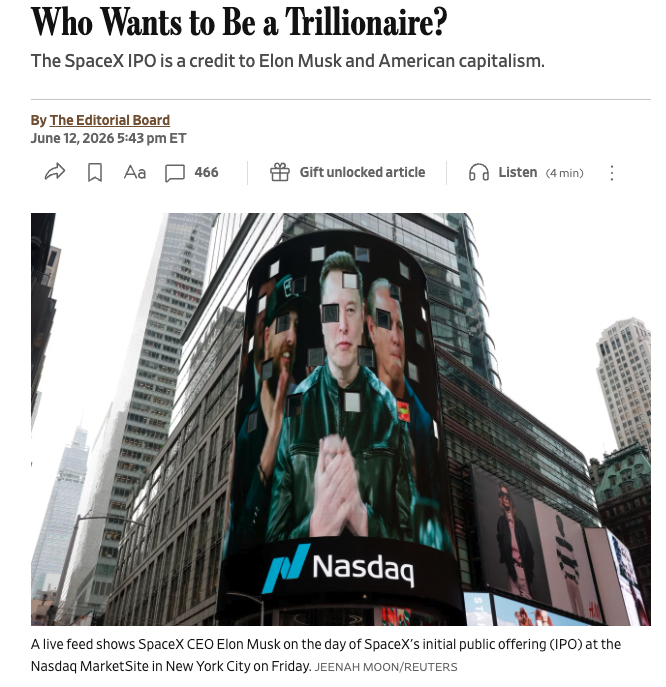
As the Wall Street Journal noted on the subject of Musk’s trillionairship, with their envy of success and wealth, our political class ignores that financial rewards are exactly what spur investors and entrepreneurs on to take risks building companies that make all Americans better off. “You don’t have to like Mr. Musk to appreciate what he has built”.
Envy is often what happens when aspiration forgets to pull up its trousers. Still, obviously, inequality matters because money is never merely just money. At scale, money becomes influence, insulation, lawyers, lobbyists, satellites, media platforms, political leverage, and the ability to turn a midlife crisis into reusable rockets. One person’s “envy” is another person’s “unfairness”. The difference lies in the question being asked.
But there is a subtle difference between envy and fairness. If great wealth comes from monopoly, corruption, inheritance, regulatory favours, labour exploitation, tax dodging, state protection, financial engineering or the ancient art of knowing the minister’s cousin, then envy is the wrong word. The right word is unfairness, or sometimes theft, depending on the catering arrangements.
But if wealth comes from building something people voluntarily buy, lowering costs, solving difficult problems, risking capital, enduring failure, and forcing sleepy incumbents to rediscover competition, then the case changes. You may still dislike the outcome; you may worry about the power; you may prefer the billionaire to post less and introspect more. But resentment becomes an inferior guide.
This is why Musk is such an irritatingly good test case. SpaceX is not a TikTok filter for Golden Retriever hijinks. It is a company that has changed the economics of space launch, challenged the old aerospace bureaucracy, built Starlink and made rockets reusable, which is the sort of phrase we now say casually, as if returning orbital boosters to Earth were just the next thing after contactless payment.
A society that cannot admire achievement is in trouble. Hello, South Africa. But a society that cannot scrutinise power is in even worse trouble. The adult position is to do both, which is why it has such poor representation online.
I sometimes think the ancients understood envy better than we do, perhaps because they had fewer hand-held devices. Aristotle called envy "pain at the good fortune of others". Aquinas called it sorrow at another’s good. Francis Bacon observed that envy is “ever joined with the comparing of a man’s self” and that where there is no comparison, there is no envy.
Mythology is full of envy. Cain does not want better crops; he wants Abel unchosen. Snow White’s queen is perfectly happy being beautiful until a mirror introduces market research. Iago does not want merely to advance; he wants Othello ruined. Salieri, at least in the magnificent theatrical version, is tormented not by Mozart’s success, but by Mozart’s gift.
This is why envy became one of the seven deadly sins. Not because every passing irritation at a neighbour’s new car required immediate confession, but because of what envy breeds. It turns comparison into resentment, resentment into grievance, and grievance into a policy proposal. Once again, hello, South Africa. Envy is wonderfully inefficient: you do all the suffering; they keep all the money.
It is also one of the few sins that gives no pleasure. Gluttony has pudding. Lust has its attractions. Pride gets a decent suit. Greed at least accumulates. Envy sits alone in the dark, refreshing LinkedIn.
But the defenders of wealth do cheat a bit when they call every objection “envy”. Ask about tax, and you are envious. Ask about monopoly, and you are envious. Ask whether one man should control rockets, satellites, social media, artificial intelligence and half the world’s attention span, and you are apparently a resentful leveller.
The key question is this: would you be satisfied if the poor became much richer while Musk remained very rich? If "yes", you are probably worried about fairness, opportunity and living standards. If "no" — if the existence of his fortune remains intolerable even in a world where everyone else rises — then we have left the territory of justice and wandered into envy.
This is where the current argument about inequality becomes especially interesting. The old left promised abundance. Socialism would out-produce capitalism, eliminate poverty, and deliver material plenty without the vulgar inconvenience of billionaires. Then history occurred, as it has a habit of doing. The Soviet Union did not become Sweden with tractors.
Incredibly, parts of the fashionable left have changed the pitch. Perhaps abundance itself is the problem. Perhaps rich societies should consume less, build less, fly less, work less, grow less, and generally become poorer (though of course in a more ethical, inclusive, and exquisitely facilitated way). This is the degrowth temptation, and it comes peppered with words like sufficiency, wellbeing, care, justice, decolonisation, and planetary boundaries. Some of the concerns are real.
This is a real thing.
 Olivier De Schutter and Joseph Stiglitz and Thomas Piketty and Kate Raworth and Jayati Ghosh and Jason Hickel
Here is a great critique ..
 Noah Smith
There is surely a vast difference between saying growth should be cleaner, broader and less stupid, and saying growth itself is morally suspect. This is where the politics of envy become bigger than billionaires, but rather a politics of anti-ambition. The problem is no longer that the prizes are unfairly distributed; it is that the prizes exist. Every yacht becomes a public-policy emergency.
Yet the world’s poor do not need the rich to become poorer; they need the poor to become richer. Obvs. They need growth, trade, energy, investment, infrastructure, technology, education, functioning states and boring things like ports that work. Oh, and maybe Starlink! Nobody escaped poverty through a stirring national programme of wanting fewer things.
The great miracle of the modern world is not that some people became absurdly rich. It is that billions of people became less poor. It happened because productivity rose, markets expanded, technology spread, capital accumulated and governments, when not actively looting, occasionally did useful things.
The fantasy that confiscating a billionaire’s fortune would make everyone rich is what happens when moral outrage tries to do arithmetic in its head. The fantasy that every billionaire deserves his fortune is what happens when capitalism writes its own hagiography. Between the two lies the only argument worth having: not whether someone has more, but whether they earned it, whether others benefited, and whether the rules remain fair after they have won.
That is less satisfying than envy. But then most useful truths are. 💥
From the department of Africa's first funeral director...
 Nicola Davis
From the department of please, not more of that ...

From the department of yes, but we know he did it ...
 The Associated Press and Dave Collins
Thanks for reading - please share if you have a friend (or enemy!) you think would value this blog and ask them to add their email in the block below - it's free for the time being. If the sign-up link doesn't appear, you'll find it on the site.
Till next time. 💥