The most famous asymmetric battle in history begins, as these things often do, with a large man developing an extremely dire over-confidence problem.
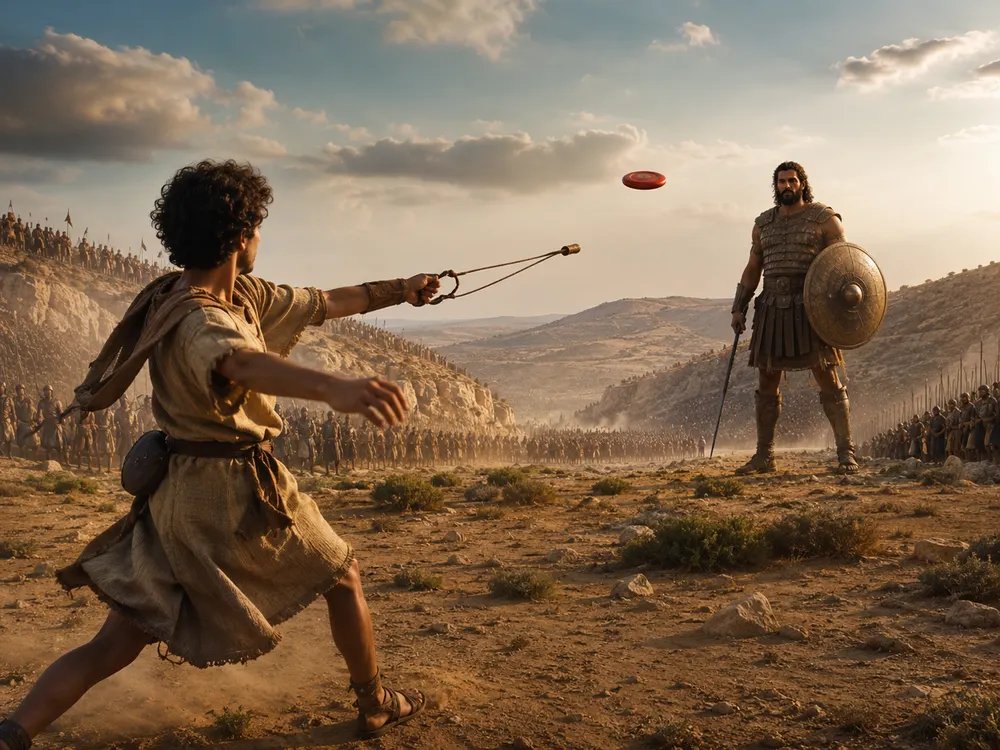
According to the bible, the Philistines and Israelites are camped on opposite hills in the Valley of Elah, staring at each other across the ravine, presumably doing whatever ancient armies did while waiting for someone to make a poor tactical decision. Out of the Philistine lines comes Goliath of Gath, huge, armoured, armed with spear, sword and shield, and very much the sort of man who would have had a personalised parking bay at the Ministry of Defence.
He offers the classical strongman’s bargain: send someone to fight me. If I win, you serve us. If he wins, we serve you. It is the sort of proposal that sounds wonderfully efficient, provided you are the enormous man holding the spear.
For forty days, nobody volunteers. King Saul, who is himself no small man, remains sensibly unavailable. Then David arrives, not as a soldier but as a delivery boy, bringing food to his brothers. He hears Goliath’s challenge and is offended not merely by the Philistine’s arrogance but by the failure of Israel’s leadership, the chosen people of God, after all, to respond.
David convinces Saul to let him have a go because (and I am not making this up, although somebody else may be ... ) “When a lion or a bear came and carried off a sheep from the flock, I went after it, struck it and rescued the sheep from its mouth.” Not short on self-aggrandisement, our young David. He also points out that the Philistine is uncircumcised, which will obviously give David a big advantage.
What the bible does not actually say is whether the Philistines outnumbered the Israelites, but historians say, they probably had some military advantages over early Israel. The Philistines were coastal, urban, better connected to eastern Mediterranean trade, and often portrayed as having superior equipment, especially iron weapons and chariots. The Israelites, by contrast, were hill-country based.
Anyway, Saul offers him armour, but David refuses it. He is not trained for armour. He is trained for sheep, predators, and stones. And that is the point we generally miss; David did not agree to Goliath’s war. Goliath expected close combat - weight, reach, armour, spear, shield. David turned the encounter into a ranged-weapons contest. Goliath is probably the first recorded victim of overconfidence in legacy military hardware.
The stone flies. Goliath falls. The Philistines panic. the Israelites win the way, and go on to write the history. David does not merely beat Goliath. He symbolically produces the most successful campaign poster in ancient near-eastern politics. Later, he becomes king. Obvs.
The story remains relevant not just because it is about size, heroism, overconfidence, or bravery. It is all about terms. The invader’s fatal assumption is that the other side will fight the war for which he came prepared, not the other way around.
This is why the coincidence with our own moment is so striking. There are, currently, two great asymmetric wars unfolding at once: Ukraine’s defence against Russia, and Iran’s defence against the United States.
They are very different conflicts, morally, legally, militarily and historically. Ukraine is a sovereign country resisting an invasion. And you can also go a bit too far with the asymmetric argument, since Ukraine is supported by a whole bunch of countries to its West.
Iran is a state under attack in a wider regional conflict. Iran is using endurance, geography, missiles, proxies, maritime disruption, and the economics of inconvenience.
Not to over-stress the point, but in both cases, the aggressor is discovering the same old problem. It can win battles without winning the war.
Russia expected Ukraine to collapse. It did not. The United States expected overwhelming military superiority to translate into Iranian strategic submission. It has not. In both cases, the larger power has found that strength is real, but not always decisive. The strong win the battles; the weak decide when the war is over.
Survival, it turns out, is the original asymmetric advantage. An army fighting for its existence will always outdo an army fighting for a strategic objective.
That sounds sentimental until you think about it, at which point it becomes almost boringly repetitive. Darius, Napoleon, the British in Afghanistan, the French in Algeria, the Americans in Vietnam, the Soviets in Afghanistan, the Americans in Afghanistan: it's history’s most expensive repeated mistake. You could even add the Boer War, because as we know the boers lost the war but won the peace. Every great power walks into its asymmetric war convinced this one will be different. It's almost as though hubris is the only force more reliable than gunpowder.
But there is something of a trap here. The lesson is not that the weak always win. They don’t. Sometimes Goliath does exactly what Goliath looks as though he might do.
The 1991 Gulf War is the clean counterexample. Saddam Hussein’s Iraq fought the United States and its coalition largely in the way the coalition was designed to fight, with conventional armies, open desert, fixed targets, command structures, and air superiority. It was not a fair fight, and it was not a long one. Kuwait was liberated, and the Iraqi army was smashed. If the weaker side accepts the stronger side’s preferred contest, the weaker side generally loses. There is no romance in being helpfully target-shaped.
Sri Lanka’s defeat of the Tamil Tigers is a still harsher example. The LTTE was one of the most formidable insurgent movements in the world. It was innovative, disciplined and ruthless. Yet the Sri Lankan state crushed it militarily in 2009. That victory came with terrible moral and humanitarian controversy, but as a strategic fact, it matters. Insurgencies can be defeated when they are isolated, boxed in, deprived of sanctuary, and confronted by a state willing to bear enormous costs.
Chechnya adds the most uncomfortable footnote because it works both ways. Russia lost the first Chechen war politically, then returned and won the second by applying overwhelming force, local co-option, and sustained repression. Chechnya’s lesson is blunt: ruthlessness, applied consistently, is also a strategy. Presumably, this outcome is what is partly motivating Russia after five years of fighting.
So the arc of asymmetric warfare bends toward - eventually, expensively, bloodily - the defender, who is anyway in a better tactical position, fighting genraly at home. But not automatically. It bends when the defender survives long enough, learns fast enough, finds support, keeps legitimacy, and makes the aggressor’s original objective either unreachable or not worth the bill.
It's almost as though the modern battlefield has acquired a grotesque accounting department. Congressman Ted Lieu put it with admirable American compression, saying, “We cannot keep throwing Ferraris at frisbees.” Isn’t it incredible how truths often inadvertently spill out, and tell you more about a conflict than carefully prepared statements? He was talking obviously about the absurdity of firing hugely expensive defensive missiles at relatively cheap Iranian drones, but the same could be said of Russia in Ukraine.
Fareed Zakaria, the CNN host and Washington Post columnist, made a similar point in his essay on Iran and the new arithmetic of war. The old lesson of the Gulf War was that advanced technology could make war precise. The new lesson, he argued, is that “precision will now be mass-produced.”
That is the horror and the novelty. The expensive side still has better aircraft, better ships, better satellites and better missiles. But the cheaper side now has enough accuracy, enough range, enough visibility and enough volume to create strategic nuisance at scale. Not victory in the old sense. Something more irritating: non-defeat.
 Scott Galloway
There is a flip side to this argument, too. Scott Galloway points out in his column this week that some of the most significant victories of our age have not been won with hard power but with soft power.
In 1990, just after the end of the Cold War, political scientist Joseph Nye popularised the term “soft power” to describe how state actors achieve their goals without using force, making threats, or paying bribes. According to Nye, a nation’s soft power resides in its culture and political values, plus its foreign policy (to the extent that its peers see it as legitimate and having moral authority).
“A country may obtain the outcomes it wants in world politics because other countries — admiring its values, emulating its example, aspiring to its level of prosperity and openness — want to follow it,” Nye wrote. “This soft power — getting others to want the outcomes that you want — co-opts people rather than coerces them.” As Nye said in 2019, “The Berlin Wall collapsed not under an artillery barrage, but from hammers and bulldozers wielded by people whose minds had been affected by ideas that had penetrated the Iron Curtain over the preceding decades.”
But soft power seems to have gone out of fashion, and isn’t that just a sign of the times? Instead, Ukraine has been the great laboratory of change. Drones get most of the attention, but they are only part of the story. The real transformation is the network, including satellite imagery, electronic warfare, battlefield software, commercial communications, mobile air defence, precision artillery, open-source intelligence, repair workshops, cheap sensors and improvisation at industrial speed.
There is a good argument that modern weaponry makes asymmetric wars more viable for defenders in the modern age, particularly because the larger powers have focused so much nuclear power, which it turns out is unusable. Defenders don't have to be more powerful than their opponents. They just have to become harder to digest.
That is a different thing, and in some ways a more dangerous one for the invader. Russia can still destroy, advance, and impose terrible suffering. But it has failed at the thing it most wanted: a quick political victory. Instead of swallowing Ukraine, it has helped manufacture a Ukrainian nation more armed, more hostile, more internationally connected, and more difficult to subordinate than before.
Iran is not Ukraine, of course. But Iran’s strategic problem for America is also asymmetric. Iran does not have to defeat the US Navy; it has to raise the cost of using the US Navy. It does not have to win air superiority; it has to make the absence of political victory obvious. It does not have to destroy the American economy; it has to remind everyone that oil, shipping, insurance, bases, allies and public patience are all part of the battlefield.
This is where old military superiority begins to look oddly fragile. Precision strikes are formidable, but they do not guarantee political submission. A missile can hit a target; it cannot, by itself, produce a legitimate post-war order. There are few things more dangerous in politics than a government that mistakes the ability to bomb something for the ability to solve the problem it poses.
That, too, is one of history’s memos, sent repeatedly and ignored with magnificent consistency. Great powers are very good at entry. They are less good at exits. Seduced by the map and flattered by briefings, their first strikes work! The President gives a speech after the enemy’s air defences are degraded. The markets wobble but don't collapse. We hear loads of new military-speak on the nightly news, like “de-escalation ladder”, “off-ramp”, and “limited objectives”, while the war quietly develops a personality of its own.
Then comes the awkward second phase, when the other side carries on. The larger power arrives with hardware, while the smaller power replies with duration.
It is tempting to turn this into a moral fable, but history is not quite so obliging. Sometimes David is heroic. Sometimes David is ugly. Sometimes Goliath is an invader. Sometimes, Goliath is a state trying to defeat an insurgency that itself commits atrocities. Sometimes the stronger side wins, and the victory is brutal. Sometimes the weaker side survives, and the survival is also brutal.
But the pattern is still there. The great power’s advantage is force. The defender’s advantage is meaning. Force can destroy much. Meaning is harder to bomb. 💥
From the department of "hello Rocky!" ...
 Allen G. Breed and Holly Ramer
From the department of this is just the start ...
 Drew Turney
From the department of OMG, you really do have very large teeth ...
 Ben Hooper
Thanks for reading - please share if you have a friend (or enemy!) you think would value this blog and ask them to add their email in the block below - it's free for the time being. If the sign-up link doesn't appear, you'll find it on the site.
Till next time. 💥