
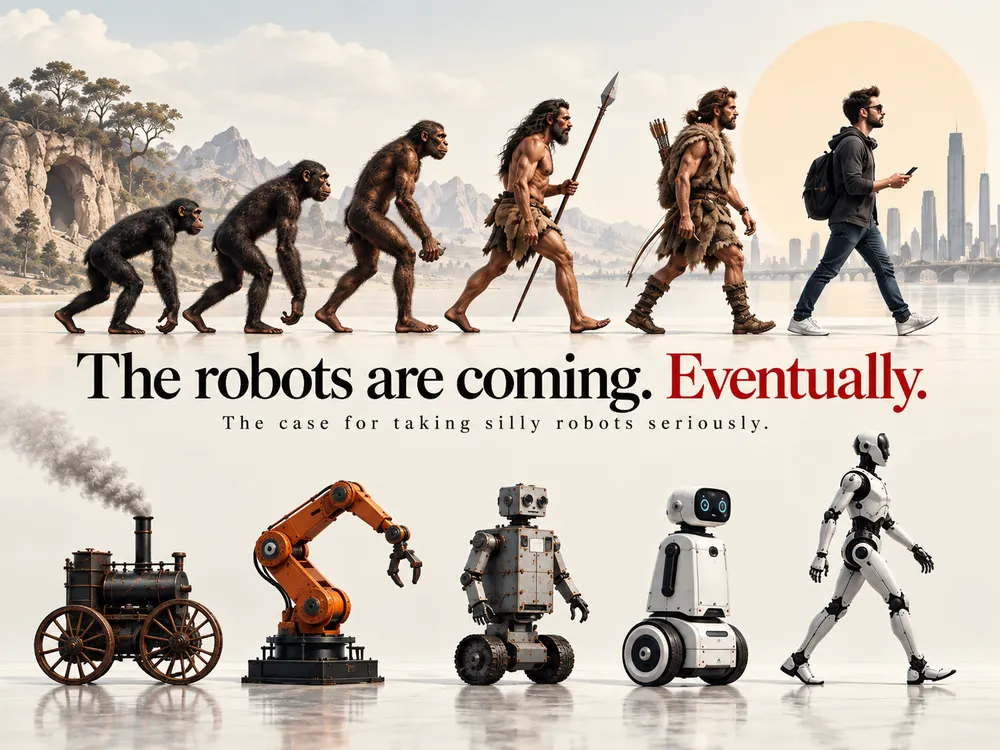
The World Humanoid Robot Games in Beijing have just wrapped up and judging by the footage, they were glorious, amazing, and thankfully, wonderfully hilarious.
The Wall Street Journal's take is that the genre delivers exactly what we need right now: pure physical comedy, schadenfreude and a reassuring feeling of superiority. One clip shows a bunch of two-legged machines on a 100m track in Beijing slamming full tilt into the finish-line barrier, collapsing and reeling like drunks. "More than one flopped backward in a cartoonish froth of sparks," John Jurgensen wrote. Others ran off the track entirely, or bashed into each other.
It was endless, and it was funny.
Except those same clumsy machines had just broken Usain Bolt's 100-metre world record. That's the first time that ever happened. Well, "first time" needs an asterisk: this is only the second Games. But last year, they weren't close. Tiangong Ultra's 100m time fell to 8.86 seconds this year from 21.50 seconds at the 2025 Games.
That wasn't the only human record to fall. In the 400m, a large-class robot ran 38.15 seconds, down from 1:28.03 a year earlier, beating Wayde van Niekerk's human world record of 43.03 seconds. In the standing high jump, robots cleared 3.40m against the widely recognised human record of 1.65m (Ray Ewry, 1900), roughly double, and up from just 0.95m at last year's Games. In the standing long jump, the robotic mark is 4.83m against the human record of 3.71m: only about 30% farther than the human best, but more than three times what a robot managed a year ago.
It's a bit like chess computers back in the day: interesting but inferior - right up until they beat the world champion.
Robots are having a moment. Better performance, more real-world deployments, rising sales, and a future that's gone from science fiction to just about conceivable. Dealroom says global VC investment into humanoid-robotics startups had already reached $8.7bn in 2026 by July 22, almost double the whole of 2025, with five months of the year still to run. China accounted for roughly two-thirds of that funding.
I think three things arrived at roughly the same time to make this happen.
First, AI. Models have become vastly better at vision, language, reasoning, and, increasingly, action. The crucial advance is what the industry calls vision-language-action models: large language models first learned to turn language into language, but these systems are learning to turn what a robot sees and hears into physical movement. Internet text alone isn't good enough to teach a robot physics. It needs to watch people actually doing things, at scale.
Figure's Helix 02, for instance, links vision, touch, balance, and movement through one neural system. Earlier this year, the company showed a robot walking around a kitchen, unloading and reloading a dishwasher for four minutes with zero human intervention. Its newer Figure 03 has now gone back to BMW's Spartanburg plant, where an earlier version (Figure 02) ran more than 1,250 hours, handled over 90,000 parts, and helped build more than 30,000 vehicles.
Second, simulation. A robot no longer needs 10,000 expensive hours of breaking crockery to learn to pick up a plate. Nvidia and others build enormous synthetic training environments and generate endless variants of a physical task from a handful of human demonstrations. Nvidia is building a whole "physical AI" ecosystem where robots train in simulated worlds and transfer what they learn to real machines; its GR00T models are effectively an attempt at a general software layer for humanoids.
Third, hardware built for entirely different industries has spilt over. Electric vehicles gave robotics better motors, batteries, power electronics, and manufacturing know-how. Smartphones handed over cheap cameras, inertial sensors, and computing power.
And then there are two enormous background concerns that robotics might help solve: fertility and war.
There's a reason humanoid robotics has taken off with such steam in China; the country has entered a demographic reversal of breathtaking speed. In 2025 there were 7.92 million births, down 17% from 9.54 million in 2024, while 11.31 million people died. The population fell by 3.39 million, its fourth straight annual decline. Twenty-three per cent of Chinese people are already over 60, while the working-age (16 to 59) population has fallen to about 851 million.
The consequences are enormous. The UN's central projection has China's population shrinking by roughly 204 million people between 2024 and 2054, and by around 786 million by 2100, meaning China would lose more than half its people. This isn't today's problem; China still suffers unemployment. But it has spent 40 years building the world's factory floor, and there's now a real, if distant, prospect that it could run out of factory workers.
Then there is war. The two grinding wars in Ukraine and the Gulf have put robotic tech everywhere, from drones to unmanned vehicles, and focused minds on whether the movie fantasy of robot soldiers might actually be coming.
There's no question wars are demonstrating the value of robots. But they're also demonstrating why the first genuinely successful robotic soldier probably won't look much like a soldier at all.
Ukraine is the laboratory. In May this year, Ukraine's Brave1 programme said ground robotic systems had completed more than 14,000 logistics and casualty-evacuation missions. Ukraine is now combat-testing cheap armed ground robots, while Estonia's Milrem Robotics expects more than 200 of its unmanned vehicles to be operating in Ukraine by year's end.
The Americans have moved just as explicitly. The US Army's xTechHumanoid competition exists to develop "militarised humanoids," which it defines, rather wonderfully for our purposes, as a technological replication of a human warfighter "in form, capabilities, and functions." The stated aim, initially, is to operate alongside soldiers and reduce their exposure to danger.
But here's the twist: humanoid robotics keeps teaching us, oddly, what fabulous creatures humans actually are.
A human retina alone holds roughly 90 to 125 million rods and 4 to 7 million cones per eye. Skin carries an estimated 200,000 to 270,000 nerve fibres wired to mechanoreceptors, about 17,000 of them in the hairless skin of one hand. Then add pain, temperature, proprioception, balance, hearing, taste, smell, and the internal sensors telling your brain what your organs and muscles are up to right now.
Cameras are cheap and extraordinarily good. Stick a few around a robot's head, and torso and you can give it better-than-human vision in some respects, including infrared, zoom, and 360-degree coverage.
But touch doesn't work like that. Give a robot electronic skin dense enough to know exactly what's happening across its whole body, and you've built yourself an engineering nightmare: more wiring, more power draw, more calibration, and more places for the thing to fail. A 2026 paper in Nature's flexible-electronics journal, npj Flexible Electronics, makes the point bluntly: pack in more sensors, and you buy structural complexity, harder fabrication, and higher costs.
Think about picking up a wine glass without looking straight at it: locating it in three dimensions, judging its shape and weight, placing five fingers correctly, sensing contact pressure, continuously correcting your grip, moving your arm while keeping your balance, and doing all of it almost without thinking.
Silicon Valley has made extraordinary progress giving robots something resembling a brain. The trouble is the brain is attached to a body still largely wearing oven gloves. This is partly the reason why all of this has actually taken quite a long time. It was 26 years ago that Honda unveiled ASIMO, the robot that really put humanoids into the public imagination.
But ... these problems are being ticked off, slowly. One 2025 system built optical fibres into electronic skin so a robot could detect molecular signatures using near-infrared light. A January 2026 project went after the manufacturing bottleneck directly, developing a cleanroom-free way to produce customised multimodal skin combining pressure, bending, temperature, and proximity sensing.
Laugh until you don't laugh.
There is an extraordinary boom in companies building humanoid robots right now, with Tesla, Figure, Boston Dynamics, Agility Robotics, 1X, and a swarm of Chinese companies including Unitree, AgiBot (you know, the agitated one), and UBTech all trying to build the machine science fiction writers spent decades warning us about. Nvidia and Google DeepMind are building the intelligence to drive them. Robotics is at the centre of China's industrial strategy for the foreseeable future.
But here's an odd thing: the people who invented humanoid robots in fiction mostly thought building them was a terrible idea.
Karel Čapek, whose 1920 play R.U.R. gave us the word "robot," was unusually blunt about it. "The product of the human brain has escaped the control of human hands," he told the London Saturday Review. "This is the comedy of science." In the play, robots are built to free humans from the tedium of work. They discover, eventually, that humans themselves are the tedious bit.
Isaac Asimov spent much of his career devising rules to stop robots from killing us (the three laws of robotics from I, Robot to which he later added the Zeroth law). Philip K. Dick wondered whether the more interesting danger was humans becoming machine-like, since "androidization requires obedience. And, most of all, predictability." (He also wondered whether androids dreamt of electric sheep, which gave us one of my favourite movies, Blade Runner). Kurt Vonnegut invented a humanoid robot who dropped napalm on people, but who scandalised the public mainly for having bad breath.
And then there was Douglas Adams, who gave us Marvin the Paranoid Android: phenomenal intelligence, naturally employed doing menial tasks. "Here I am, brain the size of a planet, and they ask me to take you down to the bridge. Call that job satisfaction? 'Cos I don't," he says at one point.
Marvin's most famous line was: "Life. Don't talk to me about life."
But you know, actually, do. 💥
From the department of the utility of not having too few immune systems...
 Tulane University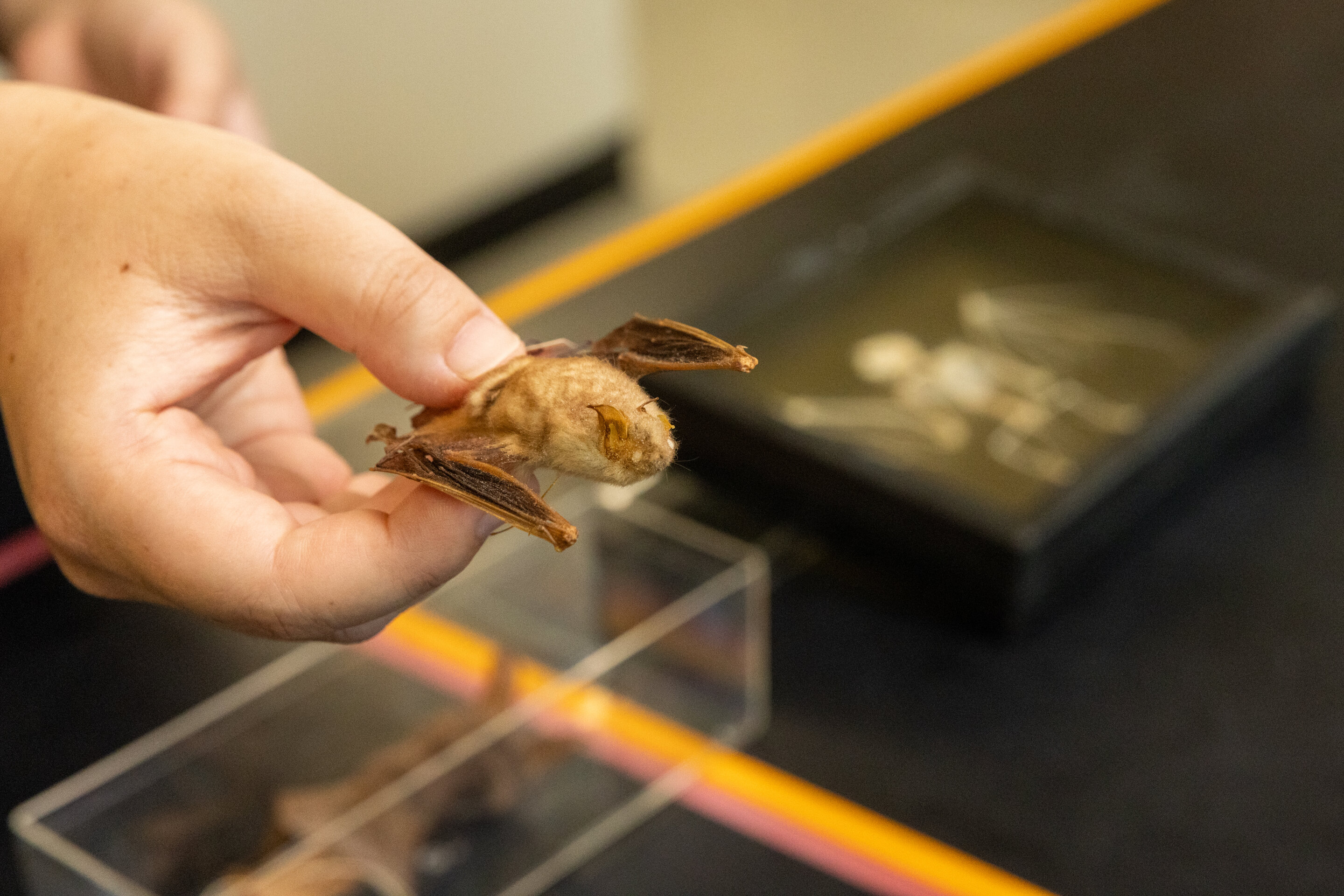
From the department of well, I just don't believe it ...

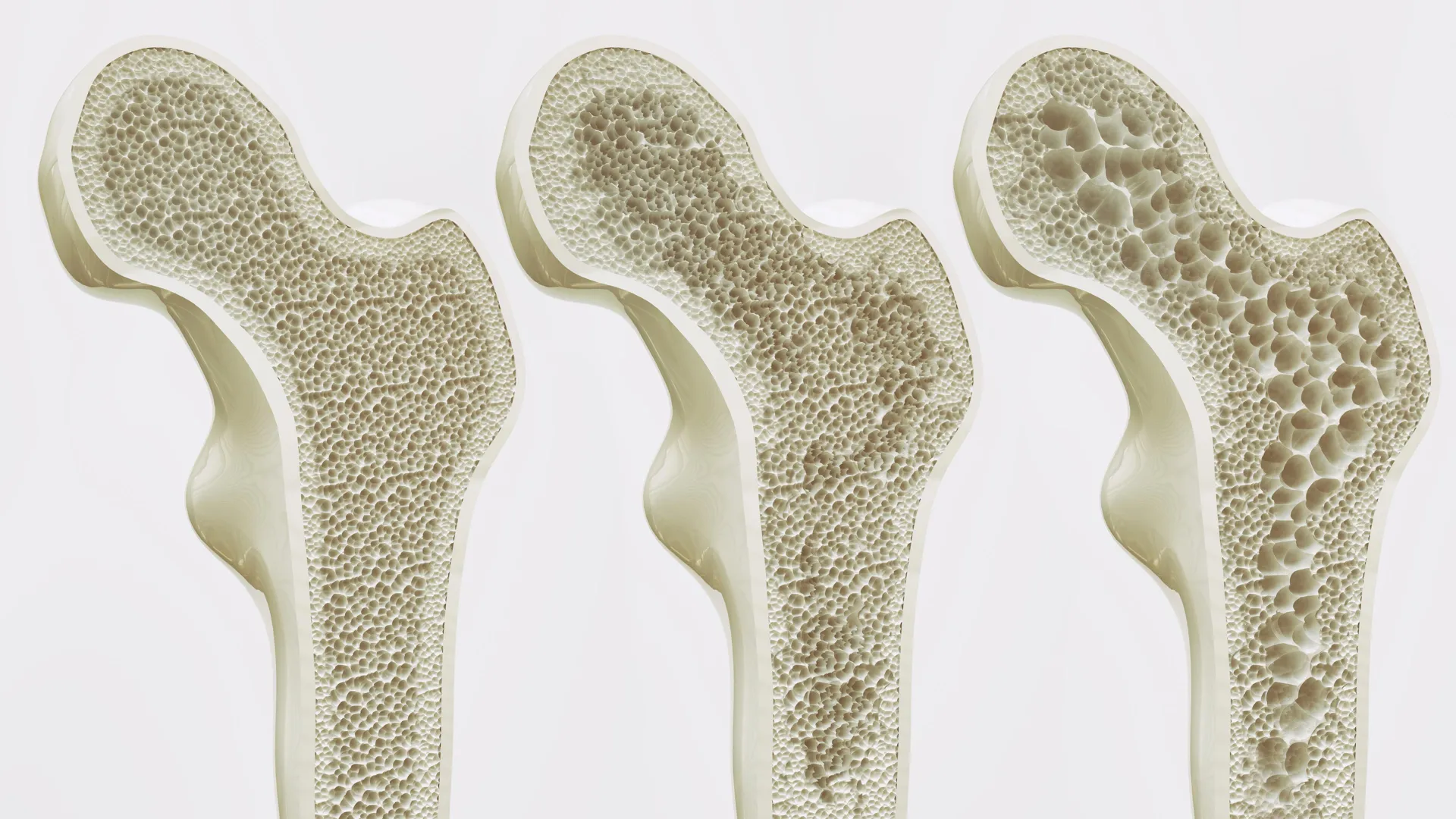
From the department of the mask coming off...


Thanks for reading - please share if you have a friend (or enemy!) you think would value this blog and ask them to add their email in the block below - it's free for the time being. If the sign-up link doesn't appear, you'll find it on the site.
Till next time. 💥