
I have known two spies, both in their own way honey traps, and their stories give me what I think might be a different perspective on the Jensen Huang affair (yes, I know, cheap pun). I say “in their own way” because both had grounds to object to the description, and one actually took it to the Press Ombud. We’ll get to her.
Honey traps, the use of love or sex to elicit information or manipulate a target, are a favourite subject of spy thrillers for obvious reasons. They are emotional quagmires. The possibilities for drama, twists, turns, and sex scenes are rampant. The heroines of honey-trap narratives always seem, by chance, to look great in tight leather bodysuits. Hello, Jennifer Lawrence, Scarlett Johansson, Charlize Theron, etc., etc.
But in reality, we know quite a bit about honey traps mainly thanks to the abrupt disappearance of East Germany, a country that went out of existence while a good deal of its filing system survived. What emerged about its secret police, the Stasi, was eye-popping in its breadth and foulness. Among the smaller surprises was that the attractive woman slipping a hand into the inside pocket of a diplomat’s dinner jacket had been cast the wrong way round: the successful perpetrators were more often men, known as “Romeos”, than women. Markus Wolf, East Germany’s foreign intelligence chief, appreciated something his Western adversaries tended to overlook: If you wanted to know what was in the minister’s correspondence, you could always ask the woman who typed it.
This content is free for the time being, but if you feel like buying me a coffee ...
The most celebrated case featured Gabriele Kliem, a translator at the American embassy in Bonn. In 1977, on the banks of the Rhine, she met a handsome blond physicist called Frank Dietzel. Her previous love had been a handsome blond maths teacher, a detail the Stasi had gone to the trouble of establishing. Within three months they were engaged. Over seven years she gave him hundreds of embassy documents, believing they would help with his work for peace. Only when she was arrested in 1991 did she discover that her former fiancé was a married East German officer who had received a medal for his work with her. Some of her love letters had gone to Stasi psychologists, and many of her presents to him as a precursor to their life together had gone to his actual wife.
Which brings me to the first spy I knew, Stephen Laufer. South African readers may remember him as an associate editor of Business Day. I was also a Business Day employee at the time, and we began as respectful colleagues (I didn’t know about his history at the time) and ended as bitter enemies. What I remember about him was an odd kind of neediness and loneliness, despite being genuinely affable and entertaining.
One little detail: he was constantly complaining about the fact that he didn’t have an office of his own (I did). But the real bitterness concerned South Africa’s famous arms deal; Laufer was the person in the newsroom almost vociferously in favour of the deal, while my feelings toward it began as quizzical and ended as definitively against. Laufer eventually left Business Day to work as a press officer for the consortium negotiating the deal, which was increasingly necessary because the bribery involved in the deal was becoming increasingly public.
But way back when, Laufer lived in Germany at the most tense time of geopolitical rivalry at the height of the Cold War. As deputy press officer at the American mission in West Berlin, he was precisely the man a journalist wanted to know, and apparently the Russians had come to much the same conclusion. Berlin correspondents remembered him as a splendid gossip with an excellent line in background briefings.
Laufer actually dated the daughter of General James Boatner, the American commander in West Berlin, for about a year. They were engaged to be married but ultimately didn’t. When the Berlin Wall came down, there was at least one person definitely not celebrating. Stasi spies, hoping for lesser prison sentences, apparently ratted on Stephen who was a KGB spy (the Stasi and the KGB didn’t trust each other, so they both ran spies in East Germany). In 1992, a German court gave Laufer an 18-month suspended sentence. Whether Moscow ordered the courtship, or got so much as a lunch menu out of it, is unknown.
Actually, in a way, I sympathise with Laufer’s predicament. His father, a South African communist who had settled in East Berlin, introduced Stephen to his Soviet handler. Stephen told the court his father had given him to understand that his parents’ right to remain there depended on his co-operation. After his father died, his mother was ill, and Stephen hoped to bring her across to the West. She died before he could. A young man might have quite a high opinion of his ability to resist the blandishments of Soviet intelligence, but still find it really difficult to say no to his dad.
The other spy I knew was Olivia Forsyth, who arrived at Rhodes University in the 1980s with an extraordinary capacity for student politics somewhat boosted, it must be said, by good looks and a flirty personality. She edited the student paper, chaired the local End Conscription Campaign and even chaired a mass meeting about the prevalence of police spies on campus, a subject on which, for once, the person chairing a student meeting could claim genuine expertise. She was, at the time, a serving officer of the Security Branch.

In left-wing Rhodes circles there reputedly circulated at one point a badge of distinction which read, “I did not sleep with Olivia Forsyth.” When a journalist investigated the story years afterwards, nobody could reliably remember an actual badge, although the joke had survived in excellent condition. But I moved in the same circles as Forsyth at the time as a student at the University of Natal, and I know for a fact she was pretty free with her favours, which, somewhat embarrassingly, did not extend to me.
Forsyth actually acknowledged relationships on both sides of the political divide, including with her first spymaster and an ANC man in exile. She also said her orders expressly forbade affairs with the enemy and disputed the suggestion that she slept with people to obtain information. Ja. Right.
Yet the person whose account best explains how Olivia operated was a woman who had shared a house with her. Bridget Hilton-Barber regarded Olivia as one of her closest friends. She spent three months in detention without trial in Port Elizabeth and discovered after her release that her friend had betrayed her. Think what that does to your memories of an ordinary evening at home. You can reconstruct what you told your friend. How do you reconstruct which parts of her answer she meant?
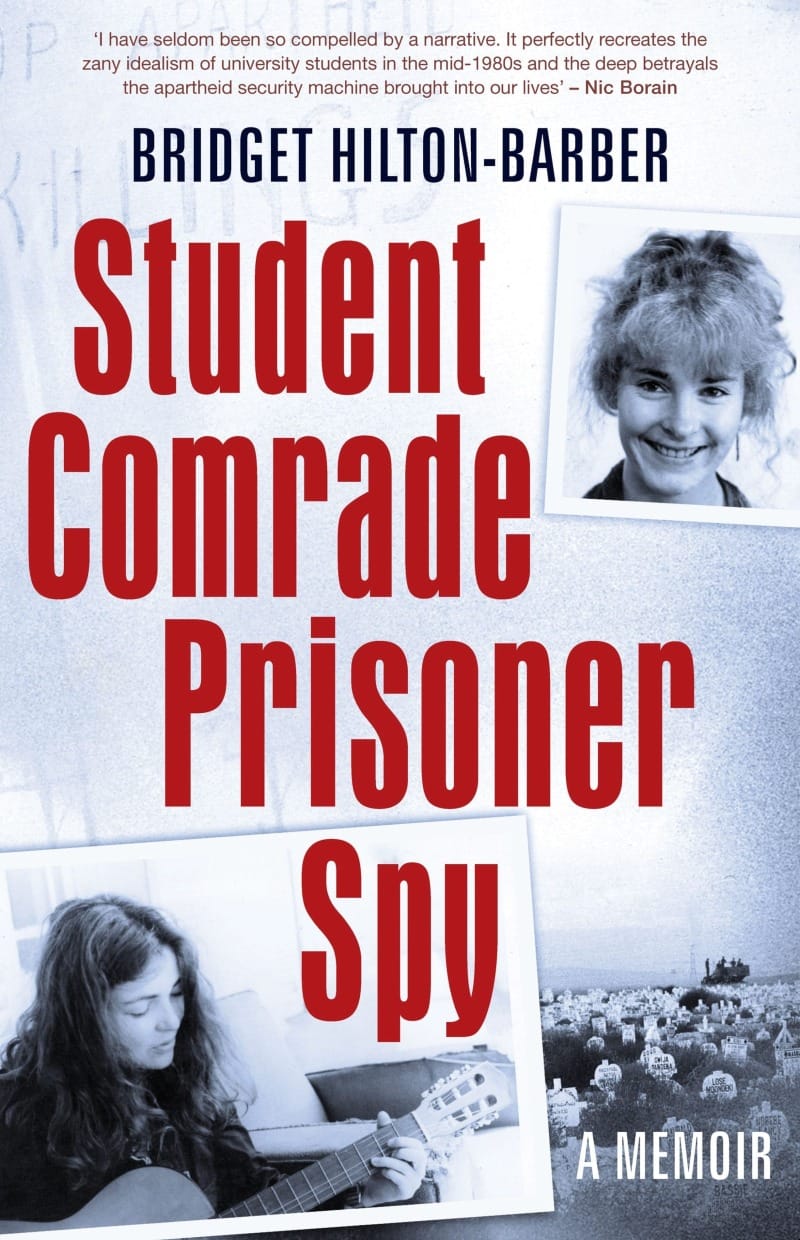
Olivia herself actually tried to change sides - and then changed back again. By her account, she had come to believe the activists were right. When she skipped the country and tried to join the ANC in Zambia, they had excellent reason to appreciate her talents, so she was promptly locked up in its Quatro camp in Angola. She spent seven and a half months there. It is a peculiarly lonely achievement to have made yourself such a convincing friend that when you finally offer your friendship in earnest, nobody in their right mind will accept it.
As he related in his memoir, Man Without a Face: The Autobiography of Communism's Greatest Spymaster, Stasi head Markus Wolf related that one of the qualities Wolf’s service looked for in a Romeo was empathy. But of course being able to tell that somebody is unhappy is a separate accomplishment from deciding what to do about it. A surprising number of Wolf’s men were ordinary-looking people whose great distinction, according to a journalist who attended the women’s trials, was that when a woman spoke, they listened. One hesitates to contemplate quite how much classified Western intelligence might have been saved if the local competition had occasionally thought of that.
On the subject of Western intelligence, it's interesting that the CIA rather frowns on honey traps. A former operations officer, Thomas Mulligan, recalled an explicit prohibition on blackmail and sexual exploitation when he was trained. His explanation was practical. A person frightened into cooperating has every reason to tell the officer what will make the threat go away. The officer still has to decide whether any of it is true
I wonder, too, about the neediness and psychology on the agent’s side. A chip on the shoulder, the feeling that nobody has quite appreciated what you have to offer, might make an invitation to do something secretly indispensable very appealing. Two acquaintances make a rather small sample, particularly when both have had professional training in giving you the wrong impression. But what does strike me about Stephen and Olivia is that both were conspicuously good at belonging. Each found a place among people whose company depended on their keeping an enormous part of themselves out of the conversation. For all their sociability, it must be a terribly lonely way to live.
And so to Huang Le, also known as Alice Huang, a former Chinese television reporter who worked in finance and in 2023 became a director of Megaspeed, a Singapore-based customer of Nvidia. Here, surely, is the woman from the opening scene of the spy thriller? Well, possibly.
But consider how differently her story reads depending on where you put the camera. The New York Times reported that US intelligence linked Alice to a Chinese operation targeting Jensen Huang. Megaspeed was investigated over whether advanced American chips reached China in breach of export controls. Singapore seized her passport, subsequently said it had insufficient evidence to establish that she had committed an offence, but barred her from returning after she left. Beijing denies the spying allegation. The US attorney-general said this week that his department had yet to reach a conclusion on it.
Jensen Huang acknowledged being unfaithful to his wife. Reuters reported that he had twice given Nvidia colleagues a misleading account of his relationship with Alice. Then came reports of a separate affair with an executive who reported to him, and on November 12 he resigned as chief executive of the company he had helped found 33 years earlier. Cheating on your wife is one thing, apparently, but cheating on your mistress is really unconscionable.
But what about Huang Le, or Alice Huang? The most salient personal detail about her is that the man who introduced her to Jensen Huang (they are not related, of course) was her husband, Kang Wei. Kang was a Chinese fund manager who had known Jensen for about a decade. They had met in Asia through the video-game business, back when Kang invested in gaming companies, and Nvidia was best known for graphics chips.
People who knew the couple told the Journal that, for about two years, Kang appeared to accept the affair and spoke openly about how close the two had become. He would sometimes tell associates, half-jokingly, that his wife was Jensen’s “personal assistant”. Kang and Alice were also business partners building Megaspeed together.
Doesn’t that just underline my point about the neediness and loneliness - and sadness - in the very unsweet business of being a honey trap?💥
From the department of keeping careful track ...
From the department of the original high society ...
 University of Bern

From the department of the longest commute that never left the car park ...
 Sumer Loggins

Thanks for reading - please share if you have a friend (or enemy!) you think would value this blog and ask them to add their email in the block below - it's free for the time being. If the sign-up link doesn't appear, you'll find it on the site. And my book - based on these columns - has just been published, get it here!
By all means respond in the space below or email me directly.
Till next time. 💥