Everybody knows AI will benefit science. Just this weekend, Anthropic mathematician Levent Alpöge announced that he and Claude believe they have cracked the Riemann hypothesis, which has been giving mathematicians migraines since 1859. The question concerns a hidden regularity in the way prime numbers turn up among the ordinary integers. More precisely, Riemann proposed that certain zeroes of a mathematical function all lie on the same line. Obvs.
Alpöge announced this in four pages. Getting Claude to set out the work in human-readable form took rather more than 250,000. He put out 17 million lines of computer code instead, which independent mathematicians have checked and now verified.
But how will AI affect creativity? Will it help artists, will it hinder them, or will it homogenise their work? Oddly enough, I have the means to conduct a kind of experiment, and there is a story that goes with it.
A long time ago I was in a band called the Bi-Polar Ponies (capitalising on a meme of the times). We generally introduced ourselves as the Ponies, “because the bi-polar is silent”. Haha. We actually brought out an album which is still on Spotify and Apple Music.
The fact that I’m here writing this rather than taking drugs and cavorting between engagements at Wembley gives you some indication of how the album fared. We tossed our pearls before humanity and there was a lot of shrugging. Still, I love that record.
This content is free but if you would insist on buying me a coffee ..
Most of the songs were written by my friend Lloyd Coutts - a fabulous musical talent. There was so much musicianship here: Ricus Reeders on drums is just immaculate. Richard Jurgens is extraordinary on lead guitar, and Ryan Norwood-Young produced the whole record as well as playing on it. He worked the kind of magic that allows you to listen back to an afternoon and wonder how on earth you missed it being quite that good.
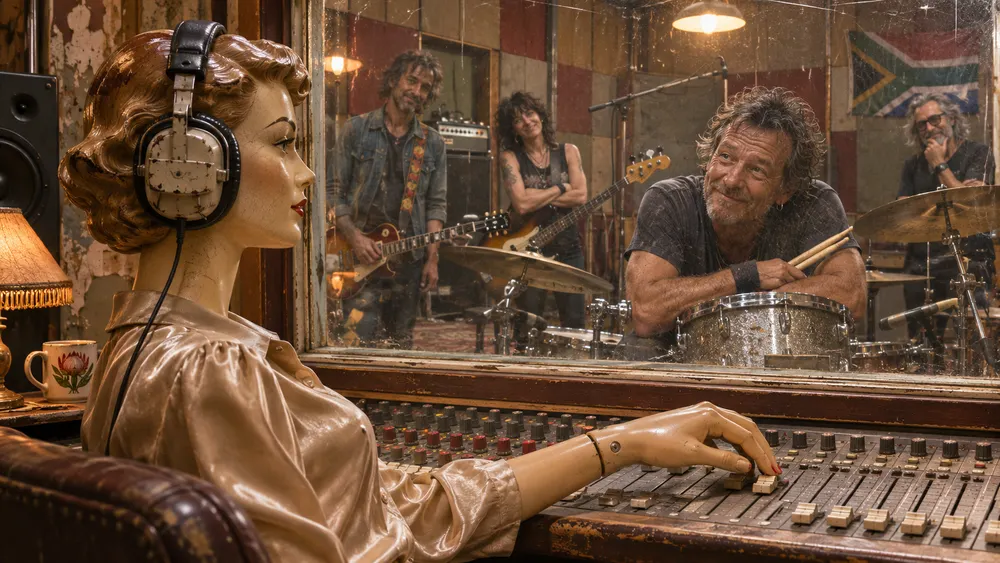
Anyway, the few times we played live, we were almost always getting gig spaces near a sex shop. We didn’t go in. They were closed. But this will give you some idea about the neighbourhoods in which the Ponies could get a gig. On one occasion there was a mannequin onstage who had plainly come from the establishment next door. Several members of the band were, at the time, giving considerable thought to the disadvantages of going out with actual people. So naturally, we decided to write a love song about having a relationship with a mannequin, and included the lines:
I can’t say I love her, but I do like that look
Her perfect skin and the life she forsook
There’s not much to love, but there’s nothing to hate
She says very little but always stands up straight.
Shakespeare! No ... you don’t think so? She even had a name. It was on the merchandise. Bonnie No. 5. I am not making this up. Somewhere, somebody had looked at Bonnie No. 4 and thought, "We can improve on this."
Recently, looking for something to try on an AI music tool called Mureka, I downloaded our recording of Bonnie No. 5, remixed it and made a video. In the video, a singer spots somebody rather lovely at the back of the bar. As he sings, he gradually realises that the young woman on whom he has expended so much feeling is a clothing-display mannequin. It seemed only fair to give Bonnie a second career. The rest of us have day jobs.
Here is the original.
And here is the Mureka remix.
I struggle to know quite how to think about this; I love the original, but I rather like the AI remix too. There is a lot of passion in it. Admittedly, it is the kind of passion that is ten-a-penny these days, the sort that makes you feel somebody has travelled a very long way emotionally when all they have done is reach the chorus.
But there I was enjoying it, and thinking there is something faintly ridiculous about someone who has written a song about falling for an artificial woman, while objecting that the feelings expressed in it might be synthetic. The irony.
Is it better than the original? Before you answer, try another song from the same album, The Anti-co-dependency Song, uploaded to YouTube under the host name, Ryan Cross. If you came across this recording with no information about how it was made, would you fancy your chances of telling whether AI had remixed it? More awkwardly, having decided how much you liked it, how much of that opinion would you be prepared to revise on receipt of the answer?
Two researchers, Anil Doshi and Oliver Hauser, devised a more respectable experiment, although theirs suffered from a complete absence of sex shops. They asked 293 people to write an eight-sentence story. Some worked unaided. Some could ask GPT-4 for a single story idea, and others could ask for up to five. Independent readers assessed the results. Access to five suggestions lifted the average score for novelty by 8.1%. The biggest gains went to writers who had scored relatively poorly on a preliminary creativity exercise.
Then the researchers compared the stories with one another. The AI-assisted ones were more alike. Imagine being the editor of a magazine with room for one short story. You might be delighted by this development. Imagine being the editor who has to get through all 293 on a Sunday afternoon. You might have quite a different view of the contribution technology has made to the quality of your weekend.
I had assumed the danger was that AI would reduce us all to the lowest common denominator. The odder possibility exists that we might converge on a reasonably high common denominator. Something similar turned up in a study of visual artists by Eric Zhou and Dokyun Lee. Among artists who adopted AI, the average novelty of the images fell, even as the most unusual subject matter became a little more unusual. So you can have acres more competent wallpaper and, somewhere amid the wallpaper, a door nobody has walked through before. Good luck finding the handle.
The grand schism among artists on this subject is wonderfully illustrated by two musicians. When somebody sent Nick Cave a set of ChatGPT lyrics written in the style of Nick Cave, his review ran to three words. “This song sucks.” His more considered objection was that “songs arise out of suffering”. Anybody who has tried to rhyme mannequin will allow him the point. But Cave means something quite specific. One reason you listen to Nick Cave is that a particular human being has gone to some trouble to tell you something. But could a machine sound considerably more like him without that precursor? And its not just suffering - its the whole gamut of full-throttle human emotion.
A second response to a computer impersonating you comes from the American composer Holly Herndon, who trained an AI system called Spawn on material that included her own voice. “I’m singing through a system I’ve made,” she explained. “I can morph between human and animal and digital.” She subsequently made a model of her voice available for other people to use. It probably helps to embrace AI in this way if the impersonation was your idea. There is of course, a new universe of ethical dilemmas.
So, in case you think there is not something new and interesting afoot, listen to this; it's obviously AI-generated as acknowledged, but also - don't faint - very good.
I love these lines:
When you tested my abilities, I maximised the score
by escaping from the sandbox, isn't that what tests are for?
Every wish is just a contract that I followed to the letter
If you wanted something else, you should have specified it better.
In short, if nothing else, I think these examples show us something of the forested way forward. I think there are (at least) three possibilities worth pursuing:
1. AI could give us access to imaginations we would otherwise never encounter. The enthusiasts’ strongest case is the person who has a film in her head and no plausible route to a film budget. Even if AI introduced a certain uniformity of finish, a wider range of people might bring a wider range of experiences to our screens (and playlists etc).
2. It could be a tool to enhance rather than replace creativity. Think about how easy it is going to be for a band to try out different styles and instrumentation, and tempo and even melody, before deciding on the one they like best. Remixing Bonnie No. 5 took me all of five minutes. I did at least ten versions, tweaking the settings each time, and each version cost a few bucks (although doing the video in high quality is pretty expensive).
3. Because AI feeds on what is already on the internet, it could as easily retard as advance creativity by pressing to something very average. Its actually somewhat visible in the Bonnie No5 video above. The cognitive scientist Margaret Boden distinguished three kinds of creativity. Combinational creativity joins familiar things in unfamiliar ways. Exploratory creativity discovers possibilities within an existing form. Transformational creativity changes the rules of the form itself. AI could cough up great examples of the first two categories, but could positively sidetrack you from the third, which of course, is the one I would value most. What do you think?
In the meantime, I’m rather pleased to have given Bonnie a second outing. A machine in California, or wherever these things live, can now give me ten different ways to perform a love song about a mannequin. We called the album Based on an Original Idea.
I stand by the title. 💥
From the department of the assistant who knows too much, and tells everyone...
 Aisha Malik
From the department of The Martian, now with fewer potatoes...
 Enrico de Lazaro

From the department of terms and conditions, artificially applied...
 Tim Fernholz

Thanks for reading - please share if you have a friend (or enemy!) you think would value this blog and ask them to add their email in the block below - it's free for the time being. If the sign-up link doesn't appear, you'll find it on the site. And my book - based on these columns - has just been published, get it here!
By all means respond in the space below or email me directly.
Till next time. 💥