It’s amazing how Dolly Parton’s death has prompted an outpouring of grief beyond what you might expect for someone of her fame, generosity, and ability. Her careful lifelong effort to appeal to a wide audience, her ebullience, and her spirited humour, combined to produce a genuinely heartfelt torrent of tributes.
Some of the reactions have been wonderful. Kacey Musgraves said simply that “the world feels a lot less sparkly all of a sudden”. Taylor Swift described Parton as “true grace and true grit, all in one dazzling person”. Perhaps Carrie Underwood came closest to explaining the scale of the mourning: Parton, she said, “was probably the one person on planet Earth that everyone loved and could agree on”.
In an era of sharp differences and sharper elbows, Parton was and remains a rare, cherished, unifying figure.
Personally, I liked her music, admired her deft songwriting - 3000 songs! - and loved her wonderful quips and quotes. But in truth, I would describe myself as an admirer rather than a fan; many of her songs were a little on the syrupy side for me.
Perhaps one thing that has been overlooked in the fanfare is how adept she was at business. In all honesty, she doesn't have much more to tell the world about love, heartbreak, jealousy, and the general calamity of human relationships than we already know, notwithstanding the artistry with which she did it. But I suspect she has an enormous amount to tell us about money.
There is a line widely attributed to Parton that goes: “Every day I count my blessings. Then I count my money.” I haven't been able to establish that she actually said it, which is a pity because she really should have. What she definitely did say was almost as good: “I count my blessings more than I count my money.” And then, inevitably, came the Dolly kicker: she worked hard to make the tons of money doing what she loved because, as she had always joked, “It costs a lot to look this cheap, and I need the money.”
By the end of her life, Forbes estimated Parton's fortune at $450 million - an extraordinary sum for someone who began earning in an industry notorious for making everyone except the songwriter rich.
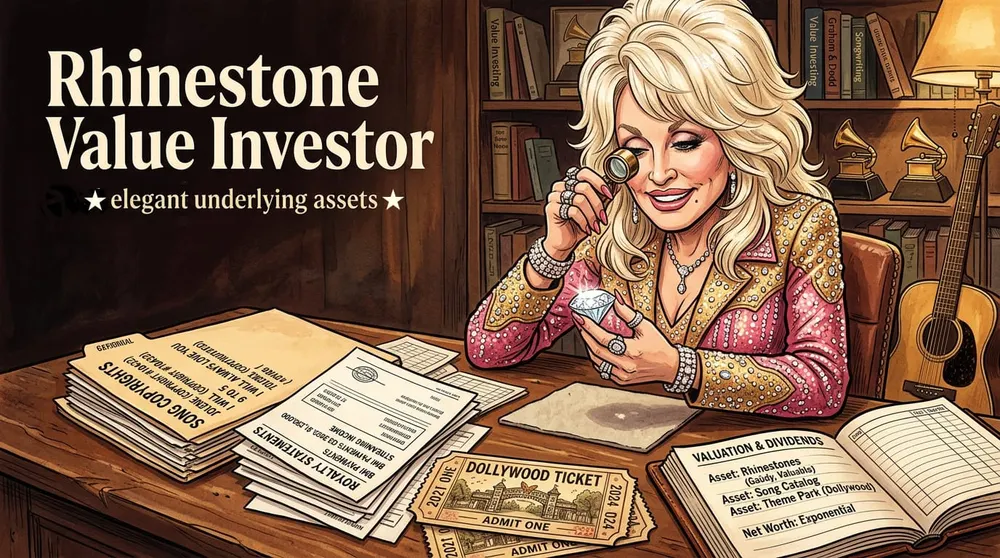
AI video by Grok
Her fortune puts her in extremely rare territory, though no longer at the absolute summit. Forbes currently lists Taylor Swift at about $2 billion, Bruce Springsteen at $1.2 billion, with Beyoncé, Rihanna and others also crossing the billion-dollar mark.
But Dolly's $450 million is arguably more impressive than the raw ranking suggests. She earned most of her money in an era when the economics for musicians were far worse. No $2-billion Eras Tour, no Spotify-scale global monetisation, no modern stadium ticket pricing. Springsteen's fortune, for example, received a single $500 million boost from selling his catalogue; Dolly kept hers. She also gave away huge swathes of her fortune, unlike most of her musical contemporaries.
But Parton was obviously not Warren Buffett in a push-up bra. She was a singer-songwriter who became extremely rich principally by investing in the one asset about which she possessed an enormous informational advantage: Dolly Parton. Still, given this constraint, if you want to call it that, by all indications she played her cards extremely well.
The most famous example of her determination to retain control over the song I Will Always Love You. Elvis Presley wanted to record it, which for a young country songwriter should have been the financial equivalent of the heavens opening and raining dollar bills. Unfortunately, Colonel Tom Parker, Elvis's manager, wanted half the publishing rights.
Parton said no.
Think about how hard that decision must have been. Elvis was Elvis. She was Dolly, but not yet Dolly. The immediate prestige, exposure, and money would have been enormously tempting. Yet she understood that the song was the asset and the publishing rights were the ownership of the asset, and she wasn't going to give half of it away for the privilege of somebody more famous singing it.
It sounds obvious now. Most good investments do.
Nearly two decades later Whitney Houston recorded the song, it became one of the biggest singles in history, and Parton retained the publishing income. She later joked that Houston's version had made her enough money to buy Graceland.
Investors routinely forget this because financial markets are full of Colonel Tom Parkers. Everyone wants a slice. Bankers want fees, managers want options, private-equity firms want preferences, governments want taxes and, occasionally, the chap standing next to you simply wants half because he has brought Elvis.
Parton had understood the importance of ownership astonishingly early, and long before many of her musician colleagues discovered it. When her original publishing contract expired in 1966, at the age of 20, she and her uncle set up their own publishing company. She subsequently retained the rights to nearly all her songs. Decades before music catalogues became fashionable financial assets selling for hundreds of millions of dollars, Dolly had already worked out that the pretty bit was singing the song but the valuable bit was owning it.
Paul McCartney, rather unusually for a musician paying tribute to another musician, specifically saluted her as “a very clever businesswoman” - smarting perhaps because the Beatles never owned their early catalogue.
She also understood something investors tend to learn painfully: appearance and value are different things. The aforementioned quote, "It costs a lot of money to look this cheap” is surely one of the great value-investing aphorisms, even if that was not remotely what she meant by it.
Markets are hopelessly susceptible to appearances. Expensive companies can look cheap because their shares have fallen. Cheap companies can look expensive because the share price is high. Glamorous businesses can be terrible investments; deeply unfashionable businesses can quietly compound money for decades.
Dolly herself was an exquisite warning against superficial analysis. Everything about her said frivolous: the wigs, the breasts, the fingernails, the rhinestones, the distinct Tennessee accent, and magnificent determination to dress as though a Christmas tree had won the lottery.
But underneath she was an extremely serious operator.
That may be another useful investment quality: self-awareness. One of the great dangers in markets is encountering executives who have fallen in love with their own annual reports. Parton's great defence against pomposity was to puncture herself first. She knew the hair and the rhinestones were ridiculous; that was why it was so good. She even once said, "I look like a woman, but I think like a man. I've done business with men who think I'm as silly as I look. By the time they realise I'm not, I've got the money and gone."
There is another fascinating overlap between Dolly and investing: diversification.
Not financial diversification, obviously. By conventional portfolio standards, Parton was terrifyingly concentrated. A huge portion of her wealth was invested in her songs, her name, her image, and Dollywood. Her largest asset was essentially herself. But her audience was extraordinarily diversified, particularly for an American country music singer.
This may have been her greatest commercial achievement. Dolly Parton was loved by people who probably can't agree about much else.
Traditional country audiences saw faith, family, and Tennessee. Feminists saw a woman who had the agency to walk away from a controlling male mentor, owned her copyrights, and ran her own businesses. Gay audiences adored the camp and her tolerance. Black fans appreciated her work with black artists, lack of prejudice, and tangible acts of alliance. ("Do we think our little white asses are the only ones who matter? No!") Working-class Americans recognised someone who never became embarrassed about poverty. Metropolitan hipsters eventually discovered, sometimes with apparent astonishment, that Jolene is an almost perfect song. Johnny Rotten loved it. Patti Smith performed it. The Sisters of Mercy and Beyoncé, covered it. Meanwhile everyone's grandmother had been listening all along.
The extraordinary thing is that Parton achieved this breadth without becoming bland. Usually, when brands try to appeal to everybody, they end up meaning nothing to anybody. Committees get involved. Edges are sanded down. Somebody suggests changing the colour of the logo to teal. Parton went the other way.
The bigger the audience became, the more Dolly she became. That strikes me as a genuinely important lesson about valuable franchises: the very best can widen their market without weakening their identity. Parton had a strong identity but an extraordinarily low barrier to entry.
Dollywood itself may be the most Dolly investment imaginable.
Having made money in Nashville and Hollywood, she invested it near where she grew up in eastern Tennessee. In 1986 she partnered with an existing amusement-park operator and attached her name, history and cultural capital to the business. Annual attendance sits at around 700,000, and Dollywood subsequently became Tennessee's most visited ticketed tourist attraction and, according to Forbes, the largest single component of her fortune.
The investment does suggest something about a circle of competence. Parton didn't suddenly decide that her real edge was in Indonesian nickel futures. She invested in music, entertainment, tourism, Tennessee, and Dolly Parton. She understood the customer because, in important respects, she was the customer.
And then comes the really interesting bit - giving her money away.
Parton was deeply philanthropic without ever adopting the faintly reproachful manner of people who regard having money as a character defect. She seemed to see making and giving as parts of the same process.
“I don't work for money, never did,” she once said. And when she gave money away, she was equally allergic to sanctimony. Receiving the Carnegie Medal of Philanthropy in 2022, she claimed not to have much of a strategy: “I just give from my heart.” If she saw a need and could fill it, she said, she would. Then she immediately skewered the whole celebrity-philanthropy business: “I don't do it for attention. But look! I'm getting a lot of attention by doing it.”
In reality, some of her giving was enormously sophisticated.
Her Imagination Library, begun because her father could not read or write, grew into a vast book-distribution operation that has now sent more than 330-million books to children. She funded scholarships, hospitals and disaster relief, and put $1m into Vanderbilt research that contributed to the development of the Moderna Covid vaccine.
Perhaps that is why the response to her death has been so unusually emotional. People are not merely mourning a singer. Kathryn Schulz, writing in the New Yorker, suggested she was uniquely democratic: "Part Betty Boop, part Annie Oakley, part Abraham Lincoln." They are mourning a public figure who somehow managed to become enormously famous, enormously rich and enormously recognisable without acquiring the usual hard shell of celebrity. She seemed to understand it all so instinctively.
Perhaps her best financial insight was therefore also her simplest. Count your blessings more than your money. But count the money. 💥
From the department of underpants utility ...


From the department of the fire pool's final invoice...
 Nonkululeko Njilo
From the department of the cephalopod's superior proofreader...
Thanks for reading - please share if you have a friend (or enemy!) you think would value this blog and ask them to add their email in the block below - it's free for the time being. If the sign-up link doesn't appear, you'll find it on the site.
Till next time. 💥