Is there such a thing as “national culture” and if there is, how would you identify it? One possible way might be to compile the words that are unique to a language and try to draw some conclusions about a national culture from them.
This has no danger of falling deep and hard into a stereotypical crevasse, right? There is no possibility here of being instantly and permanently cancelled, right? Sensible, careful journalists stay away from topics like this because the risk of tripping over some cultural nuance is just huge. But fortunately, I’m not sensible, and you know what? Even if they deny it, people do think this way.
Also, it's irresistible. Just take French for example, or your image of France, or … let's be honest … the French stereotypes most readily to hand. I was watching a YouTube video done by an actress, Angelique Joan, who was born in the UK, grew up in France, and who does lots of videos on the English/French divide. She helpfullyl gives us below seven words that only exist in the French language.
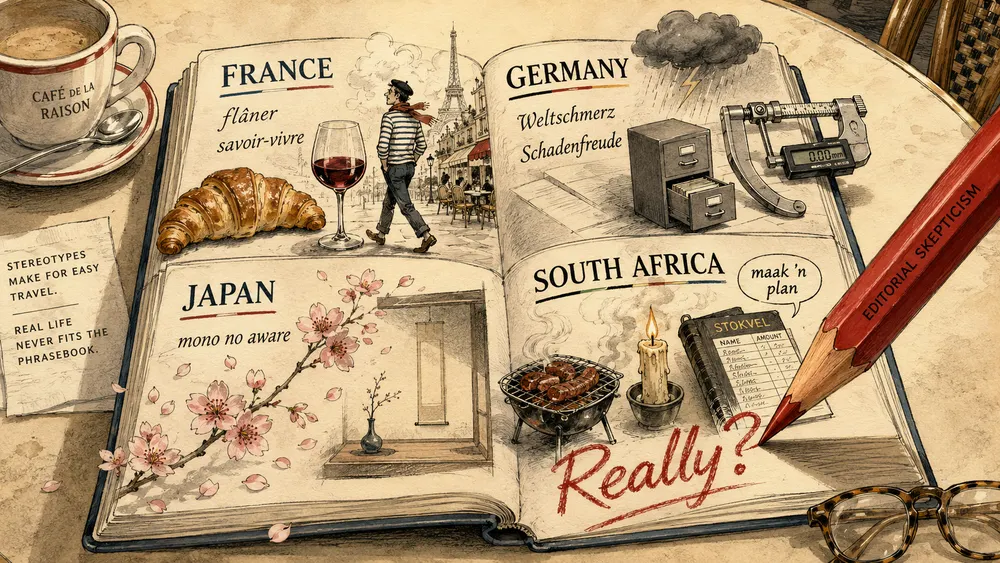
The words, flâner (to walk without urgency, observing and enjoying one’s surroundings), dépaysement (feeling out of one’s element), retrouvailles (the happiness or emotion of meeting again after a long separation), bon vivant (someone fond of good food, wine, company, and pleasure) la flemme, (to lack the energy or inclination to do some thing), tartiner — to touch or feel gently and tentatively, to handle delicately, and savoir-vivre (knowing how to behave elegantly or appropriately in society).
I mean, isn’t this the most French stuff ever? Can you, or can you not, imagine someone strolling around Paris in the springtime because if you live in the city of light je flâne toute les temps. That is what you are doing when you are not eating and being a bon vivant, spreading your butter on your croissant tartiner. It fits perfectly, doesn’t it?
Well, of course, but you have to beware of inverting the causation. There may be a real signal here, but it's buried under considerable noise, not to mention the way we talk about our conclusions after a fair amount of ex post facto reconstruction. In order to test this theory, I did what all good researchers do: I asked my friends, which may explain the preponderance of Scottish and South African words. But also ChatGPT, and then I checked ChatGPT with Claude - and frankly I slightly disagree with both of the AIs.
But just for fun, let's gallop down this dangerous side path, which probably goes nowhere.
Claude affirms the idea (always suspicious when an LLM does that), but the explanation is logical, as you might expect. “Language does encode cultural preoccupation. When a culture develops a single, precise, widely-used word for something — rather than a clunky phrase — it suggests that thing comes up often enough to need efficient labelling. Vocabulary density in a particular domain is meaningful.” Nice.
Claude cites some alignments that it says are genuinely striking:
- Portuguese saudade is perhaps the most convincing case. It's not just a word; it is a structuring myth of Portuguese national identity — the bittersweet longing for something loved and lost or never had — and it connects coherently to the history of maritime exploration, dispersal, and absence. The word, the literature (the fado tradition), and the historical experience form a genuinely coherent triangle.
- Japanese aesthetic vocabulary — mono no aware (the pathos of transience), wabi-sabi (beauty in imperfection and impermanence), ma (meaningful negative space or pause) — clusters around impermanence, incompleteness, and indirection in ways that do seem to connect to Buddhist influence, island geography, and aesthetic traditions going back centuries. Shōganai, a graceful acceptance of what can’t be changed, fits this cluster naturally rather than standing alone.
- Danish hygge aligns plausibly with Nordic social egalitarianism — the deliberate cultivation of unpretentious, candle-lit domestic warmth as a counter to hierarchy and status performance. It's not accidental that this emerged as a named value in a flat, high-trust, egalitarian society.
- Russian toska (Nabokov described it as a longing with nothing to long for — anguish of the soul) and dusha (soul, but with a vast penumbra of moral and spiritual weight) do connect to the Russian literary tradition of intense interiority and suffering as ennobling.
But Claude also warns that selection bias is severe: “We discuss the words that confirm existing stereotypes and quietly ignore the ones that don't. There must be thousands of untranslatable Japanese words that have nothing to do with fatalism or aesthetics, and thousands of German ones unrelated to orderliness. The sample we circulate culturally is pre-filtered through the stereotypes we already hold”.
Ultimately, Claude says words that are characteristic in a language are not entirely a parlour game, but it warns that it involves cherry-picking, circular reasoning, and projecting a false unity onto hugely diverse populations. “The words are real data points; the national character narratives built around them are mostly stories we already wanted to tell … vocabulary density and specificity in certain semantic domains is a weak but real signal of cultural preoccupation.
ChatGPT has a different warning. Most people know schadenfreude is the German word that means delight in someone else’s embarrassment or misfortune. But, says Chat, rather diplomatically, schadenfreude tells us very little about Germans. Germans did not invent delight in someone else’s embarrassment. “They merely provided English speakers with a more respectable word for an emotion we were already experiencing whenever a pompous person walked into a glass door”. Love it when the LLM’s get funny.
Schadenfreude is reflective of German cultural history in a different way. German has produced an extraordinary ecosystem of compound words for nuanced emotional and intellectual states, like weltschmerz (a melancholy sense that the real world is disappointing) , fingerspitzengefühl, (instinctive tact, sensitivity or diplomatic skill, literally fingertip feeling) verschlimmbessern (to make something worse while trying to improve it) and of course schadenfreude. That does, says Claude, suggest a cultural habit of systematic categorisation applied even to interior life. “That's not nothing”.
My friends approach differently: dump the cultural significance and approach the issue through humour rather than through faux, mediated seriousness. In Scottish you have glaikit which is a look of stupidity, unawareness, and ignorance. And haven’t we all been there at some time or another. And in Finnish you have kalsarikännit, which is by some definitions the act of getting drunk alone in the kitchen in your underwear. Been there too.
What about South Africa?
I have to say, I love some of these idiosyncratic South African words because it is an especially rich test case because it is multilingual. The result is that the revealing words are often the ones that escape their original language and become shared public vocabulary.
The obvious starting point is ubuntu, from isiXhosa and isiZulu, which is commonly rendered as humanity, human-heartedness, compassion or the proposition that one’s humanity is bound up with that of others. It is much stronger than the Japanese shōganai or French savoir-faire examples because it has entered South Africa’s public and constitutional language.
It was invoked in the transitional constitutional settlement and developed in Constitutional Court jurisprudence, particularly in S v Makwanyane and Port Elizabeth Municipality v Various Occupiers, where it became associated with dignity, reconciliation, and a communitarian understanding of rights. To me, ubuntu says less about daily conduct than about the moral country South Africans wish they inhabited.
Then there is indaba; a fabulous word, very South African, it does say something about South African political culture: consultation, negotiation, and public deliberation have enormous status, not least because the democratic settlement itself was negotiated. The great national instinct is often that before something can be fixed, all affected parties must gather in a conference centre with name badges, bottled water, and a (probably too-long) keynote address.
Afrikaans culturally specific words are particularly appropriate; ”maak ’n plan”, to devise a way through a difficulty, and lekker. And the opposite; gatvol, ag shame, now-now; the country that is always frustrated, patronisingly forgiving, and late for everything. I think stokvel is actually interesting: it's ubuntu with a bank balance; technically it means communal mutual financial support.
In South Africa, the most revealing words often concern how people live together under pressure: sharing money, negotiating marriage, discussing conflict, surviving failure, acknowledging frustration, aspiring to humanity.
And perhaps that is the clue to what all this means. These words are not necessarily national characteristics in miniature; they become national signifiers partly because we want them to be. We are not merely in danger of reversing causality. We reverse it deliberately, selecting the French words about pleasure, the German words about order, the Japanese words about transience and the South African words about survival because they tell the national stories already lodged in our heads.
From the department of the definitively creepy ...


From the department of discovering a carnivorous “death ball” sponge, and other stuff ...
 Maya de Paz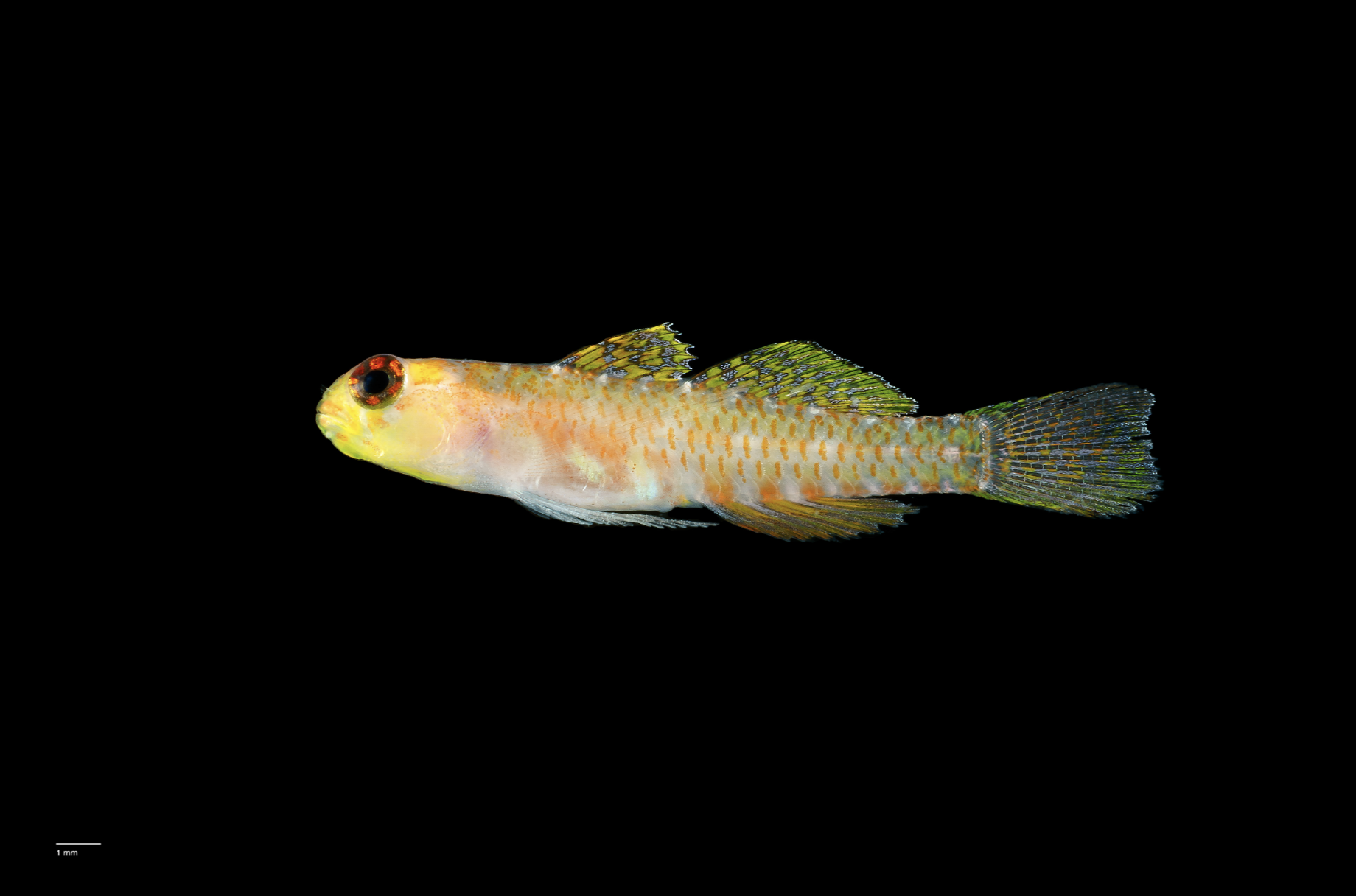
Form the department of stuff that's going to happen a lot now ...
 Davide Castelvecchi
Thanks for reading - please share if you have a friend (or enemy!) you think would value this blog and ask them to add their email in the block below - it's free for the time being. If the sign-up link doesn't appear, you'll find it on the site.
Till next time. 💥
 Tim Cohen