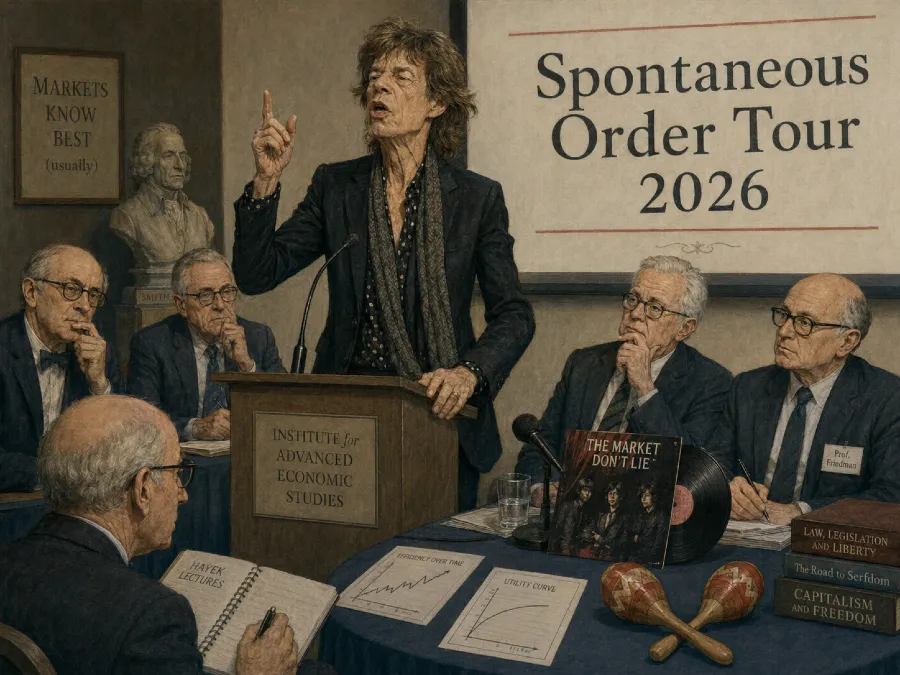
July's launch of the Rolling Stones’ 25th studio album, Foreign Tongues, raises the question of Mick Jagger’s approach to economics in general and Friedrich von Hayek in particular.
Actually, it doesn’t.
I mean, really, perish the thought.
No normal person wakes up in the morning, pours the coffee, glances at the news that Mick Jagger, Keith Richards, and Ronnie Wood are once again assembling themselves into a rock-and-roll organism, and thinks: “Ah, splendid, another chance to interrogate the Austrian theory of dispersed knowledge.” Most people, if they think anything at all, think: how are they still doing this? What preservatives are involved? And is Keith Richards now technically a protected monument?
But you know, it is actually interesting that the only rock musician whose support for an individual economist we know about in almost a century of rock music is Mick Jagger’s alleged “devotion” to Hayek, though this may be dubious. It came, after all, in a Wayne’s World sketch on Saturday Night Live in 1993, which is not normally considered a primary source for the history of political economy, though perhaps it should be, given the quality of much political economy.
Should we know about the economic philosophy of rock musicians? Do we care? Should we care?
I think we should. Or at least, we should care a little. Not because rock stars are sages, but because successful rock stars are businesses with choruses. Their careers reveal what they really believe about ownership, contracts, markets, tax, labour, and risk. Their interviews tell us what they think. Their balance sheets tell us what they know.
Let’s start with Jagger.
The famous moment came in the Wayne’s World sketch, that early-1990s shrine to suburban rock fandom in which Mike Myers and Dana Carvey played Wayne and Garth, two loveable dimwits hosting a public-access television show from Wayne’s basement. Mick Jagger appeared as musical guest on the February 1993 episode, promoting his solo album Wandering Spirit, and was duly subjected to the usual Wayne’s World treatment: mock awe, rock-star worship, and then, suddenly, macroeconomic policy.
Garth asks whether Jagger thinks it is a good idea to stimulate growth by sharply increasing government spending on infrastructure. Jagger replies that, “As a disciple of Friedrich von Hayek”, he (Jagger) has always been sceptical of larger government involvement in economic stimulus and prefers a more market-oriented approach to government spending and deficits. Garth then says he had not figured Jagger for a Keynesian economist, which is funny partly because Jagger has just said the opposite, and partly because the spectacle of Garth Algar discussing countercyclical fiscal policy with the lead singer of the Rolling Stones is one of those tiny moments when civilisation justifies itself.
Now, was this real? Or was it performative?
The answer is yes.
It was a comedy sketch. Nobody should treat it as a notarised statement of Jaggerite political economy. It was written, or at least shaped, by comedy writers, delivered for laughs, and embedded in a sketch whose whole purpose was incongruity. Wayne and Garth expect rock gossip. Garth suddenly asks about fiscal stimulus. Mick replies as if he has just come from a Mont Pelerin Society lunch.
But comedy needs a hook, and the hook was real. Jagger really did go to the London School of Economics. He was not, as sometimes lazily repeated, an economics major; he studied finance and accounting. He did not graduate. He lasted roughly two years, which, to be fair, is about two years longer than most rock singers spend thinking about accounts before discovering, usually too late, that someone else has thought about their accounts very carefully indeed.
And this is where the joke begins to acquire teeth.
Bob Spitz, in his biography of the Stones, apparently refers to the Hayekian spirit of the band, but does not elaborate. Yet, in discussing Jagger, Spitz has made a crucial observation: after Andrew Loog Oldham stopped managing the Stones, they never really had another conventional manager; they had money people, advisers and lawyers, but Jagger himself effectively became the manager.
That is a remarkable thing. The most famous lips in rock history were attached to a man who read the contracts.
This matters because the Rolling Stones’ career is, among many other things, a magnificent case study in property rights. The band’s early business life was dominated by the Allen Klein Affair, which has become one of the great cautionary tales of the music industry. Klein, an aggressive American accountant-manager, arrived as the man who could get the Stones more money from Decca, and initially did. But the relationship later curdled into acrimony, with Klein walking away from his Stones years owning rights to much of their 1960s recordings and copyrights, rights the band believed, rather reasonably, were central to its value.
The Allen Klein Affair was the Rolling Stones’ private Road to Serfdom: not the march of socialism, but the discovery that if you do not understand your contracts, your royalties and your rights, someone else will understand them for you — and invoice accordingly.
This, more than anything, is where the Hayek joke becomes serious. Hayek’s great theme was not simply “markets good, governments bad”, which is the version one hears from people who have read neither Hayek nor, often, the minutes of their body corporate. His deeper point concerned knowledge: that information is dispersed, that no central planner can know enough to direct complex social systems efficiently, and that institutions, prices, and general rules matter because they allow people to coordinate without anyone seeing the whole picture.
The Stones learned a rock-and-roll version of this lesson in the most painful way possible. They generated the value. Other people understood the paperwork. The party with superior information captured the asset. Somewhere in the distance, Hayek adjusted his spectacles and muttered, told you.
From that point, Jagger’s business reputation makes perfect sense. The public saw the swagger, the hips, the scarves, the impossible rooster-strut across the stage. Behind that was a man who had learned that freedom is not just the ability to sing about rebellion; it is the ability to own the master, control the tour, read the royalty statement, structure the tax position, and know precisely which smiling intermediary is about to remove your trousers.
In this sense, the Stones were culturally anarchic but economically Hayekian. The music said rebellion; the accounts department said, Friedrich von Hayek. Keith supplied the riffs. Mick watched the royalties.
Consider the main Hayekian elements of their career:
First, spontaneous order. No ministry of culture decided that a skinny Dartford LSE dropout and a collection of blues obsessives should become one of the most durable institutions in modern entertainment. There was no five-year plan for the Rolling Stones, though there were probably several five-day benders, which are administratively different. Audiences, radio stations, record shops, journalists, promoters, teenage boredom, sexual electricity, and parental disapproval all voted, repeatedly, with cash.
That is how markets work at their best. Nobody knows in advance what will last. Nobody could have predicted in 1962 that the scruffy blues band would still be releasing albums in 2026, by which point some of its original fans would be old enough to complain about the noise from inside retirement estates. The market discovered the value, then rediscovered it, then repackaged it, remastered it, sold it on vinyl, sold it on CD, sold it on streaming, sold it on deluxe anniversary vinyl again, and then sold the T-shirt.
Second, incentives. The Stones began as musicians, became stars, then became a touring corporation with unusually good cheekbones. They learned where the money was. In the early days, the money was in records, publishing, and radio. Later, as the recorded-music business changed, the money shifted to touring, sponsorship, merchandise, premium tickets and the global monetisation of nostalgia. The Stones adapted faster and better than almost anyone.
There is something gloriously Hayekian about this. The band did not sit down in 1964 and design a 60-year global brand strategy. They responded to signals. They watched where the revenue moved. They turned scandal into status, status into tickets, tickets into spectacle, spectacle into brand value, and brand value into the most improbable pension plan in cultural history.
Third, property rights. The Klein mess taught them that ownership is not an abstract legal nuisance; it is the thing. Songs are assets. Masters are assets. Publishing is an asset. The tongue logo is an asset. Even disreputability, if properly curated, is an asset. The Stones did not merely sell rebellion. They copyrighted it.
Fourth, taxation. The Stones’ move to France in the early 1970s, during the Exile on Main St. period, is often described against the background of Britain’s punitive top tax rates. You do not need to turn Exile into a concept album about marginal rates (though, frankly, it would explain some of the basement gloom) to see the basic point. Mobile capital moves. In this case, wearing scarves.
The Stones did what high earners often do when confronted with confiscatory taxation: they reorganised themselves geographically. Governments may imagine they are taxing a fixed thing. The fixed thing may then get on a plane. Hayek would have understood this immediately.
But the Stones are not purely Hayekian. That would be too neat, and neatness is suspicious in both economics and rock music.
Their songs are often emotionally anti-Hayekian. The business career says ownership matters, incentives matter, contracts matter, managers cannot be trusted, taxation changes behaviour, and decentralised market discovery beats central planning. But the songs often say capitalism is exhausting, authority is violent, consumers are manipulated, ordinary people get crushed, sex and money deform everything, and modern life is a magnificent shambles.
“You Can’t Always Get What You Want” is the obvious Hayekian anthem, a pop song about scarcity and trade-offs. If Keynes had animal spirits, Hayek had that title. Jagger just made it more singable.
“Satisfaction”, however, cuts both ways. It is a perfect market song because it is about desire, advertising, consumption, and restless appetite. It is also a perfect anti-market song because the consumer is drowning in stimulation and still empty. The market produces choice, but not necessarily peace. It can deliver the product. It cannot deliver the soul, though for an additional fee, it may offer a deluxe box set.
“Street Fighting Man” flirts with revolution, collective anger and the romance of 1968, but also undercuts it. The narrator wants upheaval and yet seems oddly aware of his own theatrical distance from it. Revolution looks marvellous in a chorus; then someone has to run the electricity grid.
“Gimme Shelter” is not the invisible hand. It is the visible panic. It is a song about social breakdown, not market discovery. “Mother’s Little Helper” is a nasty little satire of suburban consumer life and pharmaceutical quietism. “Fingerprint File” is surveillance-state paranoia. “Doo Doo Doo Doo Doo (Heartbreaker)” is urban institutional failure. “Undercover of the Night” is politics as menace. “Sweet Neo Con” is evidence, should any be needed, that Mick Jagger is not exactly the house bard of the Republican National Committee.
So perhaps the best formulation is this: the Rolling Stones’ business career was Hayekian, and their songs were written by the prosecution.
The accounts department believed in property rights. The rhythm section believed civilisation was one bad weekend from collapse.
This is why we should occasionally ask rock stars about economics. Not because they have special wisdom about fiscal multipliers or monetary aggregates. Most of them do not, and frankly, many finance ministers do not either. We should ask because musicians are not just artists; successful musicians are economic actors of a very pure kind. They create intangible goods, negotiate rights, hire labour, manage brands, fight intermediaries, exploit scarcity, adapt to technology and discover, usually with some horror, that idealism does not survive first contact with the royalty statement.
Springsteen gives you labour, dignity, and deindustrialisation. Radiohead gives you price discovery and digital disintermediation. David Byrne gives you the economics of disassociation. Taylor Swift, though not rock in the old sense, has given the world a masterclass in intellectual-property ownership and strategic re-recording. Bono gives you aid, trade, capitalism, and the strange phenomenon of Irish moral exhortation delivered over stadium delay.
Jagger gives you Hayek with hips.
Rock stars have always told us they wanted to change the world. It might be useful, occasionally, to ask whether they mean by fiscal stimulus, deregulation, debt relief, copyright reform, or simply another farewell tour.
In the Stones’ case, the answer is probably all of the above, except the farewell. That, after all, would be bad business.
From the department of I regret the internet ...
 Jason Koebler
From the department of making something wonderful that's by definition priced at a premium ...
 Marcus Mendes
From the department of incomplete bell curves ...

Thanks for reading - please share if you have a friend (or enemy!) you think would value this blog and ask them to add their email in the block below - it's free for the time being. If the sign-up link doesn't appear, you'll find it on the site.
Till next time. 💥
 Tim Cohen