Politics & Power: The German election - the year the centre buckled even more.
Politically, the year 2025, you might have guessed, would belong to US President Donald Trump simply based on the quantum of news generated and weird stuff done. But, as it turned out, Trump’s actual effect on the world has been much less than the reportage on his activities and rants suggested.
The best example is that global trade is on course to exceed a record $35-trillion this year, a nominal 7% year-on-year increase, according to UN Trade and Development’s (Unctad's) year-end Global Trade Update. Who would have thought that would be the case in a year beginning with Trump increasing tariffs on Chinese goods first to 10% in February, 20% in March, 34% at the start of April, 104% later that month, and then finally settling on 145%.
China followed the US upwards, ending with similar tariffs of 125%. And then in May, Trump caved, earning the acronym TACO (Trump Always Chickens Out), although US tariffs on Chinese goods does still remain at 30% and Chinese tariffs on US goods are currently at 10%. So obviously, the Chinese trade surplus with the world declines, right? Not so much.

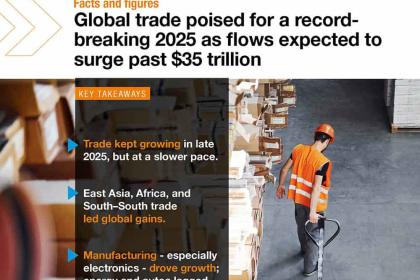
China's trade surplus has grown from $993-billion in 2024 to being on course to reach $1.08 trillion in the first 11 months of 2025, making it the first country in recorded history to reach the $1-trillion milestone.
Ultimately, Chinese trade with the US has collapsed, and the US trade deficit has declined to slightly less than the level it has been over the past five years. US exports and imports actually increased a bit in value during 2025. But while its goods deficit with China declined, the deficit with Canada and Mexico, the other two big targets of early 2025, increased. I am not making that up.
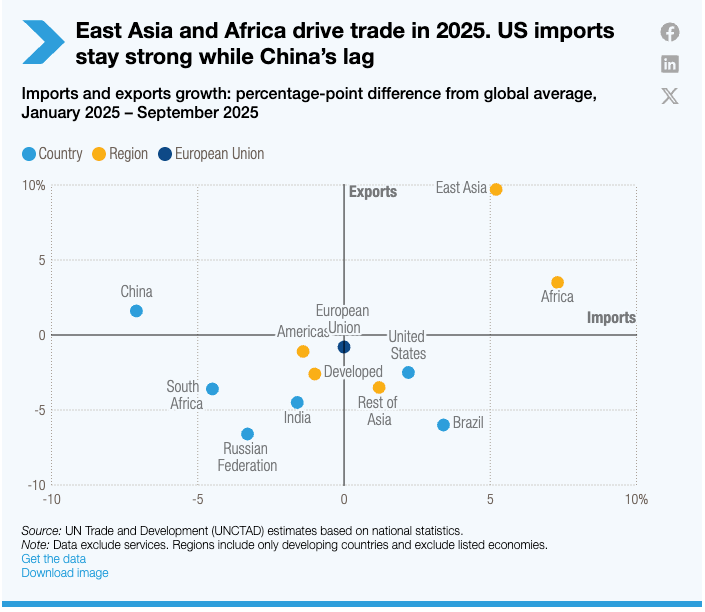
So how is it possible that Chinese exports to the largest economy in the world declined by almost 25 percentage points while its surplus in the goods trade overall increased? Well, that becomes clear when you look at global trade by region; the region that exploded in 2025 was, you guessed it, East Asia. Or, to put it another way, Chinese stuff is making a quick stop at Indonesia’s biggest port, Tanjung Priok, in the north of the country, and other ports in the region, before heading for the US.
Trump's tarrif tantrum has hurt two countries: South Africa and Brazil, which both had 30% tariffs imposed on their exports to the US. Trade decreased overall in both countries in percentage terms, but the timing was lucky, and both countries maintained solid trade surpluses through the year. Helps to have all those goodies in the ground.
Overall, it turns out, Trump’s tariff tantrum was a lot of sound and fury, signifying not very much, which has been the overarching characteristic of his bloviating presidency, followed by considerable outrage and an almost indescribable level of grift as he uses the office for personal enrichment - essentially, chaotic and haphazard, stumbling from one all-caps drama to the next. I'm verging on the notion that Trump will not only be a shocking failure, but he will also permanently drag down the entire Republican Party, much like Boris Johnson, who threw the Tory Party's deepest virtues on the altar of his own personal ambition, tossing the entire government to a succession of underwhelming alternatives.
So if the Trump tariff tantrums were not the most significant political event of 2025, what was?
Former New Yorker editor Tina Brown said of 2025 in her blog: “Little did I know when I called this newsletter Fresh Hell last year that purgatory could come in so many different forms. On the geopolitical front, no list, she writes, would be complete without the gutting images of tormented civilians in Gaza herded from one 'safe zone' to the next, now told to be happy about returning to 68 million tons of rubble they used to call home. "And then there was the unforgettable video glimpse of six ashen Israeli hostages poignantly marking Hanukkah in a Hamas tunnel, with a menorah made of disposable cups, months before they were shot to death at close range."
 Tina Brown
“Who isn’t still haunted by the national shame of the president of the United States bullying the doughty Ukrainian war hero Zelensky in the Oval Office for 'not having any cards' against Russia, as baby-faced bootboy JD Vance followed up with a dropkick sneer, 'Just say thank you'?"
Culture in 2025 has been a “carnival of disinfectant-resistant old scandals and bold-faced sexual deviants. Prince Andrew’s defenestration, the reincarnation of the sleek rap mogul Sean “Diddy” Combs as a baby-oil pervert and vicious freak-off fiend." Wow. Harsh, but I know where she is coming from.
When it comes to a larger and much more significant trend, I think the event of 2025 was seemingly rather more parochial: the German federal election inFebruary. The election saw the two largest traditional parties led by old, bald men, Friedrich Merz and Olaf Scholz, representing the centre right and the centre left, respectively. Stacked against them was a youngish, gay woman, Alice Weidel, representing the right wing, if you can believe it. Weidel verges on funky and is in favour of something called “remigration”, which is pretty close to the expulsion of foreign migrants. Being open to migration has been hallowed ground in Germany since the end of the war, on which no politician previously dared to tread. No longer.
So then what happened is that Weidel ate the other parties for breakfast, almost doubling in popularity. Not quite, but almost. Merz’s CDU did increase its total number of seats and remained the largest party. But Scholz’s SDP got hammered, losing 86 seats, while Weidel’s AfD picked up 69 seats and became the official opposition. The electoral map of Germany suggests a split almost exactly down the old East Germany / West German divide, with the AfD the now largest party in what was the GDR and the CDU largest in the west. But that is actually not saying much, because the fragmentation is now extreme.
Germany is significant for another reason, too. It's not just that dominance is declining and plurality is increasing. Germany is just not supposed to wobble. It is the gold standard of coalition discipline, bureaucratic continuity, and incremental compromise. But in 2025, coalition partners openly contradicted each other in public, key reforms (budget rules, energy, defence spending) stalled or got diluted, and voters increasingly treated state and European elections as protest outlets.
This is interesting, but it illustrates a much larger phenomenon: the declining middle. Political scientists tend to use a measure called Effective Number of Parties (ENP). In Germany in 1980 and 1990, the ENP was 2.5; it's now five. It's worse in the Netherlands, which had three or maybe four parties of consequence back in the day; it now has eight!
The largest party vote share shows the same trend. In the 1990s, the largest party usually constituted somewhere between 42–48% of the vote in democracies. In the 2010s that average declined to 35–40%. Today it falls between 20–30%. The “winner” now represents a minority of voters, often a small one.
The trend is not confined to developed countries - SA is a good example. For years, SA had an ENP of 1.6; it now has an ENP of four. Governments in democracies have become broader, noisier, and more fragile — effective in bursts, paralysed in between. One in five voters is now switching parties every election.
The German election demonstrates another thing: coalitions are now not formed based on which other party the “winner” can govern with the most comfortably. The choice is which party the "winner" hates least. In Germany, despite being the second most popular party, the AfD was shut out, and Germany went with the grand coalition solution, with the CDU, CSU and SPD all in government once again. And that same trend has been very obvious in SA, where the ANC is in coalition with nine parties, but palpably ignores them all.
That damn poem by W.B. Yeats, The Second Coming, about the centre not holding, is starting to look very prescient. 💥
For paying customers, I’ll also look at the economic and markets story of 2025, and point out my event of the year, which hasn’t actually happened! How enticing is that? To read, please do subscribe, it's cheaper than chips - literally.