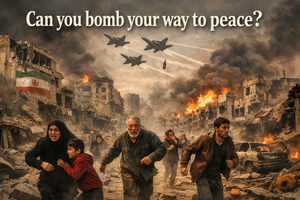
Watching the expanding war in the Middle East with drones and bombs raining down on military, commercial, and civilian targets all over the Gulf in a ghastly, spiralling, out-of-control kind of way, a tangential thought occurs to me: why was the South African road map to so poorly instructive in conflict situations in the rest of the world over the past decades? Why did the most miraculous and successful “path to peace” recorded in a century never get replicated? Why did so few combatants even try?
That statement is not quite true. It was replicated, once, and fabulously successfully, in Northern Ireland. So, you could ask the question this way - why were both the South African and Northern Ireland paths to peace so little used as models, even in an abstruse kind of way?
We don’t know. But what we do know is that you can’t just bomb your enemies into submission for the very obvious reason that even people virulently against a regime don't like to see their countries blown to smithereens by an external power, especially when it accidentally bombs schools. Instead of undoing a hateful and autocratic regime, such interventions tend to achieve the exact opposite. The regime becomes cornered, desperate … and, incredibly, more popular.
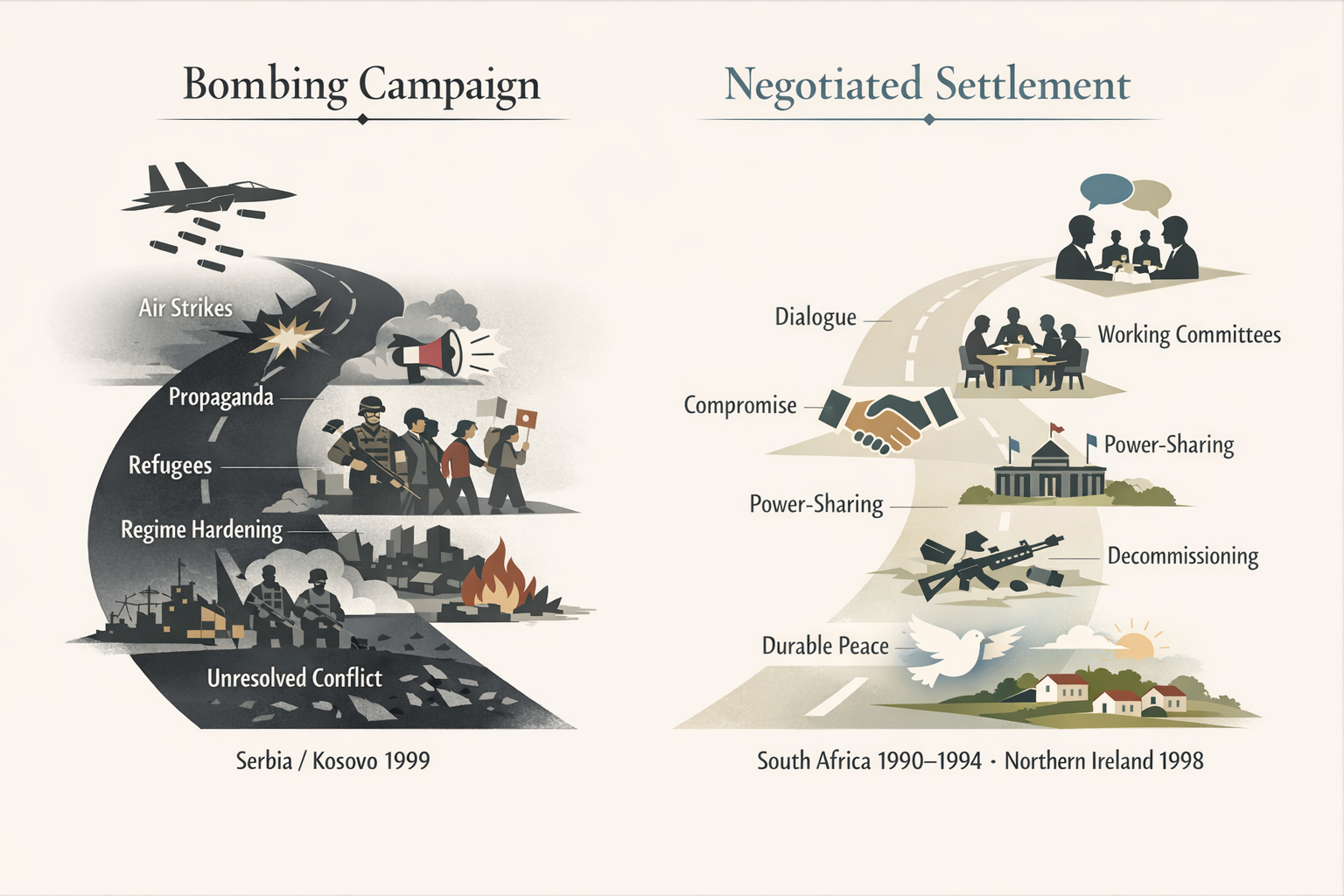
There are many examples to demonstrate this, but one of the most recent is the NATO bombing of Serbia in 1999. By 1998, Kosovo had become the most explosive fault line in the ruins of Yugoslavia. Kosovo was a province of Serbia with an overwhelming ethnic Albanian majority. Conflict had intensified between Serbian/Yugoslav security forces and the Kosovo Liberation Army; international monitors and external governments concluded that Serbian forces were carrying out widespread repression and mass displacement of Kosovar Albanians. NATO claimed that by the end of 1998, more than 300,000 Kosovars had fled their homes, while later OSCE reporting described a broad, organised pattern of abuses.
Diplomacy then failed. Western powers pushed for a settlement, including the Rambouillet talks, but no sustainable deal emerged. NATO launched Operation Allied Force on 24 March 1999 after concluding that coercion from the air was the remaining option. The campaign lasted 78 days, hitting military targets in Kosovo and Serbia, but also infrastructure and command facilities in Belgrade and elsewhere as the target list expanded. Also, accidentally, the Chinese Embassy. Remember that?
The result was … a mixed bag. But what this onslaught failed to do was spark regime change. The bombing did exactly what NATO feared it might; as an authoritarian nationalist, Slobodan Milošević was able to wrap himself in the flag, denounce foreign aggression, tighten media control, and portray domestic critics as traitors. Rather than triggering a democratic uprising, NATO enabled Milošević to look like Serbia’s defender, and he hung on for a bit longer. He was eventually voted out of office democratically, not because of the bombing but because of an economic downturn.
Neither did the intervention produce a tidy moral ending. Around 13,000 people died in the wider 1998–99 Kosovo conflict, most of them ethnic Albanians, and postwar Kosovo also saw revenge attacks, flight by many Serbs, and a long unresolved sovereignty dispute that remains politically live today.
But it did result in Serbian/Yugoslav forces leaving Kosovo, and a larger humanitarian catastrophe may have been curtailed. Given the pattern of abuses already visible in 1998 and 1999, opponents of intervention had to explain what exactly would have stopped the expulsions and killings if not force.
The pro-bombing lesson drawn from Bosnia was this: diplomacy without credible force had already failed too many times in the Balkans. From this view, NATO’s campaign was less a triumphal crusade than an admission that sanctions, monitoring missions and conferences in expensive hotels were not restraining Belgrade.
But is that the right lesson?
Allow me to reminisce a little. When I was a foreign correspondent in London in 1998 for Business Day (back in the day when such a post existed), the Northern Ireland issue was still raging, but then Labour leader Tony Blair and a group of Irish leaders from various parties had pulled off a rather extraordinary agreement, called the Good Friday Agreement.
The agreement seemed to come out of the blue and there was a huge amount of international interest. So, the UK Foreign Office organised a trip for about 40 London-based correspondents to meet various players in the peace talks; the highlight was a lunch in Stormont Castle with David Trimble, who was instrumental in the negotiations that led to the agreement. He, along with John Hume, had won the Nobel Peace Prize for this effort.
Frankly, I was slightly perplexed by the event, and I felt massively out of my depth. I had never been to Belfast in my life, and my understanding of the “troubles” was essentially rooted in pop songs, like "Oliver's Army" by Elvis Costello, "Invisible Sun" by The Police, and many others.
I shouldn’t have worried. Our first stop was a visit to the IRA. The main representative at the press conference was Martin McGuinness; all he could talk about was South Africa. In his mind, the IRA was just like the ANC, fighting a desperate, rearguard battle against a powerful occupying force.
I had to restrain myself from snorting. The situations were so ridiculously different. For one, to claim that Catholic Northern Irelanders were “oppressed” in the same way as black South Africans were subject to grinding, exclusionary, racial oppression felt not only wrong but insulting. However, in time, I came to revise this impression. It wasn’t the situation that was of central importance; it was the nature of political change and the mechanics of peacemaking that were comparable.
This was brought home to me later at the Grand Boeuf, when we were joined by journalists from Northern Ireland; I asked one whether he thought the South African political settlement had in fact played a role in the Northern Ireland peace agreement, and he said something so wise and trenchant that it has stayed with me all these years. “Yes”, he said, “it taught the IRA there was a way to win by losing”. Wowzer. Isn’t that just the whole nub of it?
The trick in peace making is essentially solving a dilemma for the group technically in the wrong, demonstrating that there is a way to dismount the tiger without being eaten. And for that to happen, the group that feels itself the moral superior has to bite the bullet, accept a solution that irritatingly and unjustly doesn’t result in their enemies' destruction even though they richly deserve a fate directly out of the Old Testament. And that means you have to concentrate not only on your constituency, but also develop a rich understanding of your opponent's constituency and what will work politically for them. It's hard and grinding. But worth it.
For the IRA, this worked … how should we say … like a bomb. The IRA gave up its military campaign, Sinn Féin became a central part of the power-sharing government in Northern Ireland, and McGuinness himself took office. Sinn Féin essentially traded the romanticism of permanent struggle for the grubby arithmetic of power - exactly as the ANC did. At the time, it felt to Catholic Northern Irelanders like a betrayal, and a whole bunch of splinter movements, like The Real IRA, sprang up. The whole agreement was touch-and-go; the IRA only formally decommissioned in 2005. But Sinn Féin has gradually become more popular not only in the devolved council of Northern Ireland, where they are now the largest party, but a major party in the Republic too.
The South Africa link became even more apparent when you looked closely at the system of achieving the agreement, with “working committees” carefully and methodically breaking down each and every touch point, gradually developing a sense of momentum until for all the parties; there was too much to lose by walking away. There were even a few South Africans involved in these unobtrusively named “working committees”. It was all so reminiscent of the format of the Codesa multi-party talks held at that ridiculous hangar outside Johannesburg airport known as the “World Trade Centre”. Both Cyril Ramaphosa and Roelf Meyer were explicitly brought to Belfast to share lessons from the South African experience.
So, instead of just bombing Iran, could this system have worked there? I don’t know. The situation is so vastly, vastly different. Probably not. But you know, you might have said the same thing about the applicability of the South African solution to Northern Ireland, as I did at the time.
For the supporters of bombing campaigns, the “enemy” is the coterie of evil leaders on the opposing side, and it's so tempting, particularly for people with the attention span of a gnat (hello, Donald Trump, who is obviously deflecting from the Epstein drama, etc.), to think that by removing them, the situation will solve itself. Actually, the issue is invariably systemic, not individual. And by the way, the person at fault here is not just Trump but a whole generation of American and European leaders, including the much sainted Barack Obama, who were so absorbed in preventing the mullahs from getting a nuclear weapon that they ignored the broader issue of achieving structural change.
As American writer Tina Brown points out in her Fresh Hell newsletter, in the first hours after the strike, Trump called on the Iranian people “to take back their country.”
“With what? Sticks and stones? For the sake of projected bravado, our bone-spur president was urging the Iranian people to come out of their houses and die. Now, IRGC forces are camped out on the streets, brandishing AK-47s, and Trump is telling the Iranian people to stay inside,” Brown writes.
“What if we have further radicalised the regime rather than eliminating it?”
Well, exactly. 💥
From the department of reports of extinction being slightly exaggerated ...
From the department of a genomic atlas spanning all domains of life - how could that possibly go wrong?
 Garyk Brixi
From the department of the sad expansion of Earth's worst food to space ...
 Keith Cooper
Thanks for reading - please share if you have a friend (or enemy!) you think would value this blog and ask them to add their email in the block below - it's free for the time being. If the sign-up link doesn't appear, you'll find it on the site.
Till next time. 💥
 Tim Cohen
Join the conversation