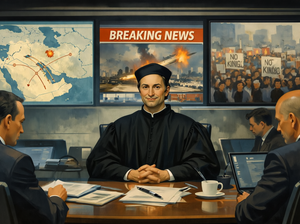
One of the things that has really struck me this year is how assassination has wandered back into respectable conversation.
In the Iran war, the killing of Supreme Leader Ayatollah Ali Khamenei was explicitly described by senior Israeli intelligence officials as part of a “decapitation campaign” against senior Iranian commanders. So far, it's estimated that over 30 top-tier military and intelligence officials have been killed in targeted strikes since the war began in February 2026.
 Contributors to Wikimedia projects
What happened to the notion that leaders killing leaders is contrary to the "rules of the game"? The strongest deterrent has been the norm of reciprocity, and most heads of state prefer a world where they aren’t constantly checking their tea for polonium or watching the skies for a localised strike. But when killing leaders becomes part of public discourse, surely that is precisely the sort of moment when Machiavelli stops being a historical figure and becomes an unwanted contemporary.
Niccolò Machiavelli, the 16th-century Florentine strategist, viewed the assassination of a leader through a lens of cold, clinical utility. In his two major works, The Prince and The Discourses on Livy, he argues that while killing a leader is a powerful tool, it is almost always tactically foolish unless it is part of a total and immediate destruction of the entire ruling family.
In The Prince, he says he wants “the real truth of the matter,” not the fantasy version, which is as good a description as any of what happens when politics drops the polite fictions and starts speaking in the blunt language of force. In the Discourses, he adds that “many more princes have lost their lives and states” through conspiracies than in open war. He was not fascinated by assassination because it was wicked; he was fascinated by it because it kept happening.
And this is why the present moment feels, in a distinctly unsettling way, a bit Florentine and his name keeps cropping up on podcasts and in political analysis.
Look around for five minutes, and the air is full of kings, anti-kings, attempted killings, loyalty rituals and men trying to turn the state into an extension of their own temperament.
In the United States, the latest “No Kings” protests drew more than 3,200 events across all 50 states. There was even one in London, where it had to be branded “No Tyrants”, because, you know, they actually have a king.
It gets better, or worse, depending on your taste for irony. Trump himself survived an assassination attempt in Pennsylvania in July 2024, and then a second apparent attempt was foiled near his golf course in Florida in September that year. So here we are in an era where the man who spurs the “No Kings” marches is himself a survivor of assassination politics, while also presiding over a world in which the targeted killing of foreign rulers has become newly revived.
Machiavelli, one suspects, would have appreciated the symmetry in a rather grim professional way. Possibly the masterclass on cynical diplomacy was provided by Charles-Maurice de Talleyrand, the legendary French diplomat who survived multiple regimes. When he was told a high-ranking official had died, he said, "I wonder what he meant by that?"
So, is this the most Machiavellian period since the Second World War?
There is, I think, a serious case to be made that it might be. Not because this is the bloodiest era since 1945; it plainly is not. The postwar period produced Stalinism, Maoism, military dictatorships, proxy wars, secret police states, and enough state-sponsored horror to keep a hundred historians employed in a permanent state of disbelief.
But this is surely the most openly Machiavellian period since then: one in which power has become less embarrassed by itself, and the old liberal habit of pretending politics is mostly about process and decorum has started to wear a bit thin. V-Dem, the Swedish-based independent research organisation that produces one of the world's largest, most comprehensive datasets on democracy, says the planet is now living through 15 years of stagnation for democratisation. Freedom House says global freedom declined for the 20th consecutive year in 2025. That is not a blip. That is the furniture moving.
The cast list helps clarify the trend. Trump is wielding executive power with few restraints, despite Article I of the US Constitution, which states that only Congress has the power to formally "declare war." The White House argues that the February 2026 strikes (including the assassination of Ayatollah Khamenei) were "defensive" actions intended to preempt imminent threats to U.S. troops and interests. This is despite the resignation of Joe Kent, the director of the National Counterterrorism Center, who argued that Iran posed "no imminent threat" to the US and accused the administration of being manipulated by an Israeli-led misinformation campaign.
But the problem is not just the US. Russian head of state Vladimir Putin, well-known for his forays into assassinations, remains the notional "indispensable man" in Moscow, still protected by the legal changes that could keep him in office until 2036. In China, Xi Jinping continues his own long campaign of discipline and purge; Reuters reported in March that he told the Chinese military it must be politically loyal and root out corruption, and this month the same news agency reported yet another Politburo-level investigation.
These are different systems and different personalities, of course. But the family resemblance is hard to miss: personalised power, obsessive concern with loyalty, and a distinct impatience with the fiddly idea that institutions are meant to exist for purposes larger than the leader’s mood.
Back to where we began: the strongest case for calling the era Machiavellian resides in the almost unbelievable idea that assassination is once again discussed - and pursued - in the halls of power. Decapitation strategies are in circulation. Emergency powers are fashionable.
Broader than that, loyalty matters more than competence. Politics increasingly feels like a struggle over fear, force, and survival, with policy details appended afterwards like an apologetic footnote. In The Prince, Machiavelli wrote that it is “safer to be feared than loved” if one cannot be both. You do not have to admire that sentence to notice how many contemporary rulers appear to have pinned it above their desks, perhaps next to a flattering portrait and a constitutional lawyer in distress.
But there is also a strong case against the proposition, which is worth taking seriously because the present has a nasty habit of flattering itself as uniquely dramatic.
The first objection is simple: the truly monstrous postwar systems were, in many cases, far more deliberate than today’s. They were not merely leader-centric or illiberal; they facilitated total control. The history of 21st-century totalitarianism reminds you just how much worse politics can get when repression, ideology and bureaucracy all fall in love with one another. By comparison, some of today’s strongmen look less like Cesare Borgia and more like overpromoted television characters with access to a personal aircraft and a bunch of drones.
The second objection is more interesting still. Machiavelli did not admire mere viciousness. He admired effectiveness. He cared about nerve, timing, skill, adaptability — about rulers who could actually master events. A surprising number of modern leaders are Machiavellian in style but not always in statecraft. They enjoy the theatre of ruthlessness, the public spectacle of domination, the little tremor of fear they can produce in allies and enemies alike.
But they are often sloppier than Machiavelli would have liked, less strategic, less disciplined, and much too addicted to noise. In The Prince, he also says, “Everyone sees what you appear to be,” which feels uncomfortably modern in an age when politics is increasingly conducted as performance. But even he, I suspect, would have expected a little more competence to accompany all the posing and posting.
And then there is the most awkward wrinkle of all: Machiavelli was not only the theorist of princes. In the Discourses, he also argued that political conflict can produce laws “beneficial to the public liberty.” Which is to say, he understood something else too: that tumults, protests, anti-court agitation, and public anger are not always signs of decay. Sometimes they are the immune system. The “No Kings” marches may be evidence of a Machiavellian age, yes — but they may also be evidence that the public has noticed.
So, where does this land us?
Probably here: this is not the most Machiavellian age since 1945 if one means the most murderous, or the most total and most efficient in its cruelty. The postwar world has uglier entries in the ledger. But the current moment may well be the most Machiavellian period since then — the one in which the dagger is back on the table, the kings are back in fashion, the anti-kings are back in the streets, and nobody feels terribly obliged any longer to pretend that politics is mainly a branch of public relations with better flags.
And that, in its way, is the real return of Machiavelli. Not because human beings have suddenly become wicked again; that department has shown admirable continuity.
He returns because the age has become less hypocritical. Power is speaking more plainly. Force is being discussed more openly. And somewhere in the distance, you can almost hear a Florentine clearing his throat. 💥
From the department of the first luxury accessory intersection of Jurassic Park and Hermès ...
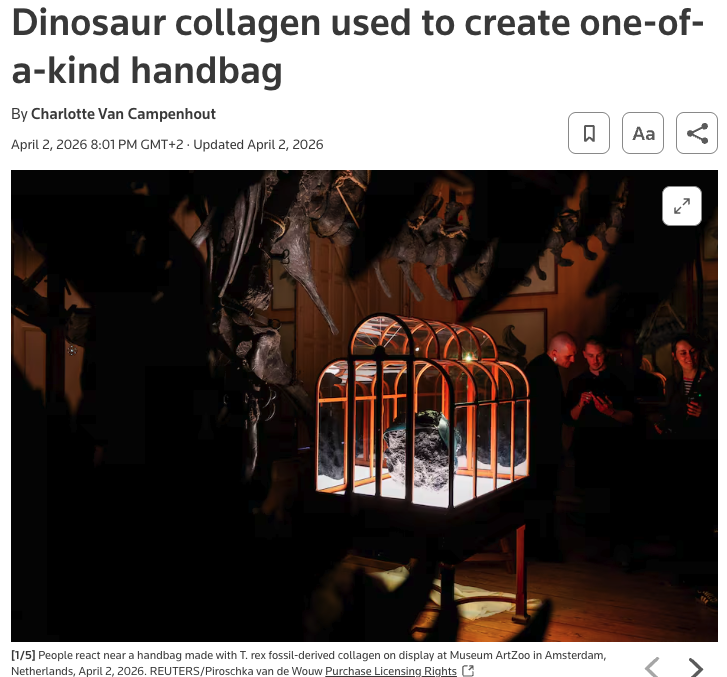
From the department of I know, I know, me too ...


From the department of one small flush for man, but one giant relief for mankind...
 , USA TODAY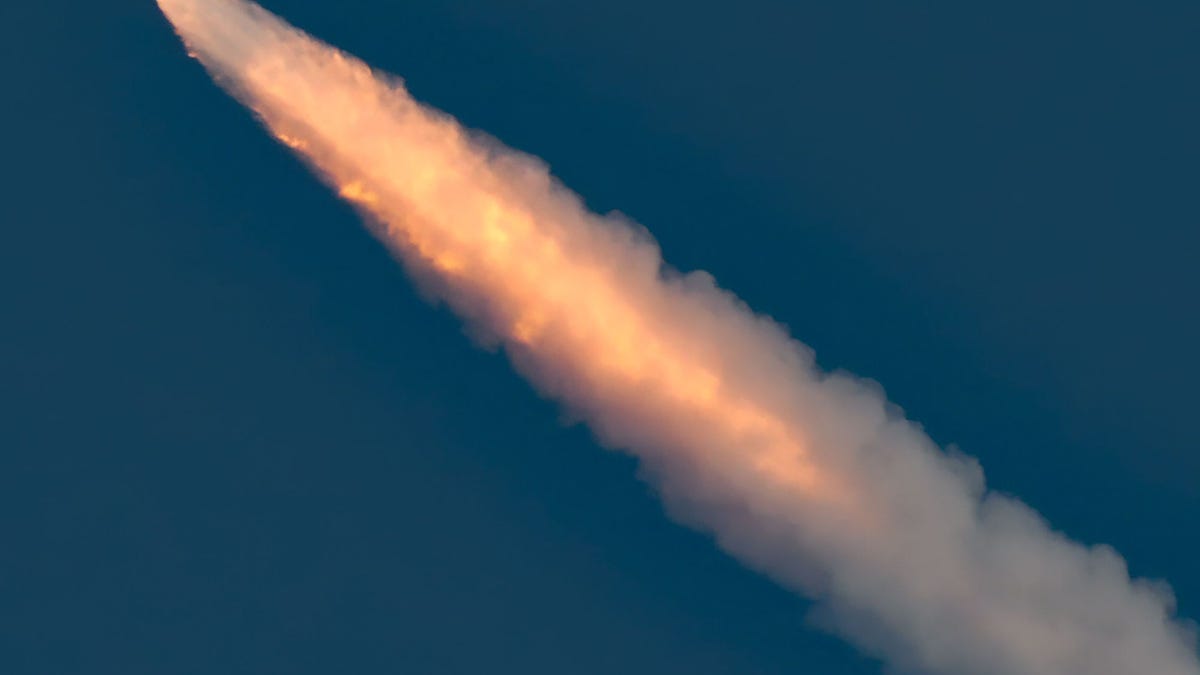
Thanks for reading - please share if you have a friend (or enemy!) you think would value this blog and ask them to add their email in the block below - it's free for the time being. If the sign-up link doesn't appear, you'll find it on the site.
Till next time. 💥
 Tim Cohen
Join the conversation