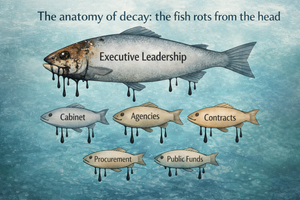
There is an old proverb that a fish rots from the head. It stands in as a wonderfully economical political theory. Entire doctoral theses in public administration can be reduced to the simple observation that when the leadership of a state signals that rules are optional, standards negotiable, and loyalty preferable to competence, the rot does not remain politely confined to the executive suite. It seeps down through the plumbing of the state, manifesting like damp through old plaster.
Which brings us to the curious sense of déjà vu watching the early months of the second Trump administration, since South Africans have seen a lot of this movie before. It ran for nearly a decade and starred Jacob Zuma as the cheerful protagonist in a drama later christened “State Capture.”
The plot was simple enough: a presidency surrounded by loyalists, institutions hollowed out by cavalier appointments, and a set of private actors — most famously the Gupta family — who appeared to exercise an influence over the machinery of government that was, shall we say, unusually intimate.
At the time, many people insisted that the problem was merely a few bad apples. It turned out to be the entire orchard.
The comparison has its obvious strengths and shortcomings, but you know, analogies are not meant to be exact depictions; they are meant to illuminate patterns. And reading about the recent travails of former Secretary of Homeland Security Kristi Noem that led to her dismissal, it all just seems to fit the pattern bizarrely well. The Department of Homeland Security (DHS), by the way, is one of the largest US government departments.
Noem made very obvious political missteps, like describing the acts of two US citizens killed by federal immigration officers as a response to “domestic terrorism,” standing by those remarks even after video evidence raised serious questions about the official account. That drew bipartisan criticism and, crucially, damaged trust in her judgment. It is one thing to be tough; it is another to sound as if you are improvising criminal labels before the facts have finished getting dressed.
But that is not the issue here. Politicians are not immune, in my experience, from saying very stupid stuff. Humans are know to do that too on occation. Her biggest mistake was the $220 million DHS advertising campaign. It was supposed to sell border security. Instead, it looked suspiciously like a taxpayer-funded Kristi Noem cosplay sizzle reel, complete with her on horseback near Mount Rushmore. It wasn’t just the vanity of the campaign, but also the contracting process - they were dished out to Republican-connected firms.
Noem also planned to use border-security money for a $300 million DHS luxury jet fleet. That included two Gulfstream G700s already purchased for about $172 million and a proposed Boeing 737 costing another $70 million. The 737, notionally for deportations, was reported to include luxury features, with critics highlighting a bedroom, shower, bar and kitchen, though Noem disputed whether those features would remain after refurbishment. It was essentially conceived as a private jet. The private bedroom might have been useful because of her alleged affair with Corey Lewandowski, a longtime adviser to Donald Trump, whom she elevated in her department. (Both deny the affair.)
What made me wonder about this incident was the mentality involved: what made Noem think she could do all this and get away with it? What was happening in her head? The answer is obviously that she thought she was invulnerable because she was on Trump’s cheerleading team. It's the same slightly deluded sense of invulnerability that seemed to permeate members of the Zuma administration, in which only one thing mattered: keeping the president happy, so its a "firepool" not a "swimming pool".
The other common factor is that the selections of Trump and Zuma were intended as revolutions not only in politics in general, but even more so within their own parties. And Noem is a great example of precisely this.
Apart from being reliably aligned to his hardline anti-immigrant culture, she matched Trump’s broader staffing pattern of favouring people who would shake up institutions rather than steward them. Like Zuma and his support of “Radical Economic Transformation”, Trump’s appointees are quite often seemingly hostile to the institutions they were meant to run. A health secretary who spent years arguing against vaccines now runs the department responsible for them, which is a bit like appointing someone who doesn't believe in rain to head the meteorological service. Supporters in both administrations shrilly believe all this to be “necessary disruption”, but critics call it what it is: reckless. Noem sat squarely in that category.
Noem was chosen in the first place, one suspects, as a perfect performer of Trumpism: telegenic, hardline on immigration, instinctively combative, and fluent in the administration’s preferred language of border emergency, muscular symbolism, and, let's face it, performative showmanship.
The big difference between SA and the US is, of course, that Trump actually got it together to fire Noem, something Zuma also did, but never on competence or corruption grounds. The decision to fire her reflects the differences in the institutional make-ups of SA and the US. US politics just moves faster; the four-year terms, midterms, the seemingly endless city-and-state political contests mean more direct and faster accountability, I suspect.
So, from an institutional point of view, it's a credit to Trump that he booted this political liability, which Zuma seldom did, notwithstanding 14 cabinet reshuffles. But interestingly, Trump didn’t fire her entirely; he appointed her Special Envoy for the “Shield of the Americas”, whatever that is. So why not simply sack her and send her home?
Because Trump often treats personnel moves less like dismissals than like court rearrangements, as did Zuma in runing his executive. People seemed to be moved around just for the fun of it, and to totally different portfolios: Fikile Mbalula held Sport and Recreation and later Police. Ayanda Dlodlo held Communications and then Home Affairs. Hlengiwe Mkhize held Home Affairs and later Higher Education and Training. Malusi Gigaba held three posts. Public Enterprises, Home Affairs and, of course, Finance. Cabinet reshuffles felt less like governance and more like musical chairs.
Moving Noem into the new role lets him preserve the fiction that she is still valued, rather than publicly conceding that one of his most visible cabinet choices had blown up on the runway. Shifting her “sideways” rather than discarding her outright protects the larger story Trump likes to tell about his personnel choices, a strategy change rather than a poor appointment decision.
And of all this figures in what might be described as the loyalty principle. The question Zuma asked potential office-holders was not “are you competent?” but “are you reliable?”, which is why he ended up with such a mixed bag ideologically, including some people ironically holding totally different views on politics and economics. Somehow, though, that didn't seem to matter to him. The Trump administration has shown a similar taste for officials whose primary qualification appears to be devotion to the cause (or the man). This is not unusual in politics — loyalty is a perfectly respectable quality — but it becomes problematic when it outranks competence by several postal codes.
The unelected courtier.
A second feature of the Zuma years was the rise of the unelected courtier. In theory, modern states are run by officials appointed through formal constitutional procedures. In practice, every administration has a court (a "Kitchen Cabinet" in America) - friends, advisers, donors, and fellow travellers who wield influence without quite holding office.
Under Zuma, the Guptas became the most flamboyant example of this phenomenon, reportedly discussing cabinet appointments over tea and procurement contracts over something stronger.
The Trump administration had its own version of the phenomenon in the figure of Elon Musk, whose influence in the administration’s government-efficiency drive occasionally left cabinet secretaries wondering whether they were in charge of their departments or merely renting desk space.
Officially, Musk was described as an adviser without formal authority, and now seems to be rather adrift. But unofficially, his chainsaw did reach rather a large number of desks.
The Zuma precedent suggests that when unelected figures become central to the operation of the state, the formal hierarchy begins to resemble the seating chart at a particularly chaotic wedding.
The Theatre of Distraction
Then there is the governing style.
Zuma had what might be called a talent for scandal density. One controversy would barely have time to reach the front page before another arrived to replace it, like waves hitting a breakwater. The result was a political atmosphere in which public attention was permanently diverted.
Every time the 783 corruption charges loomed too close, something else would happen. A controversy would erupt. A faction would make noise. A spokesperson would say something extraordinary. The news cycle would lurch sideways. By the time everyone regained their footing, the original story had been buried under seventeen subsequent stories, each one more bewildering than the last, at least until the Gupta email leaks, when the tide at last turned.
Trump's version is louder and faster because everything American is louder and faster, but the underlying rhythm is identical. The tariffs announcement crowds out the emoluments story. The trans military ban crowds out the inspector general firings. The feud with Denmark about Greenland crowds out DOGE's access to treasury systems. By the time any given outrage has been properly processed, three more have arrived to take its place, and the original is now archaeology.
This is something you might describe as “attention scarcity exploitation" — a very effective technique for governing corruptly in a democracy. Political scientists have long noted that democratic accountability weakens when scandal arrives faster than institutions can process it. The media, which must cover what is happening now, is structurally disadvantaged against a leader who simply ensures that something is always happening now.
The Trump administration has perfected government by spectacle. Every week brings a new initiative, a new feud, a new purge, a new announcement. The news cycle moves so fast that yesterday’s outrage becomes tomorrow’s footnote. Just when the Epstein files threaten to take over the news cycle ... war in the Middle East. Surprise!
It is hard to know whether this is a deliberate strategy or simply a political personality.
Either way, the effect is the same: permanent noise. And noise is extremely useful if one wishes to prevent people from noticing the plumbing.
When the economy notices
Political dysfunction does not always show up immediately in economic statistics.
For a long stretch of the Zuma era, the economy ticked along with the delusional stoicism of a patient who confuses a lack of immediate pain with a clean bill of health. Eventually, of course, the statistics mirrored the politics.
The Trump administration faces a similar dynamic. Trump and Zuma both have a curious disregard for formal economics: for them, everything is all about personality, not something as boring and complicated as formal theory.
In the US, economic growth has softened, with GDP revisions and trade tensions casting a shadow over the outlook. But this has not played out yet. One quarter does not make a crisis, but it does illustrate an important principle of political economy: administrative chaos eventually leaks into economic performance.
However, it must be said, US consumer spending looks decent, the services sector looks strong, employment is stable, and recent weakness was possibly just shutdown noise rather than structural collapse. But to me, the US economy does look more fragile and more inflation-prone than it did. It's plainly not broken, but the warning signs are real: weaker growth, softer labour data, poor sentiment, tariff drag and sticky inflation. The S&P is up about 17% during Trump’s term, although without the AI boost, that increase would be a more mundane 8%. But Japan, Canada, Brazil and even SA’s stock markets are up over 30% over the same period.
The markets, like fishmongers, have a keen nose for rot.
Why the analogy only goes so far
With all of this said, one should resist the temptation to stretch the comparison too far.
Zuma presided over a documented system of state capture that hollowed out major institutions of the South African state. The Trump administration’s problems — whatever one thinks of them — currently look more like a mixture of ideological zeal, personalist politics, oligarchic influence and bureaucratic disruption.
Corruption seeping downward also lacks the same evidentiary weight: Zuma's enabled prosecutorial capture and SOE ruin affecting millions. Trump's administration faces conflict-of-interest claims and politicisation allegations, but no equivalent institutional meltdown or convicted grand-scale theft at the top filtering down.
Legal outcomes differ too - Zuma's long-running corruption trials versus Trump's legal woes are not centred on administration-wide graft. Even for critics of the Trump administration, what’s happening is political vandalism rather than organised looting, although the Trump family’s meme-coin efforts seem to me to come pretty close. In the Zuma case, defenders really had no argument; in the Trump case, defenders argue that this is disruptive reform against entrenched bureaucracy.
But you know, it's early days. One thing we learned from the Zuma situation is that the truth tends to leak out very slowly, and it's often much worse than you suspect at first.
A universal law of leadership
Whether Trump's America follows the same pattern as Zuma's SA is, to be fair, still an open question. The institutional immune system in the United States is considerably stronger — more independent courts, more civil service protections, a free press with serious institutional weight, a constitutional architecture that is genuinely old and genuinely resilient. The antibodies may hold.
But it is also worth noting that Zuma's defenders in 2010 made very similar arguments about South Africa's constitutional order: our courts are strong, the ANC has internal accountability mechanisms, civil society will resist. Some of this turned out to be right. Eventually. After a great deal of damage that took years to accumulate and will take decades to repair.
Zuma was, at his core, a machine politician running a patronage network dressed up as a liberation movement. Trump is something more novel and in some ways more consequential: a symptom of genuine democratic fracture in the world's most powerful country.
But overall, the Zuma experience left behind a lesson that travels well.
Governments do not collapse suddenly like buildings in an earthquake. They decay slowly, through a thousand small permissions. A questionable appointment here, a vanity project there, an adviser with mysterious powers, a procurement decision that makes accountants reach for the aspirin.
Each individual step seems trivial. Together, they change the culture of the state. And once the culture changes, the fish theory of government begins to operate with the quiet inevitability of biology.
Which is why seasoned observers, watching the latest dramas in Washington, sometimes feel a faint shiver of recognition.
Not because the two countries are the same. But because political rot has a surprisingly familiar smell. 💥
From the department of boys will be boys ...
 Robert Hart
From the department of how many ways this could go very, very badly wrong...
Scientists just copied a Fruit Fly's biological brain and trapped it inside of a computer.
— Josh Kale (@JoshKale) March 8, 2026
Not an AI model trained to act like a fly... A total digital copy of a fly !! This is some sick sci-fi stuff:
- They scanned and copied the brain, neuron by neuron, synapse by synapse,… https://t.co/tL06m0E1PT pic.twitter.com/DtEa5RxV2z
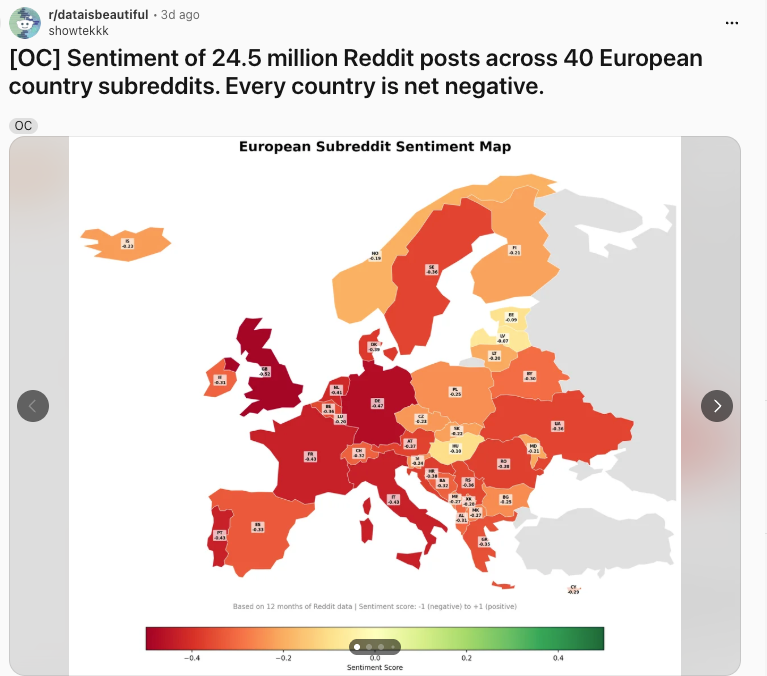
From the department of European outperformance in negativity ...
Thanks for reading - please share if you have a friend (or enemy!) you think would value this blog and ask them to add their email in the block below - it's free for the time being. If the sign-up link doesn't appear, you'll find it on the site.
Till next time. 💥
 Tim Cohen
Join the conversation