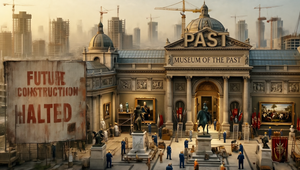
Philosopher Søren Kierkegaard noted in his journal in 1843 that "Life can only be understood backwards; but it must be lived forwards.” The quote is so pertinent now because one of the sub-currents in our political moment internationally is an elusive and complicated question: Is there a difference between countries that are “forward-looking” and those that are “backwards-looking”?
Once you start travelling down this path, it becomes increasingly absorbing - and difficult. Consider, for one, the famous rallying cry of the MAGA movement in the US: Make America Great Again. The whole idea is rooted in nostalgia for a past when the US was the lone, sole superpower. It is, by definition, backwards-looking. But does that define the country?
Consider a different topic: Europe has, broadly speaking, underperformed over the past few decades, which has caused frustration and much gnashing of teeth by continental leaders. One theory is that Europeans are too reliant on their history (outside of the continent’s devastating conflicts) when countries discovered and implemented industrialisation, introduced the key concepts of the Enlightenment, while also riding roughshod over much of the rest of the planet.
But of course, it's complicated. Many of Europe’s key figures and politicians would assert (perhaps a little too passionately) the precise opposite. The entire project of the European Union could be cited as a determinedly future-orientated project. But is it? Isn’t it by definition, a defensive rather than proactive project?
The European Journal of Political Research in 2025 examined the political programs of parties in 19 European countries and found that “nostalgic deprivation” predicts populist attitudes and voting across both Eastern and Western Europe. In that sense, a lot of European politics really is backwards-looking: not historical in a scholarly way, but emotionally invested in a lost order so much so that parties on the right promise to restore “the good old days”.
There is an obvious link to demographics and populism. Even as it is trying quite hard not to be backwards-looking in its formal statecraft, I get the sense that Europe is often backwards-looking in its politics of identity, memory and preservation. And that dovetails neatly with an aging population and a loose prejudice against modernisation and other heinous “new-fangled” ideas. In a sense, the whole Brexit campaign was at one level an act of nostalgia.
We do actually have at our disposal and great tool for measuring this: enthusiasm and usage of artificial intelligence. If there is a new kid on the block which occupies this grey zone between utility and danger, it's generative AI. And the difference in national attitudes to AI is just mind blowing.
KPMG did a 47-country survey study last year, which I’m happy to say, conforms precisely to my priors - the essence of which is that younger, developing countries with higher growth rates are just more enthusiastic about AI that older, developed countries. But even I was astounded by the disparity.
Take a look at this graph from the report for example:
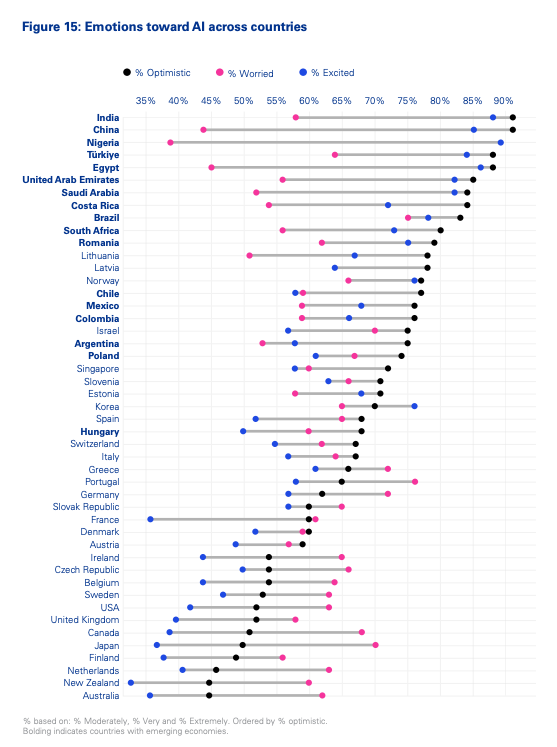
Almost every single European country and the US are more worried than excited about AI. They might be right to be worried, who knows? But for the purposes of the “forward-looking/backwards-looking” debate, the developing countries, including (emphatically) China and India, are not just more enthusiastic, they are twice as enthusiastic as the average European country.
There may be all kinds of reasons for that: the white-collar jobs on which Americans and Europeans predominantly rely are perhaps most under threat from AI - not a nice feeling. But still, it's fascinating that only 40% of Americans are “excited” by AI, given the enormous predominance of US-based AI companies who are pouring billions upon billions into its development.
There is another important question about the notion of “future-looking” countries: in what are these countries investing, at both a governmental and corporate level and at a personal level? There is an interesting endeavour called the GLOBE Project, short for Global Leadership and Organisational Behaviour Effectiveness, founded by Robert House in 1991 to study the relationship between societal culture, organisational practices, and ideas of effective leadership.
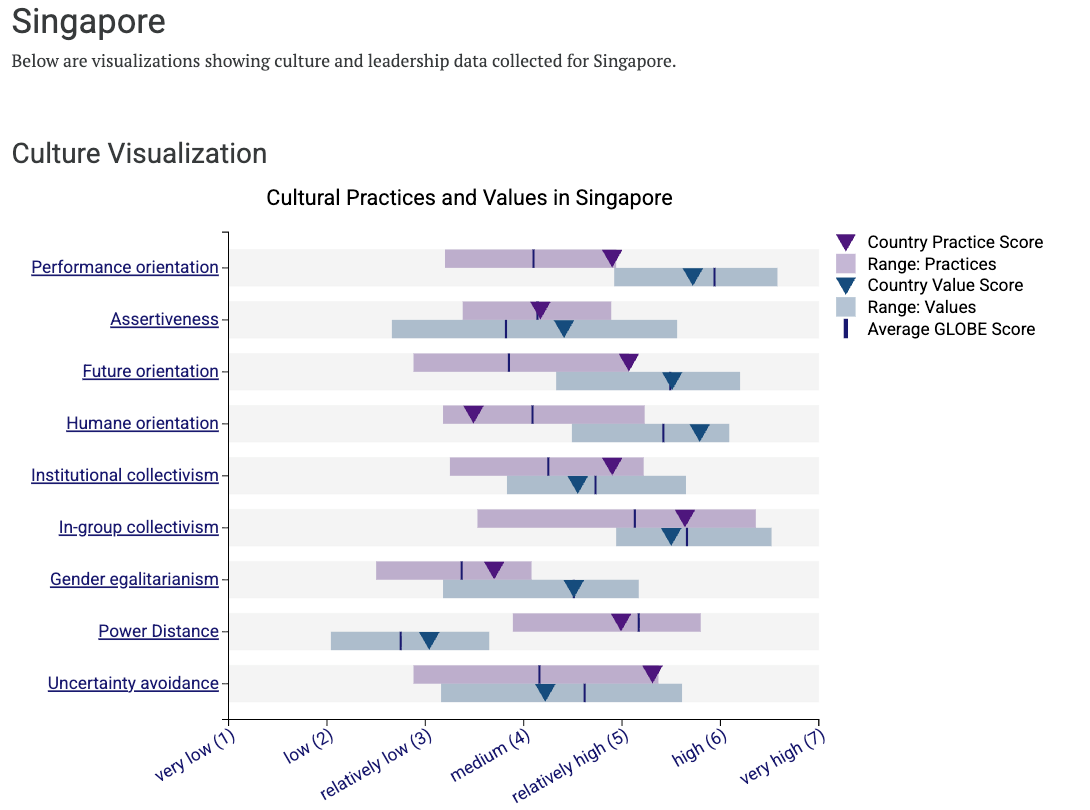
It has a whole bunch of different measures, one of which is the extent to which individuals engage in future-orientated behaviours such as delaying gratification, planning, and investing in the future. It also distinguishes between the actions and the values of different countries, which is an interesting distinction. I find it a touch too complex, and it's difficult to draw clear conclusions from it, but perhaps that’s the nature of the beast.
One country that I would classify as easily one of the most future-orientated countries in the world would be Singapore, and the survey shows this up distinctly. Look at the Future-Orientation measure: it's just wild, massively higher than the international average. But then what do you make of the values dimension? It's kinda average. What is that showing exactly? Perhaps that its citizens are comfortable with the current level of future-orientation?
In a sense, this is about the concept of temporal capital: a society's ability to defer gratification, plan for multiple generations, and learn from the past without being trapped by it. And a key characteristic of a high temporal capital country is whether it has a pension system for people not yet born, perhaps creates a sovereign wealth fund from resource extraction, and invests in basic science with no commercial application in sight.
The opposite would be countries that cut taxes for short-term consumption as debt explodes, dismantle environmental regulations for immediate job gains, and rewrite history textbooks to glorify a mythologised past. Hello, Donald Trump!
Ultimately, the most "forward-looking" countries are those that are agile learners – they honour the past as a library of lessons, not a cage of commands. They continuously run experiments (policy, social, technological) to adapt to an unknowable future. The most "backwards-looking" are those that mistake the map of yesterday's world for the territory of tomorrow. The most egregious examples are perhaps Myanmar, where the military junta focused on restoring the 2008 constitution, restoring Buddhist nationalism, and closing the economy.
But you could cite a whole bunch of others according to some or other dimension: Russia, perhaps, for its investment in WWII-style military, traditional spiritual and moral values, energy extraction, suppression of social change, emphasis on Orthodox traditionalism.
Here are some other ways to look at it:
- Future-investing societies (as discussed above), that plan, save, adapt, and build for later.
- Tradition-anchored societies, that treat the past as a moral compass.
- Nostalgia-driven polities, which mobilise a mythic past to win present political battles.
- Memory-saturated states, which derive legitimacy from grievance, liberation, trauma or remembrance.
- Anticipatory governments that institutionalise foresight instead of merely reacting.
My own blunt translation would be this: some countries are trying to build a better future; others are trying to settle accounts with the past; but most are doing both at once. The trick is to ask which side dominates politics, culture, and statecraft at any given moment.
Where does South Africa fit into all of this? What I’m building up to is that South African politics is too rooted in its history. I'm not oblivious to the idea that this is totally understandable given the trauma of apartheid. But as the years tick by, I think it's become constraining and fits to some extent in the “memory-saturated states” category.
South Africa needs, at some point, to abandon its strenuous and almost theatrical effort to construct for itself a better past.
Too much of the national argument now consists of retroactive moral landscaping: polishing old heroes, simplifying old villains, airbrushing awkward facts, and treating history not as a record to be understood but as a warehouse from which political legitimacy can be endlessly withdrawn. The country keeps looking backwards, not to learn, which would be healthy, but to litigate ancestry, allocate virtue, and reissue certificates of righteousness. It is exhausting, and worse, it is sterile.
A good example is the reopened inquest in Gqeberha into the 1985 killings of the Cradock Four. You can sympathise with the families who feel justice has not been served in the case. But four security policemen testified at the Truth Commission and were granted amnesty for the abduction and murders of Matthew Goniwe, Fort Calata, Sicelo Mhlauli and Sparrow Mkonto. Done and dusted, you might think.
But family members of the four feel, not unjustifiably in my opinion, that the higher-ups were protected, so they hauled “Prime Evil” Eugene de Kok, now 77 and who has already served 20 years in jail for the killing of other struggle activists, into the court to testify. But De Kock maintained that he had no part in their deaths and only became an accessory after the fact when those involved wanted him to alter ballistic evidence to cover their tracks.
It's hard to ignore the fact that this case is related to a separate constitutional-damages case brought in Pretoria in January by 25 families and survivors of apartheid-era crimes, including the Cradock Four families. They are seeking about R167-million in damages, arguing among other things that when the TRC ended in 2002, it handed over a list of several hundred cases to state prosecutors for further investigation, but many were never pursued.
When there are 69 murders in South Africa every day, you have to ask, why is the NPA expending so much time and effort on something that happened 40 years ago? What about the families of the people who are being killed now? It's hard to get away from the suspicion that the families are trying to leverage a politically uncomfortable set of circumstances for the ANC into cash for themselves.
The past, sadly, is not a draft document. South Africa’s problem is not merely that it remembers too much; it is that it remembers selectively, competitively, and instrumentally. Memory has become a branch of politics. History is no longer there to explain how we arrived here; it is there to furnish talking points, excuses, and emotional blackmail.
The result is a peculiar national condition: a country so transfixed by the injustice of yesterday that it risks becoming inattentive to the incompetence of today. We are forever being invited to understand the present as an inheritance, which, of course, it partly is. But inheritance can become an alibi. At some point, the appeal to history ceases to be as explanation and becomes evasion. You cannot indefinitely blame the dead for the failures of the living.
What South Africa needs is not amnesia, or still less, indifference to its past. It needs proportion. It needs the confidence to say: yes, history matters enormously, but the purpose of remembering it is to build a better future, not to manufacture a more distorted version of what went before. Nations, like people, grow up only when they stop rehearsing old grievances as personality traits.
The real pivot, then, is psychological as much as political. It means shifting from the romance of retrospective justice to the harder discipline of present competence. Less obsession with who owned virtue in 1962, more concern with who can run a municipality in 2026. Less symbolic excavation, more practical construction. Less pageantry of memory, more boring excellence.
Countries are not rescued by improved narratives about their past; they are rescued by improved performance in the present. A good example of a country which left its history behind, to some extent, is South Korea.
South Africa has arguably turned grievance into a renewable energy source. The problem is that it powers the argument, not the economy. 💥
From the department of stuff that is very meta ...
 MICHAEL CASEY
From the department of really appreciating the specificity ...
 Updated [hour]:[minute] [AMPM] [timezone], [monthFull] [day], [year] Leer en español
From the department of planetary overachievers ...

Thanks for reading - please share if you have a friend (or enemy!) you think would value this blog and ask them to add their email in the block below - it's free for the time being. If the sign-up link doesn't appear, you'll find it on the site.
Till next time. 💥
 Tim Cohen
Join the conversation