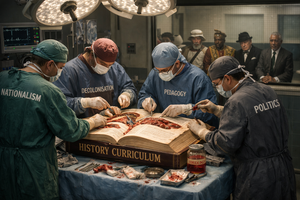
You know what I think is one of the biggest problems with how history is taught at school? It's very backwards-looking. Seriously. Not joking.
South Africans are just now, an extraordinary 30 years after the advent of democracy, really grappling with the school history syllabus. It is that sensitive and contested a topic. The Department of Basic Education has issued a call for comments on the new history syllabus for scholars, and IMHO, it is just horrible.
The way I read it, this is a proposal for a curious kind of educational nationalism and civic instruction. It’s not nationalistic in the American mould, which is often patriotic first and critical second; South African history teaching is often critical first and patriotic second. It's not “my country, right or wrong,” more “this country must be understood through injustice, struggle, and democratic repair.” And in that sense, it's more morally programmatic - in many senses, understandably so.
But of course, this is not a problem unique to South Africa. Every country teaches history as though it has stumbled, with touching innocence, on a great pedagogical challenge, when in fact it has backed into the same old political temptation: to use the dead as unpaid speechwriters for the living.
England does it with admirable tidiness, insisting that pupils know “the history of these islands as a coherent, chronological narrative”, requiring British history to make up at least 40% of GCSE content; Ontario does it more decorously, wrapping its choices in “historical thinking” and inquiry; New Zealand does it with a far more compelling frankness, rooting the subject in local lore, missing voices, and the proposition that who tells the story matters.
South Africa, now, wants to do it by swinging the lens hard toward an African-centred curriculum through archaeology, oral traditions, and the recovery of perspectives previously shoved off the stage by colonial and apartheid syllabuses. The South African ministerial review itself made the central point years ago that there is no single international model, because every country builds its school history around its own civic anxieties and national priorities. Precisely. That is the problem.
The current South African draft CAPS documents are, in some respects, intellectually serious and morally overdue. They say plainly that before 1994, the curriculum centred on “white people, mainly males”, beginning with Jan van Riebeeck, the British takeover, the Great Trek, and the old Afrikaner nationalist parade of oxwagons, betrayal and destiny. African perspectives were marginalised or not admitted as history at all.
The new draft answers this by reaching back through archaeology, material culture, oral history, praise poetry, folklore, memory, and African languages, insisting that the continent had a long, rich, connected past before European arrival and that history cannot be constructed only from documents written by colonial officials, traders, and other people who usually regarded Africans as either obstacles or scenery. That corrective is not just legitimate; it is necessary.
But they throw out the Eurocentric baby with the moralistic bathwater. In an effort to avoid “Eurocentrism”, they demote some of the most consequential changes in global history and thinking by submerging them under colonialism and revolution. A good example is that the French Revolution is paired with the slave revolt in Haiti, because, you know, they are both “revolutions”. Really?
To me at least, the South African debate has exposed, rather beautifully if accidentally, that history syllabuses around the world are not really arguments about the past; they are arguments about what the present wants from the past. England wants continuity under supervision. The US wants civic participation. New Zealand wants indigenous grounding and local belonging.
South Africa wants decolonisation, redress, and a national story no longer told from the old stoep. None of these is a wicked ambition. But they are ambitions nonetheless, and ambitions have a way of dragging history toward catechism. Right, children, today we shall learn not only what happened, but what to feel about it. That is when the shutters come down.
The South African draft is strongest where it is the least ideological and most disciplinary. It is full of good things: key questions, source evaluation, procedural concepts, oral presentation, role-play, argument, research projects, and the explicit idea that learners should understand how historical claims are made rather than merely memorising the approved sequence of pieties.
The documents repeatedly stress evidence, interpretation, multiplicity of perspectives, and the need to read even the colonial archive critically rather than simply discard it. In other words, buried in the paper is a grown-up view of history as enquiry. Good. More of that.
But content is never innocent. The syllabus does not merely expand, it reorders. In the lower grades, learners move from personal and community history toward ancient African pasts, Egypt and Mali; in Grades 7 to 9, the line swings through southern African trade, Great Zimbabwe, political centralisation, Cape colonisation, slavery, the Cold War, liberation struggle and democracy.
In the FET phase, there is a still heavier emphasis on African achievements, Ethiopia, the Scramble for Africa, slavery, anti-colonial struggle, apartheid South Africa on the continent, the national question and the politics of memory. The point is obvious enough: the continent and South Africa are no longer the supporting cast. Fair enough. But it is also obvious that this is not some neutral rebalancing. It is a new centre of gravity.
That is why the argument in South Africa is not really between the old “white” syllabus and the new “black” syllabus, though people will try to make it so because slogans are cheaper than reading. The real argument is between two theories of history teaching.
One claims the main job of school history is civic formation: to produce a citizen who understands the wounds, triumphs, injustices, and identity of the society they inhabit. The other says the job is to teach a way of seeing: how events happen, how power works, how ideas travel, how accidents matter, how character matters, how evidence is weighed, how stories are built and disputed. The first is always tempted by nationalism, even if it appears dressed as decolonisation, reconciliation or heritage. The second can become bloodless and sterile if it forgets that history is not only a method but also drama.
The great line from L.P. Hartley is that “the past is a foreign country”. Dutch historian Pieter Geyl called history “an argument without end”. Both are right, and both are warnings. The past is foreign, which means it should not be recruited too eagerly for current political errands. As an argument without end, it means any syllabus that arrives wearing the expression of moral finality should be treated with suspicion. School systems dislike both propositions because they prefer certainty. Children must be told who the heroes are. Neatly. By Friday.
South Africa’s current fight is especially interesting because it is so nakedly about replacement. The new syllabus is more capacious, more methodologically self-aware, more open to Africa’s long past, and far better at acknowledging that historical evidence does not only arrive wearing a clerk’s tie. Not terrible, but at points, it feels like a state-approved seminar in the current moral language of legitimacy. Long time educator Jonathan Jansen’s description of the draft as “anti-intellectual” and “soul-deadening” is too severe for my taste, but it lands because one can feel the risk: that a necessary correction becomes an authorised mood.
Curriculum administrators often think the problem with history is that it's too fact-laden, making it unpopular. In fact, I suspect it is not that at all; parents don’t want their children propagandised, and scholars understand the teaching of history is mainly located here, albeit in a kind of disguised way. Rather study something concrete (like science) or fun (like literature). It's revealing that many of the most popular books on historical events are not written by academic history teachers.
And South Africa is not alone. England’s history curriculum is a beautifully polished example of nationalism under the supervision of method. Pupils are to learn a coherent British story and also how to handle evidence, cause, consequence and interpretation. History teaching in the US is more varied by state, but its animating purpose is civic participation, presumably because school history in America was designed from the beginning to assimilate waves of immigrants into a shared national identity.
School history is taught badly, not because it contains too much nation, or too much empire, or too much grievance, or too much Europe, or too much Africa, though all of those can become absurd. It is taught badly I suspect because it too often confuses history with ethical vegetables. Eat your responsibility. Finish your memory work. It will improve you.
Dominic Sandbrook, in discussing the massively popular podcast he does with Tom Holland, The Rest Is History, said that history is too often presented as “hideous breakfast gruel” forced down children for their own good, whereas it should be fun, full of characters and stories. He is obviously right. History must feel alive. Alive with danger, appetite, folly, genius, miscalculation, greed, charisma, terror, idiocy, courage, vanity and consequence. Otherwise, all one has is a civics pamphlet with dead people in it.
And the irony is that the history children actually remember is almost always event-driven, character-driven, causation-driven history. Caesar crossing the Rubicon. Muhammad preaching in Mecca. Genghis Khan turning the steppe into a military algorithm. Luther nailing up his complaint sheet. Napoleon crowning himself. Lenin at Finland Station. Gandhi in homespun. Hitler in the bunker. Mandela walking out.
I suspect the way history is taught is not just wrong in South Africa, but wrong everywhere. We have over-moralised it, over-administered it, and then tried to make up for the boredom by adding “skills” as though children will be seduced by a procedural concept. They won’t. They will be seduced by human beings in impossible situations, making consequential decisions under pressure, and by the revelation that events are not random but caused, usually by a tangle of ambition, fear, ideas, money, technology, geography and bad luck. Cause. Effect. Character. Stakes. That is the grammar.
If I were designing a South African syllabus from scratch, I would make it brutally simple in principle and gloriously rich in content: 40% South Africa, 60% world; every year organised around the biggest events and turning points that changed how people lived; every topic taught through the questions, what happened, why did it happen, who drove it, who resisted it, what changed, what did it cost, and what echoes remain?
South Africa would be taught as one of the most dramatic national stories on earth, not as an exercise in self-esteem or self-flagellation. Precolonial southern African states and trade networks. The Cape and slavery. The mineral revolution. The South African War in all its dimensions. Segregation. The making of apartheid. Resistance. Exile. Violence. Negotiation. Democracy. State failure. Hope. Disappointment. Start there. But do not stop there.
The world component would be bigger, because we all need perspective, and perspective is the antidote to nationalism, self-pity, and provincial vanity. Scholars should know the agricultural revolution, the rise of cities and writing, Greece and Rome, the birth and spread of the great religions, the Mongol conquests, the Black Death, the printing press, the Columbian Exchange, Atlantic slavery, industrialisation, nationalism, imperialism, the Meiji restoration, World War I, the Russian Revolution, fascism, World War II, partition in India, the Cold War, decolonisation, Mao, civil rights, the fall of the Soviet Union, globalisation and the digital revolution.
Not as trivia. As world-altering shocks. Children should come out of school knowing the dozen or two dozen events without which the present would be unintelligible.
Most of all, history in school should be stripped of joyless moral instruction. History is not strongest when it tells youngsters what to think; it is strongest when it shows them enough to make thinking unavoidable. Show them Robespierre and Mandela, Hitler and Lincoln, Shaka and Churchill, Cecil Rhodes and Gandhi, Catherine de’ Medici and Charlotte Maxeke, the Kaiser in the wrong shoes, and the bureaucrat with the pen that ruins a continent. Let them see that ideas matter, but so do vanity, money, weather, roads, microbes, railways, and misjudgment. Let them see that human beings are neither cartoons nor saints. Let it breathe.
Then history would cease to be breakfast gruel, cease to be the nation talking to itself in the mirror, and become what it ought to be: the most exciting subject in school, not only because of what we are proud of us humans, but because it is also the study of everything that has ever gone gloriously, stupidly, magnificently wrong. 💥
From the department of when AI starts to feel like a bad idea ...

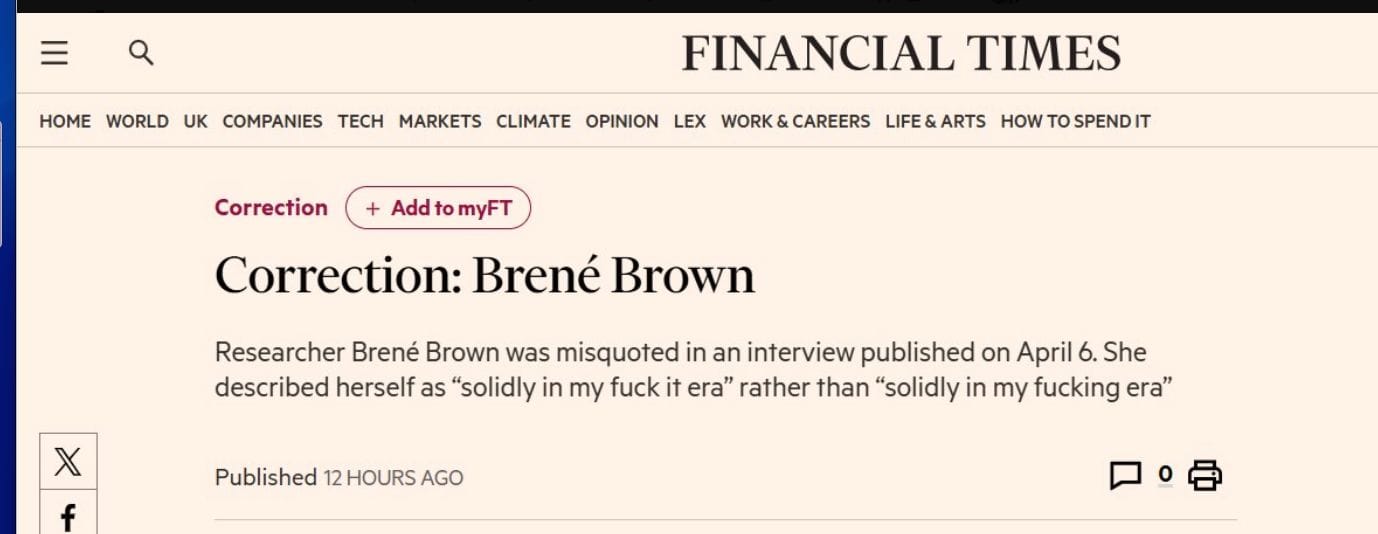
From the department of being solidly in an era where expletives are de rigeur ...
From the department of living in the worst possible timeline ...

Thanks for reading - please share if you have a friend (or enemy!) you think would value this blog and ask them to add their email in the block below - it's free for the time being. If the sign-up link doesn't appear, you'll find it on the site.
Till next time. 💥
 Tim Cohen
Join the conversation