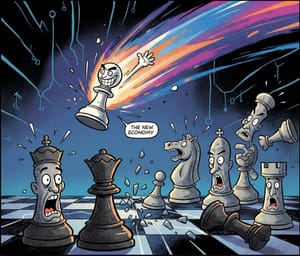
The advent of artificial intelligence poses, without a doubt, the most important tech questions of our time, and this time with a difference because it comes with a sting in the tail: how many jobs around the world are going to be lost as AI takes over? This is not a benign question such as whether the Apple iPhone is better than the Samsung Galaxy, or whether we really want our fridge telling us we are just about out of milk. Thousands, if not hundreds of thousands, of jobs are on the line. But how many? What effect will it have, not just conceptually but precisely?
It strikes me that we have an easy analogy here in chess. For years now, we have had the precedent of IBM's Big Blue making history by defeating reigning World Chess Champion Garry Kasparov in a six-game match in 1997, in New York. This marked the first time a computer defeated a world champion under standard tournament conditions. The 1997 rematch followed a 1996 victory by Kasparov.
Since then, chess “engines” have just got better and better, and now rule the game. The leading engine, Stockfish, is now rated over 3,600 compared to former World Champion Magnus Carlsen, arguably the greatest chess player of all time, who is rated around 2,840.
Now that the engines have taken over, people have stopped playing chess, right? Not so much. Chess - watching and playing - has never been more popular. There are now around 605 million people who play chess regularly, and Chess.com registers over 30 million games played per day. In 2015, the site registered about a million games per day.
The first response to most people about artificial intelligence is that, well, it's mechanical, predictable, and not beautiful, like us humans, for example. We may be fallible, but we have the music, so to speak.
Let me show you something. It's best if you know something about chess here, but not necessary - I’ll explain it. This is in a match between two engines (taking on mere humans would just be unfair, obvs), held last year in the fast-chess, knockout competition. It is white's move; black has just added pressure on the knight on C3 by placing the queen A5, which means it has thrice attacked and twice defended.
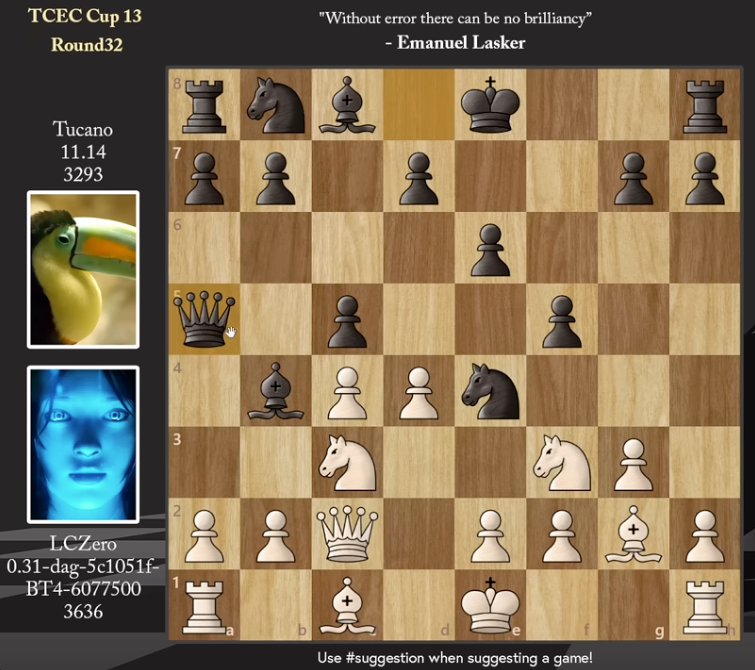
The obvious thing to do here is to defend or evade. White can easily do that by placing the bishop on D2 (defend) or castle (evade). Instead, Leila (AlphaZero’s given name) attacks by pushing forward the pawn to D5. This is the resulting position.
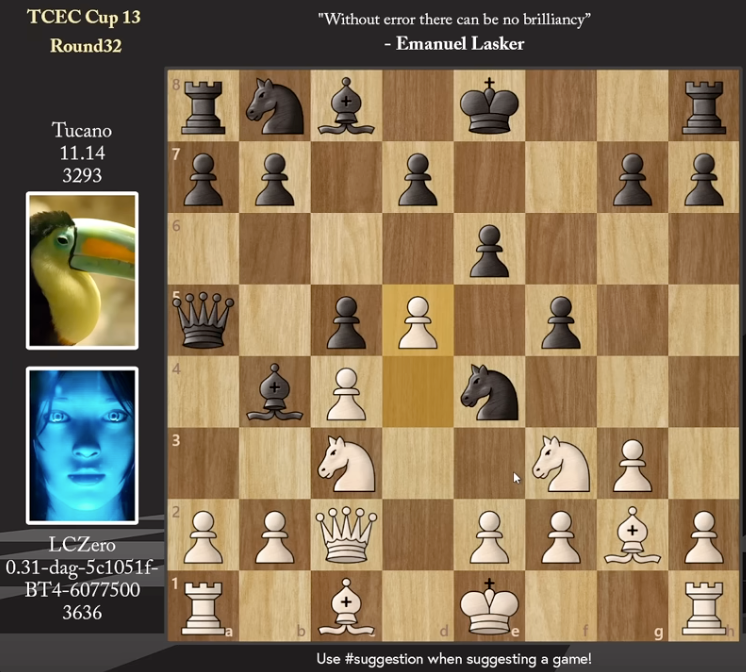
How on earth does this make sense? I play chess every now and then (it boosts my humility levels because I lose so often), so I know enough to know that this is crazy. White is definitely going to lose a piece here. And does. And then wins. Not just wins but absolutely crushes poor Tucano. You can watch the conclusion of the game here, narrated by my favourite chess analyst, Antonio Radić, better known as agadmator. https://www.youtube.com/watch?v=jAnA963WS-s
The point is that in chess terminology, the move D5 is not just clever, it's not just insightful, it's beautiful. It's beautiful because not only is it a sacrifice, but a sacrifice when perfectly sensible options were available. It's almost like Leila just wanted to throw down and cast her future to the winds. Machines aren't supposed to do that.
This little example explodes two myths about AI simultaneously: chess did not die of perfection. If anything, it went viral. It's a paradox wrapped in an en passant: superiority breeds popularity.
And the advent of the engine did not destroy beauty, innovation, and poetry; it enhanced them.
But how does this all translate to the factory floor? By 2030, projections suggest 30% of current U.S. jobs could be fully automated, while 60% will see significant task-level changes due to AI. That's not "chess is more popular now" territory. That's "the board just caught fire" territory.
The really fun part? Workers aged 18-24 are 129% more likely than those over 65 to worry AI will make their job obsolete. Young people aren't being paranoid; they're being observant. Some 37% of companies using AI in 2023 said the technology replaced workers because they were no longer needed, and by 2024, that jumped to 44% who say employees will definitely or probably be laid off due to AI.
Goldman Sachs Research estimates that AI adoption could displace 6-7% of the US workforce.
How will that affect low-skill South Africa? Worse, one expects. New jobs will obviously emerge, right? The same research cites the fact that about 60% of workers today are in occupations that didn't exist in 1940. Technology has never led to persistent unemployment. But is that not the economic equivalent of saying "don't worry about the asteroid, dinosaurs had a good run and now we have chickens”?
One aspect of the analogy is this question: why did chess flourish in the engine era? One reason is that humans actually like to watch humans and play with humans. We don’t tune in because we think we’ll witness perfection. We tune in because we might witness collapse—nerves, ego, time trouble, blunders, redemption. Even the engine analysis in the corner, with its smug little evaluation bar on chess.com, exists mainly to intensify the humiliation. “You were winning,” it says. “Then you did that.”
A great many jobs do not enjoy this protection.
Nobody “watches” payroll reconciliation for the plot. Nobody subscribes to an influencer who does really charismatic compliance reporting. In many industries, the output is the only thing anyone wants—and if the output can be cheaper, faster, and good enough, the human drama is not a feature; it’s a cost.
That’s the brutal divergence:
- In chess, imperfection is entertainment.
- In work, imperfection is a lawsuit.
So yes, AI might make the activity more widespread (as engines did for chess), while still reducing the number of people paid to do it professionally. “More popular” is not the same thing as “more employed.” There are more people taking photos than ever; there are not more people making a living as photographers.
But - and it's a big but - the other way of asking the same question is to put it this way: When machines become unbeatable, humans don’t disappear. They reposition.
They move from “being the best calculator” to “being the most interesting decision-maker under constraints.” They have become curators, explainers, performers, coaches, editors, strategists—the parts of intelligence that are social, contextual, and accountable.
But that transition is not automatic, and it is not evenly distributed. Chess players got engines largely as a public good: cheap, accessible, everywhere. In the wider AI economy, access, power, and profit can pool at the top unless forced - by competition, regulation, labour organisation, or sheer democratic annoyance - to spread.
So, is it appropriate to compare AI’s societal future to chess engines?
Yes, as a lesson about meaning: superhuman tools don’t automatically erase human purpose, and they can raise human capability.
No, as a lesson about livelihoods: chess is voluntary, bounded, and mostly fair; labour markets are mandatory, sprawling, and governed by different mechanics.
So, is the chess analogy a brilliant bishop sacrifice or a blunder? Insightfully, it's both – a reminder that tech elevates until it eliminates. Funny how we humans keep playing, even as the machines whisper "checkmate."
But heed the lesson: In society's game, we should not, er, pawn our futures. Adapt, upskill, or risk becoming the next obsolete opening. After all, as the engines teach us, the real win is in the playing.
The winners here are not going to be the ones who ignore it. 💥
From the department of things admirable and slippery ...
 Caribbean Journal Staff
From the department of don't be a complete idiot ...
 Rhiannon Williams
From the department of glimmers of hope between the dystopias ...
 Jackie Flynn Mogensen
Thanks for reading - please share if you have a friend (or enemy!) you think would value this blog and ask them to add their email in the block below - it's free for the time being. If the sign-up link doesn't appear, you'll find it on the site.
Till next time. 💥
 Tim Cohen
Join the conversation