
Sometimes, you just amble into things. There is a quixotic mixture of chance, happenstance, and mild design that is fundamental to life. I suspect this is basically the recipe for most big decisions, particularly mine. Becoming interested in the personal history of Changpeng Zhao is a story in this vein.
The crypto platform Binance is an advertiser on the website currencynews.co.za, which keeps me out of trouble with a day job, and Binance has a yearly blockchain conference in Dubai. I’m interested enough to be intrigued by the blockchain systems and infrastructure, but old enough to be slightly distant from it and cautious about it. To me, it's cryptic … like crypto itself. My hype spidey-sense is going off all the time, but it's also an undeniable part of our modern world, and I love the novelty and creativity surrounding it.
Everytime someone from my generation calls crypto a “fraud”, as JPMorgan CEO Jamie Dimon famously calls Bitcoin, I’m honestly thrilled by the opportunity provided by his snooty ignorance. Dimon said in 2017 that Bitcoin was like pet rocks and that its primary purpose was to serve scammers and money launderers - something I suspect his organisation knows quite a lot about. Well, he is still sceptical, but suddenly stablecoins are OK, and his own bank has launched a blockchain to link with crypto platform Coinbase’s wallets. What? Come again?
That is one argument for Crypto, but there is something else: how does it feel to be at the pinnacle of this whole tidal wave? What if you are the person who is absolutely blasted into space by this tsunami, rich beyond your wildest dreams, and also a kind of spokesman for this inundation. What does that do to you? How do you handle that?
I've been preoccupied with this since Binance offered to sponsor reporters from Currency to attend its blockchain conference in Dubai. It takes a certain kind of geek to enjoy conferences, and I’m afraid I'm one of them; you can absorb so much information and so many ideas packed into grabable capsules of knowledge. And then there are the random interactions that can lead you to places you don't anticipate.
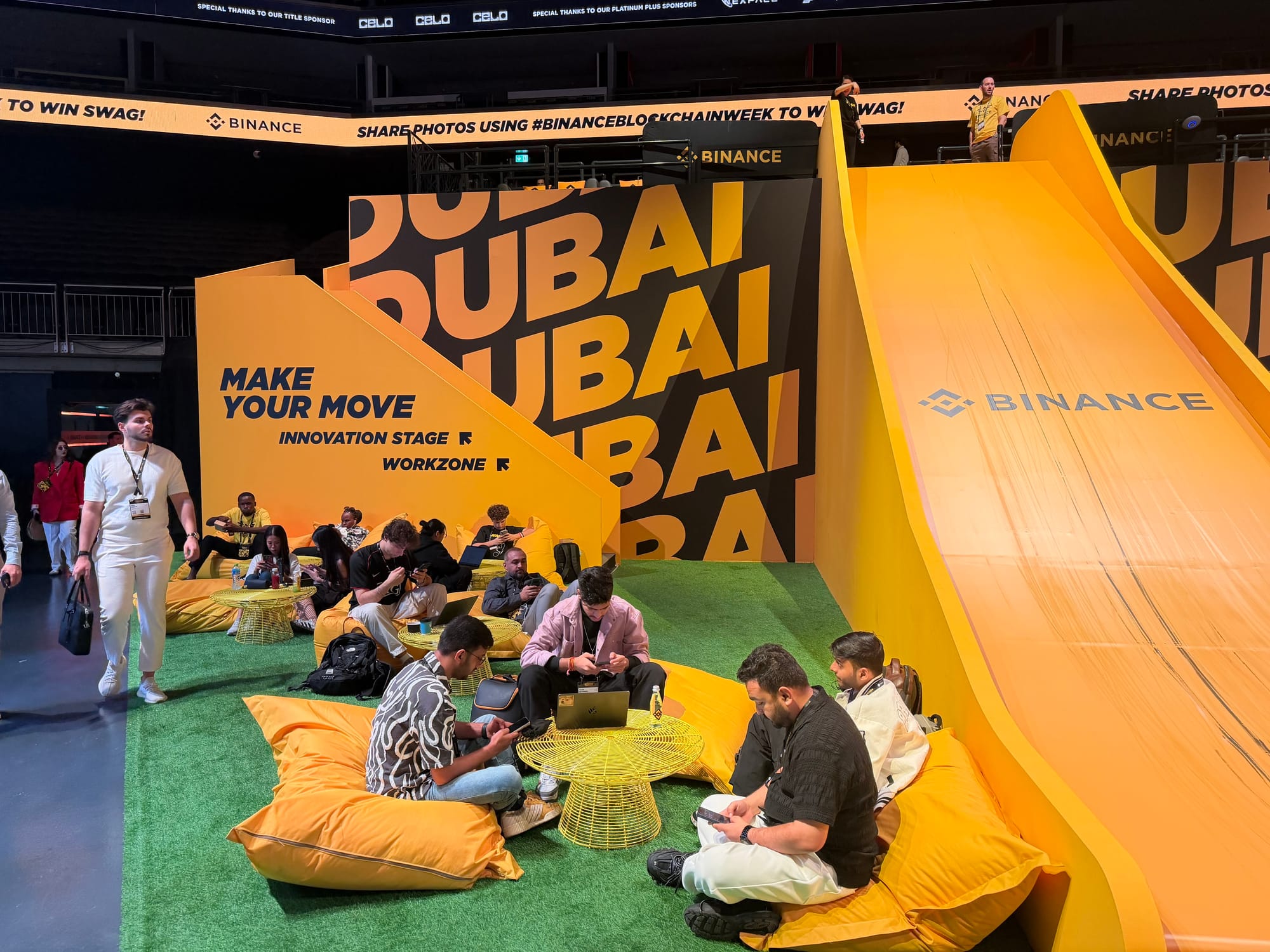
So I accepted the offer. I’ve been to lots of conferences over the years, but this one was different: the participants were younger (much); there was an obsession with the mobile phone, even by the standards of the modern generation; the conference hall offered us a roof slide and a jumping device; a DJ spun his vinyl at the entrance throughout the entire conference; and small mountains of swag was being dished out by service providers and partners of Binance.

The traditional conference fare, peopled panels talking on the stage, was ongoing, and a disproportionate amount of it was interesting. The conference opened with a presentation by the ultimate crypto booster, Michael Saylor, CEO of Strategy Inc, and it closed with a head-to-head between Binance founder Changpeng Zhao, widely known as CZ (pronounced CeeZee, cf JayZ), and gold bull and long-time Bitcoin critic Peter Schiff.
I’ve reported on both of these topics here and here, but behind all of this is CZ, who is, of course, legendary within the organisation … and outside it. But his personal story is beyond wild, and it includes a short stint in jail. As a billionaire. Seriously. I’m not making that up.
CZ is a Chinese immigrant whose educator parents were targeted in the Cultural Revolution, so the family consequently immigrated to Canada when he was a teenager. He flipped burgers at McDonald's while studying computer science at McGill University, focusing on distributed systems and high-performance computing. Natch.
It's hard to imagine something more nerdy than that, but importantly, he didn’t follow the traditional tech-bro route, crashing out of university and starting his own company. That’s what entitled white boys do, not Chinese immigrants.
Instead, he built trading systems first for a Japanese company and then Bloomberg Tradebook, where he became the head of their development team for futures trading systems. His personal methodology was not “move fast and break things”; my guess is that it was more like "work harder than everyone else and be comfortable living outside the system".
When he finally broke out of traditional business in 2017, his aim was to develop the largest crypto platform within three years. Five months later, Binance was the largest. It is now resolutely dominant in the industry, with about 40% of global volume and liquidity. Binance’s 24-hour trading volume across spot markets has recently been roughly $11 – $17 billion on typical days. Days. That is larger than the London Stock Exchange and Euronext. To me, this is all just mind-blowing. Why do we not know more about him?
Just to make it all the more intriguing, we don’t know who owns it since it is a private company, but the theory is that CZ owns about 90% of the equity. What’s that worth? Well, the ninth largest player in the industry is Coinbase, which is listed, and it has a market capitalisation of around $65 billion with roughly a 6% share of the global market. Consequently, Binance might be worth perhaps $400-billion if it were listed. Although that’s probably a bit flattering, it would make CZ one of the top five richest people in the world.
Since Binance is not listed - presumably deliberately, since CZ has chosen not to go that route. There would be a number of reasons for this, but at the core, the crypto industry is still struggling for legitimacy, particularly after the disaster that was FTX.
FTX, you may recall, collapsed over ten days in November 2022 and soon after filed for Chapter 11 bankruptcy. Its founder, Sam Bankman-Fried, was convicted of fraud and related crimes in November 2023. FTX collapsed because customer deposits were secretly diverted to an associated company, Alameda, gambled away, and collateralised with a fake token.
Binance actually played an inadvertent part in its demise because a now-famous tweet by CZ triggered a confidence crisis. All he wrote was: “Due to recent revelations that have come to light, we will be liquidating any remaining FTT on our books.” FTT was FTX’s “token” - a kind of voluntary currency like Bitcoin itself. The “recent revelations” were revelations by industry publication CoinDesk, which found that Alameda Research was massively illiquid and was showing loans of $8-billion. Ultimately, it was revealed that FTX was illegally using clients' deposits to support its bets.
Binance briefly considered bailing out FTX by buying the company, as FTX had done to various other platforms during the then crypto winter. But it pulled back when the extent of the problem became apparent. As it happens, what FTX actually did was not especially singular to being a crypto platform. Throughout history, many financial organisations that find themselves under water are tempted to bail themselves out by dipping into customers’ funds. And that’s why so much depends on the morality, good sense, and planning of the corporate executives in the company.
Whatever the case, the FTX disaster was a huge existential moment for the crypto industry: how do we know if the other platforms aren't doing the same thing? Do they actually understand the risks, particularly in the futures markets? (Binance, by the way, has its own token, BNB, which has a market cap of around $120-billion. It also facilitated markets in crypto futures.) How secure is all this?
Those are the financial questions, but politically, for Binance, the demise of FTX was also a huge setback. Fingers were being pointed at American regulators for "allowing this to happen”. Bitcoin owners who held their coin on FTX were effectively deemed unsecured creditors in the insolvency proceedings; they may eventually get perhaps 70% of the value of their tokens after everything is wound up, but the result was, and is, lots and lots of very angry American customers.
At essence, there are two different conceptions at work here: FTX chose to operate within the American financial system; Binance thinks of itself as something akin to “DeFi”, decentralised finance. DeFi is a different thing, but it might be accurate to imagine that DeFi is Binance's spiritual home, whereas FTX's spiritual home would have been Goldman Sachs. That doesn’t mean Binance opposes regulation; Binance is a registered financial service provider in 14 countries and is increasingly trying to fit into the regulated world. But essentially, it does not fall under the ambit of American legislation, specifically.
Would it be too much, I ask quizzically, to frame it this way? Here is a crypto exchange run by a nice American boy who looked cute and scruffy in short pants and who loved to support charitable causes, up against a Chinese guy running a kind of underground global exchange which has no individual regulator? SBF was constantly appearing in the American media; CZ is reclusive and private. Even where he lives is a secret.
So, the American system went after CZ. The US government alleged that Binance had wilfully failed to implement an effective anti-money laundering program and had violated the Bank Secrecy Act (BSA). Binance, it was claimed, operated as an unregistered money services business in the US and intentionally evaded US regulatory registration. Crucially, they were accused of wilfully failing to implement a "Know Your Customer" (KYC) program for years, despite knowing it was required by law.
So at this point, things were looking pretty bad for CZ, who theoretically could have received a ten-year jail sentence.
Things turned around, however. Binance, the company, pleaded guilty to the criminal charges and agreed to pay $4.3-billion, one of the largest fines in the history of financial regulation (in Binance's world, this is honestly comparable to a parking ticket). CZ had to pay a $50-million personal fine and - here is the cruncher - resign as the CEO of Binance. In the end, he was required to serve a four-month sentence, which he served at a low-security federal prison in Lompoc, California, starting in June last year.
One question is why such a light punishment? Bankman-Fried got a 25-year prison sentence. If the US Department of Justice really believed that Binance was responsible for the funding of terrorist organisations, funnelling proceeds of ransomware, money laundering, and darknet market sales, as it claimed, why didn’t it push harder? The problem was proving intention: the DOJ’s case was not that Binance or CZ intentionally facilitated terrorism and all that; their case was that Binance committed compliance failures, not predicate crimes. These are not the same thing.
And the comparison with FTX is specious too: the DOJ was not claiming that CZ stole customers' funds, lied to customers, fabricated balance sheets, and facilitated self-enrichment, as Bankman-Fried had done. The Justice Department did, in fact, push for a three-year jail sentence. Most importantly, there was no claim of self-enrichment.
And then, because the world is a roller-coaster, CZ was pardoned by US President Donald Trump in September this year. When announcing the pardon, the White House framed it as politically corrective, saying CZ was prosecuted unfairly by the prior Biden Justice Department in what it called a “war on cryptocurrency,” emphasising that he had served his sentence and the charges did not allege fraud or identifiable direct victims. But the issue remains murky. The Wall Street Journal reported that representatives of President Trump’s family have held talks to take a financial stake in the US arm of Binance.
What a wild ride. And there is more! At the Binance blockchain conference, CZ put his head briefly above water and answered journalists' questions about his ideas, his role in the future, and a host of other things. The session was fascinating, and for my paying customers, I’ll summarise the main questions and answers, including one about the relationship with the Trump family.
Allow me to make some general comments first - these are just loose impressions; I never met him personally.
I was repeatedly surprised at how unlike your average tech-bro CZ he is. He is smart, obviously, but also self-effacing and thoughtful. He strikes me as someone with his ego under control, which is very different from so many of his cohorts. Just for example, when he was debating the difference between gold and Bitcoin with Peter Schiff, he was mannered and positively deferential. At the time, I was sitting in the press room (it was impossible to get into the overflowing main auditorium), and the pro-crypto crowd in the press box was verging on being furious with him for, I suspect, not being more aggressive. “He is losing the debate,” someone wailed.
But I liked his approach. Schiff was an invited guest in his house; it was required of him to be respectful and considerate. He actually mentioned at the start of the debate that he had “home court advantage”. There was a visible maturity about wanting to understand and listen, which I find completely absent among quite a lot of the tech community. Maybe I’m too influenced by being a guest of Binance at the conference, but I don’t think so. Anyway, judge for yourself.
I’d also like to make a prediction: for the crypto community, the advent of AI is a godsend, and not only because it's a utility that helps trading and other stuff. The focus of world attention has definitively moved to large language models and artificial intelligence, and consequently, off crypto. Ironically, I think this is just great for the blockchain and crypto world, which now has the space to find real-world use cases and develop a positive interaction with the world of “fiat”.
Anyway, here are some abbreviated, largely unedited extracts from the interview for paying subscribers. Please do consider signing up; it's literally cheaper than chips! 💥