
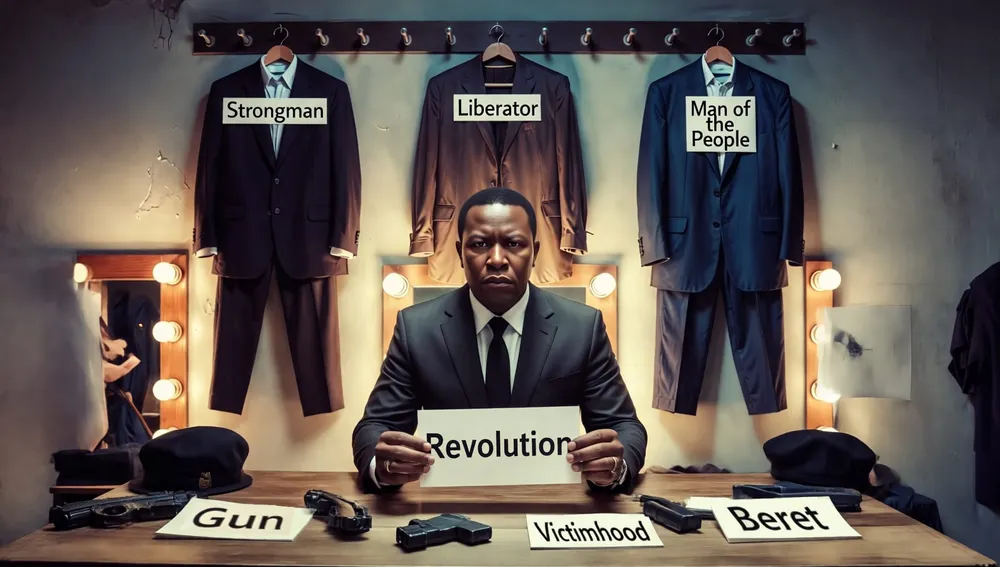
I know this qualifies as an opera scored for the world’s smallest violin, but it really is tough being a man these days.
Julius Malema’s five-year sentence for doing something as anciently, theatrically, almost operatically manly as getting his gun off was treated by his supporters as a punishment roughly equivalent to exile on Elba.
As it happens, on 16 April, Malema was sentenced to five years for unlawful possession of a firearm, plus a concurrent two years for ammunition, after firing a rifle in the air at a 2018 rally; he was then released pending appeal. He was sentenced, yes, but in the local legal style: firmly, dramatically, and not necessarily immediately.
Malema, being Malema, did not take this in the low-key manner of a man quietly reflecting on the inadvisability of waving a rifle around a public gathering. He accused Magistrate Twanet Olivier of racism and political bias because when life hands Julius Malema a judgment, Julius Malema makes identity politics lemonade.
The magistrate, by contrast, put the point rather more soberly, saying: “If crimes are allowed to go unchecked and unpunished, it poses a serious threat to our democratic state.” No kidding.
As Sikonathi Mantshantsha wrote, shooting a gun into the air is “not a misdemeanour in a country where guns kill 70 people a day”. Quite. Even in a republic with a heroic tolerance for nonsense, randomly launching projectiles skyward is not generally regarded as a contribution to the democratic conversation.
The case raises three immediate questions. Will Malema actually go to jail? Will it hurt the EFF politically? And why, exactly, is this kind of behaviour still so magnetically attractive to men?
On the first question, the answer is: not yet, and perhaps not for a very long time. Section 47 of the Constitution disqualifies an MP who is convicted and sentenced to more than 12 months without the option of a fine and adds the lovely South African rider that nobody is regarded as having been sentenced until the appeal process is exhausted or the time for appeal expires. So Malema remains an MP while the lawyers limber up and the appeals machinery hums into action. Our Constitution, majestic document that it is, contains many noble ideas, among them the notion that one is not quite sentenced until the paperwork has had a decent innings.
As to the question whether the popularity of his party will take a knock, the answer is probably not much, at least not among the faithful. South Africa has a longstanding weakness for revolutionary theatre, and Malema has always understood that martyrdom is a political asset, particularly when accompanied by a microphone, a beret, and a decent turnout.
But martyrdom is good for retaining a base; it is less good for widening one. At some point, the permanent performance of persecution starts looking less like radicalism and more like a travelling repertory production of grievance. The EFF’s problem is not so much that this reinforces the brand; it's that it may be the brand.
But the third question is the interesting one because Malema’s rifle is not only a legal problem. It is a cultural one. It is a masculine one. It is definitely a South African one.
Why do men find “getting your gun off” such a lure? Perhaps because the gun is not just a gun. It is a prop. It compresses into one object all the old masculine temptations: potency, danger, rebellion, command, status, spectacle. It is the shortest route from insecurity to significance. The gun is masculinity’s loudest shortcut and its dumbest accessory.
Pretty obviously a man with a gun is not necessarily brave, intelligent, moral, disciplined, or useful. But he certainly looks, for a moment, as though he might be at least a couple of those. And in politics, as in adolescence, the appearance of vigour can do a lot of work.
South Africa, unfortunately, has elevated this into a minor art form. We remain slightly besotted with the aesthetics of revolutionary hardness: the raised voice, the threat, the swagger, the suggestion that compromise is cowardice, and that the truly authentic man is forever one insult away from glorious retaliation.
The old struggle language lingers in the bloodstream, and for some men it provides a particularly flattering costume. Call it the Che Guevara effect. We are a country unusually tolerant of political melodrama, provided it comes with a slogan.
This is where the modern debate about masculinity becomes slippery, because I think the phrase “toxic masculinity” is both useful and often clumsy. It is useful because it identifies something real: the way some men are taught to convert vulnerability into aggression, uncertainty into domination, embarrassment into force. But it is clumsy because it can slide into the suggestion that masculinity itself is the problem, rather than men who embrace bullying.
The better distinction is between masculine virtues and masculine pathologies. Courage is a virtue; intimidation is not. Stoicism can be admirable; emotional bankruptcy is not. Protectiveness is a virtue; possessiveness is not. Competitiveness can be creative; sadism is not. Discipline built bridges, companies, armies, expeditions and families. Swagger mostly builds podcasts.
And here, unfortunately, the numbers do not entirely flatter the brotherhood. South Africa’s 2022 national gender-based violence study found that among something called "ever-partnered men" — that is, men who have had an intimate partner at some point — some 7.5% reported perpetrating intimate-partner violence.
The same study found 22.5% agreed that a woman cannot refuse sex with her husband; 11.9% agreed that if a woman does not physically fight back, it is not rape; 54.4% agreed that men need to be tough; and 30.6% agreed that men should defend their reputation with force if they have to.
Even more strikingly, 84% said they knew that a husband who forces his wife to have sex is committing a crime. So the problem is not ignorance of the law. It is that the law is competing with older instincts, older myths, older scripts of entitlement, power, and force.
There is, I suppose, a reason feminist critiques of men have landed as widely as they have. A great many men are still raised to see feelings as weakness, hardness as virtue, and a certain kind of sexual entitlement as normal. But there is also a tendency, in some versions of the argument, to talk as though masculinity itself is a sort of design flaw or pathology. If the only available models are the bully, the clown, the sulker, the predator and the overgrown boy with a microphone, then it is not terribly surprising that some men choose badly.
But IMHO, the answer to toxic masculinity is not to bleach masculinity out of existence, but to ask more of it. Courage without cruelty. Toughness without swagger. Protectiveness without possessiveness. Pride without vanity. Strength without the need for props.
Malema’s conviction matters, not necessarily or perhaps not only because it will send him to prison or puncture the EFF. It matters because it captures, in one ludicrous little burst of gunfire, several of our favourite national confusions: between radicalism and theatre, between grievance and virtue, between manhood and sheer noise.
The country does not need fewer men. It just needs fewer men mistaking performance for character. 💥
From the department of what to do with men who don't shine their shoes...
From the department of how to buy men flowers ...
From the department of what men should do if their wives insist on socialising FFS ...
Thanks for reading - please share if you have a friend (or enemy!) you think would value this blog and ask them to add their email in the block below - it's free for the time being. If the sign-up link doesn't appear, you'll find it on the site.
Till next time. 💥
 Tim Cohen